Pepper Mills: Steel vs Ceramic and Hidden Plastic Parts
A ceramic mechanism or steel finish tells you only part of the story. Compare the documented components before choosing a pepper mill.
As an Amazon Associate we earn from qualifying purchases. This is a comparison of manufacturer documentation, not a hands-on grinding or particle-release test. We identify confirmed materials and leave undisclosed components marked as unknown.
Is a ceramic or steel pepper grinder plastic-free?
Neither description establishes that the whole mill is plastic-free. It usually describes the grinding mechanism. The pepper reservoir, mechanism housing, adjustment ring and internal supports can be different materials. A transparent reservoir may be glass or acrylic; a metal-looking exterior may cover plastic parts.
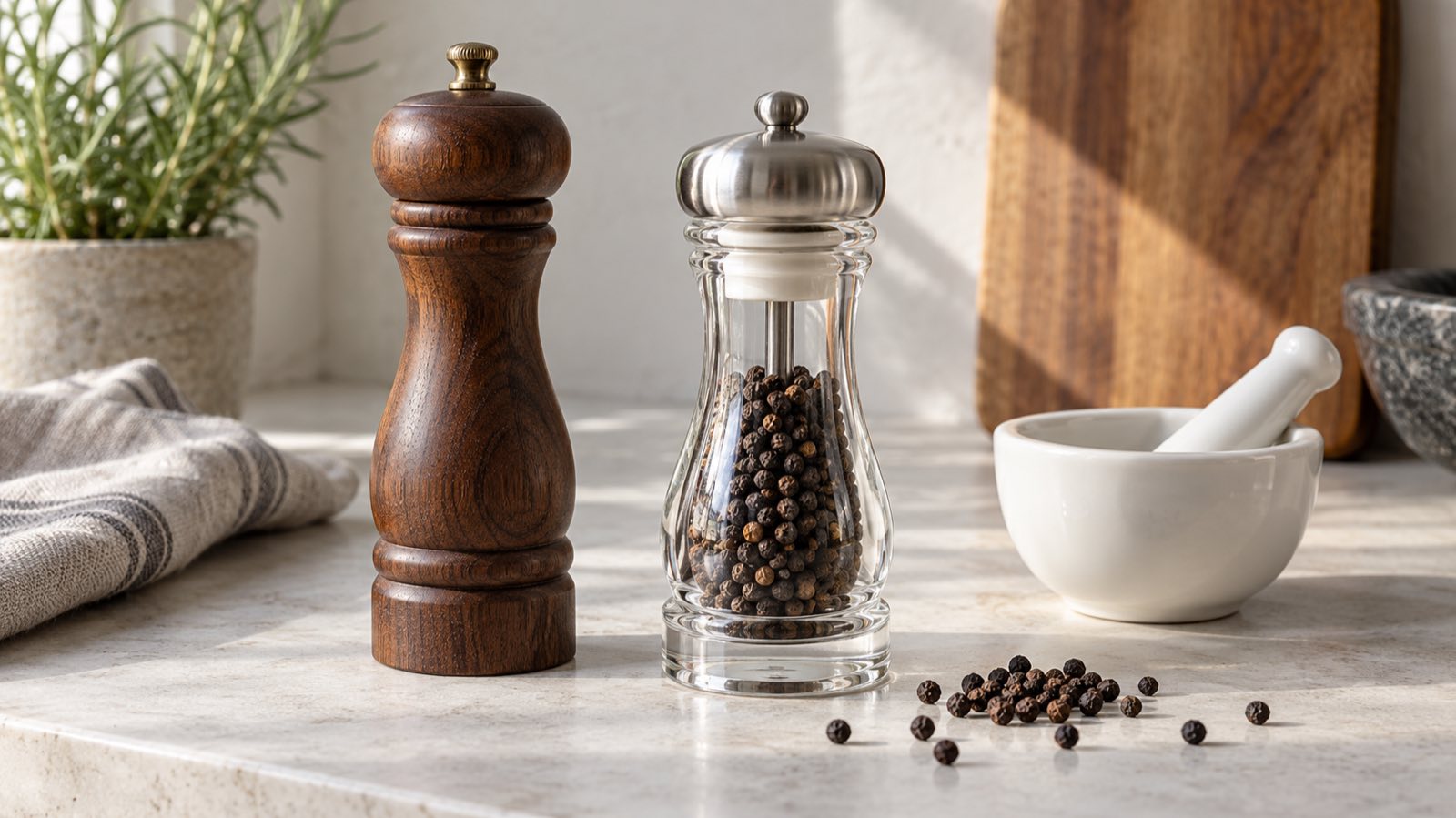
Two documented examples make the distinction concrete: Kyocera's CM-15 combines ceramic grinding parts with a glass jar and a polypropylene top. Cole & Mason's Derwent pepper mill uses a carbon-steel mechanism inside a design with an acrylic body and stainless-steel accents. Both have a non-plastic grinding mechanism; neither is an all-plastic-free assembly.
For a refillable mill with a glass reservoir, the Kyocera is worth comparing. If avoiding a hidden mechanism is your main goal, consider crushing pepper with a simple mortar and pestle. That changes the preparation method and grind consistency; it does not establish zero particle release.
Pepper mill materials: what the makers actually disclose
This table compares the Kyocera CM-15 adjustable ceramic mill and the manual Cole & Mason Derwent pepper mill, stainless-steel finish, 190 mm. It does not cover their electric models or assume a salt mill has the same mechanism. “Not itemized” means the cited product specification does not identify that part separately.
| Component or decision | Kyocera CM-15 | Cole & Mason Derwent pepper mill |
|---|---|---|
| Grinding material | Aluminum oxide ceramic | Carbon steel |
| Reservoir/body | Glass jar | Acrylic body; stainless-steel accents |
| Confirmed plastic | Polypropylene resin top | Acrylic body |
| Every support, ring and spindle | Not itemized | Not itemized |
| Care documented here | Removable glass jar is dishwasher-safe | Wipe with a damp cloth; dry thoroughly |
| Main buying tradeoff | Glass storage with a plastic top | Steel pepper mechanism with a plastic reservoir |
Sources: Kyocera CM-15 specifications and Cole & Mason Derwent specifications, reviewed October 29, 2026. These are construction claims, not measurements of what reaches food.
Steel vs ceramic: choose for pepper, then check the rest
The first question is whether the mechanism is intended for the spice you want to grind. Cole & Mason specifies carbon steel for the Derwent pepper mill and ceramic for its salt mill. Kyocera lists peppercorns among the uses for its adjustable ceramic mechanism. A matching pair on a shop shelf can therefore contain two different mechanisms.
A material label alone cannot tell you which mill will produce your preferred grind, how much effort it will take, or how evenly it will handle a particular peppercorn. We have not run those comparisons. For cooking, check the adjustment range and the return policy, then choose a model you can refill and maintain. Do not assume a salt grinder is suitable for pepper, or put salt into a pepper-only mill without checking its instructions.
There are also two separate material decisions: what crushes the pepper, and what holds it before grinding. If your priority is a glass reservoir, the table points to the CM-15. If your priority is a steel pepper mechanism, the Derwent illustrates that option—but its transparent body is acrylic. Neither preference supplies a measured microplastic-exposure ranking.
The glass-reservoir option in this comparison
Glass reservoir · plastic top disclosed
Kyocera CM-15 adjustable ceramic mill, white
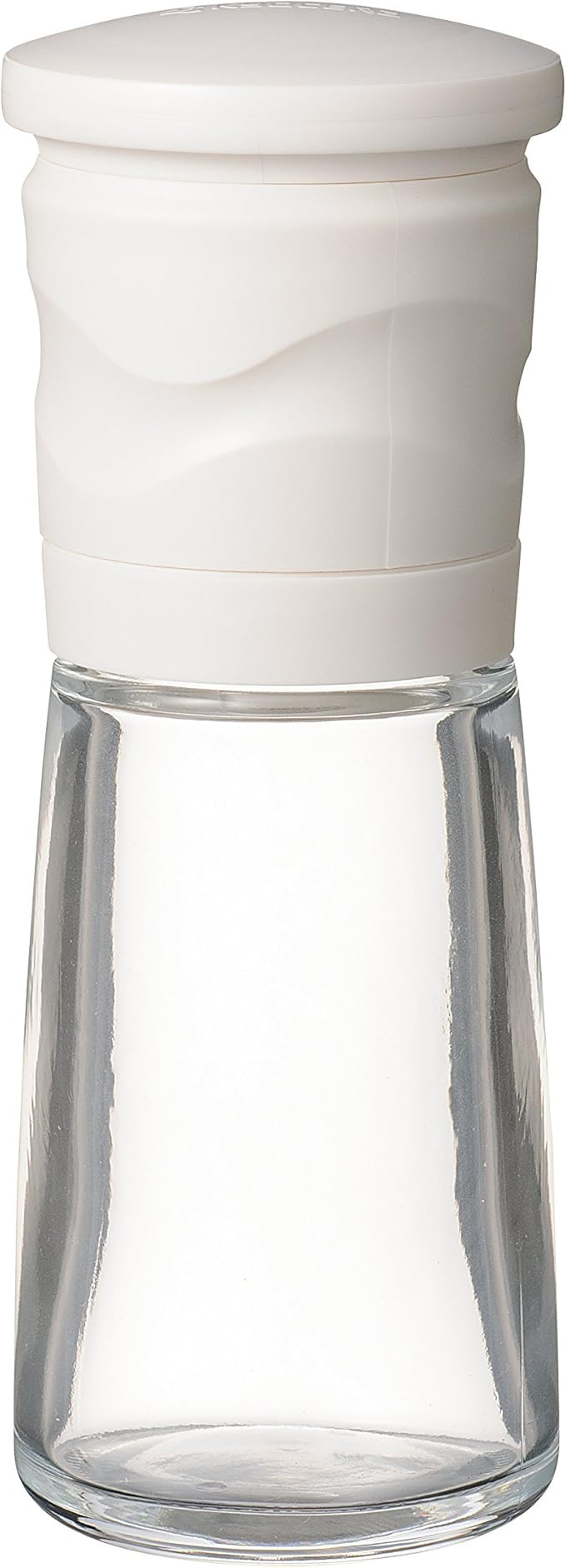
This is the refillable option to consider if you want glass holding the peppercorns and ceramic grinding parts. The white model is CM-15 NWH. Its polypropylene top remains part of the assembly, so we would not buy it on the assumption that “ceramic” means no plastic.
The removable jar has a stated dishwasher allowance; do not apply that instruction to the entire assembled mill. Verify the CM-15 model when buying because other Kyocera mills have different designs.
Check the white Kyocera mill on AmazonPreset settings or an adjustable dial?
The mechanism material does not tell you how you will control the texture. Derwent uses six preset pepper-grind settings; the CM-15 uses a dial that tightens or loosens. That is a more concrete difference to consider than assuming steel always grinds better than ceramic.
If you often move between fine and coarse pepper, a marked preset gives you a setting to return to. An adjustable dial suits someone comfortable making small changes and checking the result. These are workflow differences, not evidence that one produces a more uniform grind: we have not measured the particle-size distribution or effort per turn for either mill.
For a practical comparison at home, keep the peppercorns and quantity consistent, grind onto a plain plate, and check whether the result suits your recipe. Record the setting you prefer. That is a cooking preference check, not a microplastic test, and we have not performed it on these products.
Check the peppercorn blend before the finish
Cole & Mason recommends whole black peppercorns and permits pink peppercorns mixed with another pepper type. Do not assume every decorative peppercorn blend has identical compatibility. Check the mixture you actually use against the exact mill's instructions before buying.
The same caution applies when changing from a standard black-pepper refill to a different spice: an adjustment control is not a universal spice-compatibility claim. If a specific blend is central to your cooking and the instructions are silent, ask the manufacturer about that blend.
Match the mill to your routine
- You mainly want a glass reservoir. The CM-15 is the relevant option in the materials table; accept the disclosed plastic top rather than treating it as an all-ceramic product.
- You want to return to marked grind settings. Consider the Derwent's adjustment design, while deciding whether its acrylic reservoir fits your materials preference.
- You mostly crush a small amount during food preparation. Check whether equipment you already own does the job before buying a dedicated table mill. Our existing mortar discussion explains that alternative.
- You want a tested low-shedding winner. This documentation comparison cannot supply that ranking. Neither the burr material nor an attractive finish establishes it.
What salt-grinder studies can—and cannot—tell us
A 2020 preliminary study examined abrasion from five salt grinders. That is a reason to inspect grinder construction carefully. It is not a test of the two pepper-mill configurations compared here, and it does not give us a particle count for grinding peppercorns.
We therefore do not transfer a salt-grinding result to pepper, infer a health benefit from a body material, or call one of these mills “microplastic-free.” The underlying salt research and alternatives for dispensing salt have their own salt-grinder microplastics guide. This page answers the different purchasing question of how to evaluate a pepper mill's components.
Cleaning instructions can decide the purchase
The removable-jar allowance in the comparison table does not make either entire assembly dishwasher-safe. Cole & Mason specifically says to keep the mechanism out of water. If your routine requires immersing every food-contact component, these published instructions do not support that approach.
Before buying, decide whether you are comfortable with the model's permitted cleaning procedure. If you need a replacement component later, ask for that exact part and model number; a mechanism warranty does not by itself establish that every internal piece is sold separately.
Pepper mill questions
Is a ceramic pepper grinder plastic-free?
No. Ceramic may describe only the grinding parts. The Kyocera CM-15, for example, has a glass jar and ceramic mechanism but a polypropylene top.
Is a stainless-steel pepper mill made entirely of metal?
Not necessarily. The Derwent's stainless-steel finish accompanies an acrylic body and a carbon-steel pepper mechanism. Check each component rather than relying on the finish name.
Does the number of grind settings tell me which mill grinds better?
No. Settings describe adjustment choices. Comparing grind uniformity, output and effort requires testing under comparable conditions; we have not performed those tests.
Can I use a pepper mill for salt?
Only if its manufacturer permits it. The Derwent salt and pepper versions use different grinding materials; an identical-looking pair does not make them interchangeable.
Which pepper mill releases the fewest microplastics?
We cannot rank these mills by particle release from the documentation reviewed. Manufacturer material lists and salt-grinding studies are not comparable shedding tests of these pepper mills.
Sources and editorial method
We checked current manufacturer specifications for the two named mills and the published salt-study abstract. We did not buy, disassemble or laboratory-test these products. Our comparison makes the missing component information explicit. Product design and availability can change; confirm the exact model before purchase.
- Kyocera: CM-15 materials and care.
- Cole & Mason: manual Derwent materials and care.
- Schymanski et al. (2020): preliminary salt-grinder abrasion study.
For other kitchen contact surfaces, see our wood and stainless-steel utensil guide.