Ditch the Black Plastic Spatula: The Best Plastic-Free Cooking Utensils
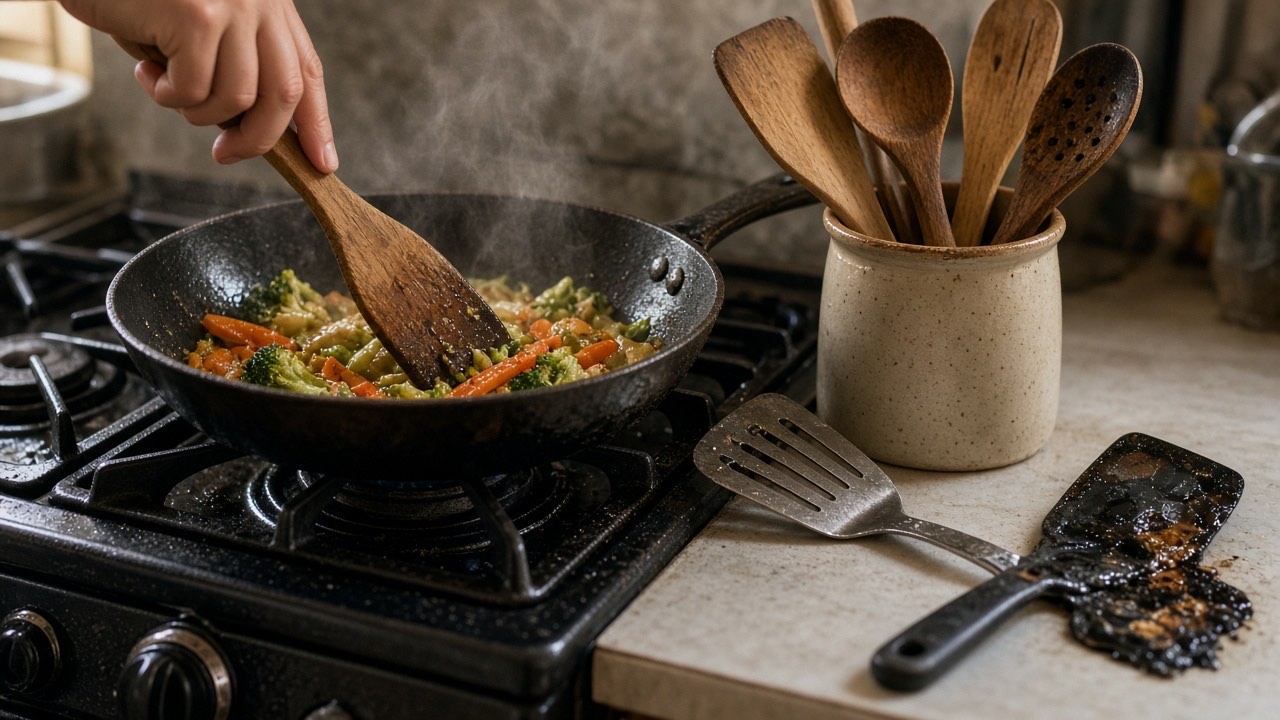
A plastic spatula meets a 400 °F pan every night, scraping against metal the whole time — heat and abrasion, the two things that make plastic shed. And if it's black, it may have started life as a TV casing. Wood, steel, and silicone fix all of it for under $40.
We may earn a commission when you buy through our links. This helps fund our reporting at no additional cost to you. Our recommendations are based solely on independent research and expert consensus. As an Amazon Associate we earn from qualifying purchases.
Quick Picks: At-a-Glance
| Pick | Best for | Why we recommend it |
|---|---|---|
| Woodenhouse 10-Piece Teak Set | Replacing everything at once | Every utensil you use, carved from single pieces of solid teak — no glue, no coating. |
| OXO Good Grips Stainless Fish Turner | Cast iron & stainless pans | The thin, flexible steel spatula pros reach for; nothing to melt, ever. |
| GIR 10-Piece Platinum Silicone Set | Nonstick cookware | Seamless one-piece platinum silicone, heat-stable to 550 °F — the safe way to protect a coated pan. |
| Eddington's Italian Olive Wood Spoons | Heirloom pick | Dense, naturally oily olive wood, handcrafted in Italy; the spoons you'll still have in 20 years. |
Heat, Abrasion, and a Flame-Retardant Surprise
Cooking utensils hit the two conditions this site keeps coming back to at the same time. Heat: a nylon spatula is typically rated to around 400 °F, while a preheated skillet routinely passes 500 °F — which is why the edges of every old plastic spatula are melted and deformed. Abrasion: the same 2023 research that found plastic cutting boards shedding tens of millions of particles a year applies to any plastic scraped against a hard surface — and a spatula is scraped against metal, deliberately, for the entire time it's in use. Those melted, worn-away edges didn't evaporate. They went into dinner.
Then, in 2024, researchers publishing in Chemosphere tested black plastic household products and found brominated flame retardants — including decaBDE, banned in the US since 2021 — in black kitchen utensils. The likely source: black plastic is hard to sort at recycling plants, so recycled electronics casings (which are loaded with flame retardants) end up in kitchen products. The authors later corrected a calculation error that had put estimated exposure near the EPA's reference dose; the corrected figure is roughly ten times lower. But the detection itself was never in question — flame retardants that have no business near food were found in utensils that touch hot food daily. It's the reason black plastic tops the replacement list.
The good news mirrors every other kitchen swap here: the plastic-free versions are older, cheaper, and better. Wood has stirred pots for millennia, steel is what restaurant kitchens use, and platinum silicone handles the one job — protecting nonstick coatings — that wood and steel can't. Once the utensils are sorted, the pan itself is the next question; a nonstick pan with a scratched coating sheds fluoropolymer particles too, which is why our cookware guide is next on the roadmap.
In-Depth Reviews
Our pick
Woodenhouse 10-Piece Teak Kitchen Utensil Set
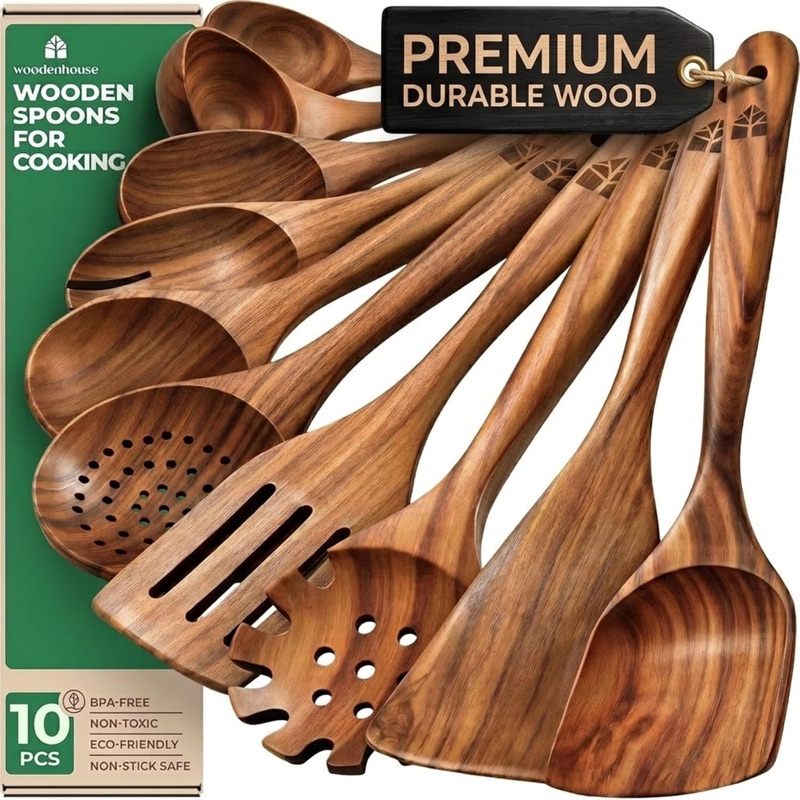
The full drawer replacement in one box: spatulas (solid and slotted), spoons, a turner, a fork, tongs, and a spoon rest, each carved from a single piece of teak — no glued joints to trap water, no varnish to flake off. Teak matters here: its natural oil content resists moisture and cracking far better than the beech or acacia used in cheaper sets, so it survives years of stir-fries with occasional oiling rather than constant babying. Wood is quiet in the pan, safe on every cookware type including nonstick, and simply can't melt. If you're replacing the whole drawer at once — the right move — this is the set.
Check price on AmazonSteel pick
OXO Good Grips Stainless Steel Fish Turner
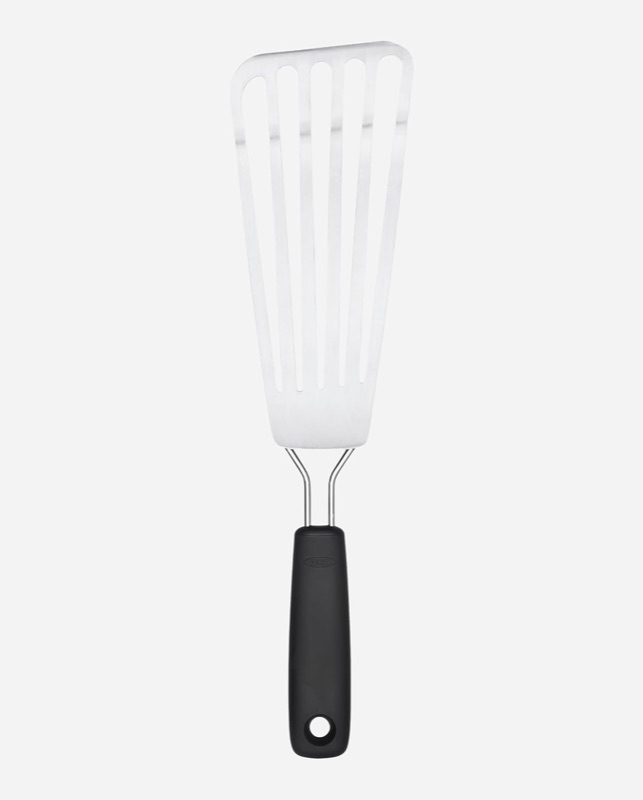
Ask a line cook what spatula they'd keep if they could only keep one and this is the shape they'll describe: a thin, slightly flexible slotted stainless blade with a beveled edge that slides under fish skin, smash burgers, and fried eggs without tearing them. It's the tool for cast iron, carbon steel, and stainless pans, where the metal-on-metal contact that ruins nonstick is a non-issue. The blade is all steel — nothing near the food can melt or shed — and the soft handle stays out of the heat. Once you've used one, the plastic turner feels like a toy.
Check price on AmazonFor nonstick pans
GIR 10-Piece Silicone Essentials Set
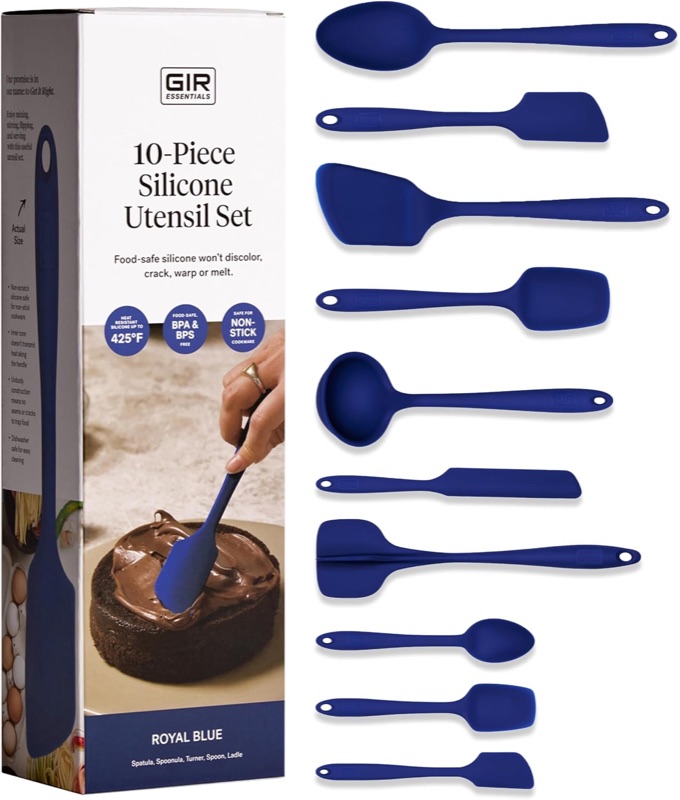
Silicone is the pragmatic exception this site makes, and GIR ("Get It Right") is the brand that made it respectable: seamless, one-piece platinum-cured silicone with a fiberglass core, rated to 550 °F. Unlike nylon or polypropylene, platinum silicone isn't a thermoplastic — it doesn't melt, deform, or fragment at pan temperatures, and the seamless construction has no joint to crack or trap grime (the failure point of cheap silicone-over-plastic utensils). The spatulas are stiff enough to actually flip and scrape yet soft enough to protect a coated pan. If your cookware is nonstick, this is the set that protects both the pan and the food.
Check price on AmazonHeirloom pick
Eddington's Italian Olive Wood Cooking Spoon Set
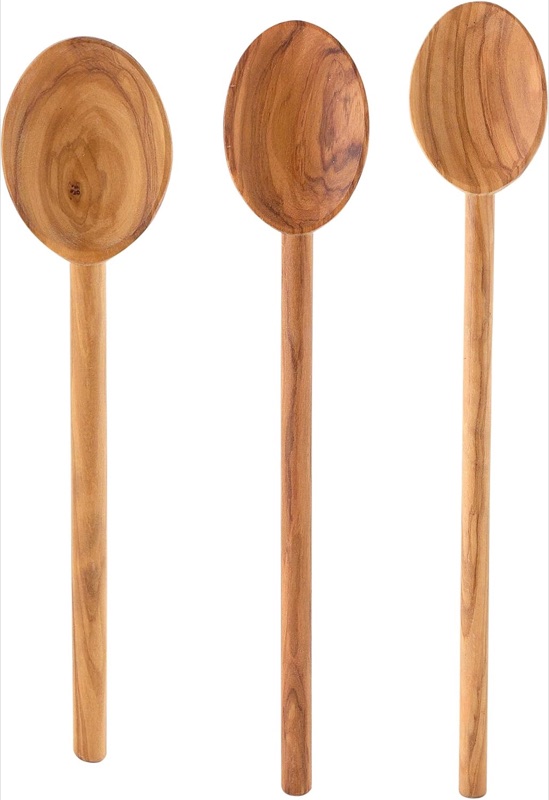
Olive wood is the top of the wooden-utensil hierarchy: extremely dense, naturally oily, and grained like marble, so it neither absorbs flavors nor cracks the way lighter woods do. Eddington's set of three — 10, 12, and 13.75-inch spoons — is handcrafted in southern Italy from wood harvested when the groves stop producing. They're the spoons that end up on the counter in a crock rather than in a drawer, and with an occasional wipe of mineral oil they'll outlast the stove. Pair with the OXO turner and you have a two-material kitchen that covers everything.
Check price on AmazonFrequently Asked Questions
Is the black plastic thing real or overblown?
Both, in a specific way. The Chemosphere 2024 study genuinely detected brominated flame retardants in black kitchen utensils — that finding stands and was never retracted. What was overblown was the exposure estimate: a math error made it look close to the EPA reference dose when the corrected figure is roughly ten times lower. Our view: the presence of e-waste flame retardants in a spatula at any level is reason enough to swap something that costs $15, especially since the heat-and-abrasion shedding problem applies regardless of color.
Isn't silicone just another plastic?
Chemically it's a silicon-oxygen polymer, not a petroleum thermoplastic. Practically, the distinction that matters is behavior at pan temperature: platinum silicone stays stable to ~500 °F and doesn't melt or fragment, while nylon and polypropylene deform at 400 °F. The rule is to buy solid platinum silicone (GIR, or any set labeled platinum-cured and seamless) and avoid silicone coatings over plastic cores.
What about bamboo utensils?
Solid carved bamboo is fine. The trap is "bamboo fiber" products — bamboo dust bound with melamine-formaldehyde resin, a plastic that can leach melamine when heated. If it's molded, glossy, sold as dishwasher-safe, or suspiciously uniform, it's a composite. Solid teak or olive wood avoids the ambiguity entirely.
Won't metal ruin my pans?
Only nonstick ones. Cast iron, carbon steel, and stainless steel are meant to be used with metal utensils — that's what restaurants do all day. For nonstick pans, use wood or platinum silicone. And if your nonstick is already scratched, the coating flakes are their own microplastic source; our cookware guide is next on the roadmap.
Care & Maintenance Tips
- Hand-wash wood, dry immediately, and store upright in a crock — the dishwasher is what cracks wooden utensils.
- Oil wood monthly with food-grade mineral oil or a board butter; never cooking oils, which go rancid.
- Sand out rough spots on wood with fine sandpaper and re-oil — a five-minute fix that adds years.
- Silicone and steel go in the dishwasher without a second thought. Silicone stains (tomato, turmeric) are cosmetic and lift with baking soda or sunlight.
- Retire any remaining plastic utensils with melted or frayed edges immediately — that's the shedding, made visible.
Keep Swapping
Check one more food-contact surface: our salt grinder microplastics guide explains plastic burrs, ceramic and steel mechanisms, and ways to skip grinding.
Utensils and the surface they scrape against are the same problem. Pair this guide with wood and rubber cutting boards, then send the finished meal into glass containers instead of plastic — heat is the enemy at every step.