Do Plastic Salt Grinders Release Microplastics? What to Use Instead
The grinding mechanism deserves a closer look. Here is what the studies found, how to check yours, and four practical alternatives.
We may earn a commission when you buy through our links, at no additional cost to you. As an Amazon Associate we earn from qualifying purchases. These are research-based recommendations; we have not performed hands-on or particle-shedding tests.
Yes, plastic salt grinders can release microplastics. Research has measured particles from tested plastic mechanisms. To avoid grinding salt against plastic burrs, use salt that needs no grinding, a porcelain mortar, or a mill with a documented ceramic or steel mechanism. A glass jar alone does not tell you what the grinding parts are made of. See the studies and product sources.
Our simplest suggestion is also the least elaborate: use a food-safe bowl you already own with salt in the grain size you want. If you prefer a dedicated container or grinder, the options below serve different needs.
Salt grinder alternatives at a glance
| Option | Best fit | What to know |
|---|---|---|
| RSVP stoneware salt box | Serving salt without grinding | Stoneware body, bamboo lid; an existing bowl works too. |
| HIC porcelain mortar and pestle | Crushing small batches | Porcelain contact surfaces; more manual effort. |
| Kyocera adjustable ceramic mill | Replacing plastic burrs | Ceramic mechanism and glass jar; plastic housing remains. |
| Peugeot Line Natural salt mill | Grinding dry rock salt | Steel mechanism; check salt type and crystal size. |
These options are not ranked by measured health benefits or particle counts. Choose by the task you need to do and the materials the maker actually documents.
What the salt grinder microplastics studies found
The 2026 study
A 2026 paper in Science of the Total Environment tested three plastic grinder heads from each of three retailers, using 50 g of salt per test and a ceramic mortar control. The dominant identified polymers matched the heads: polyethylene terephthalate (PET) or polycarbonate (PC).
| Retailer group | Head material | Particle count |
|---|---|---|
| A | PET | 1,091 ± 239 |
| B | PET | 2,420 ± 1,805 |
| C | PC | 15,743 ± 1,858 |
Those are experimental results, not counts per meal or a ranking of all grinders. The researchers used optical photothermal infrared spectroscopy to identify subsampled particles. The paper does not establish health outcomes or test the alternatives recommended here.
Why “ceramic” is only part of the answer
A 2020 study of five salt mills found contamination in the unground reference salt as well as particles associated with grinder materials. One ceramic mill contained polystyrene components, and polystyrene particles appeared in its ground salt. That is a reason to ask about the complete mechanism, including its supports.
The studies used different methods, sample quantities, and size cutoffs. Their counts are not a common scoring system for products. Nor can a particle count alone tell us the health effect of using a particular mill.
How to check a grinder before buying
A product can be described as glass, wood, or stainless steel because of its outer body. For this purchase, ask a more specific question: what are the burrs, the toothed parts that crush the crystals, made of?
- Find the exact model. Match the brand, size, salt-versus-pepper version, and model number. Similar-looking mills can have different mechanisms.
- Look for a mechanism specification. “Ceramic burrs” or “steel grinding mechanism” is more useful than a broad material badge. If only the jar’s material is given, ask the maker.
- Check nearby components. Ask about the carrier, adjustment pieces, and other parts in the salt’s path. Do not assume a nonplastic burr makes the entire assembly plastic-free.
- Match the salt. Follow the mill’s instructions for moisture and crystal size. Do not use a pepper mill for salt unless its maker permits it.
- Consider skipping the mill. If you want fine salt every time, buying that texture and using an existing bowl may suit you better than another appliance.
Inspect visible parts without forcing apart a sealed mill. Color, shine, and a “BPA-free” label are not enough to establish a complete materials list. We would not turn a simple salt swap into a destructive inspection project.
Four product alternatives worth considering
We selected these examples for documented materials and distinct uses. Product photos show the linked models; the header image is an illustration. Use the Amazon buttons for current price and availability.
Our first choice · skip the grinder
RSVP International Stoneware Salt Box
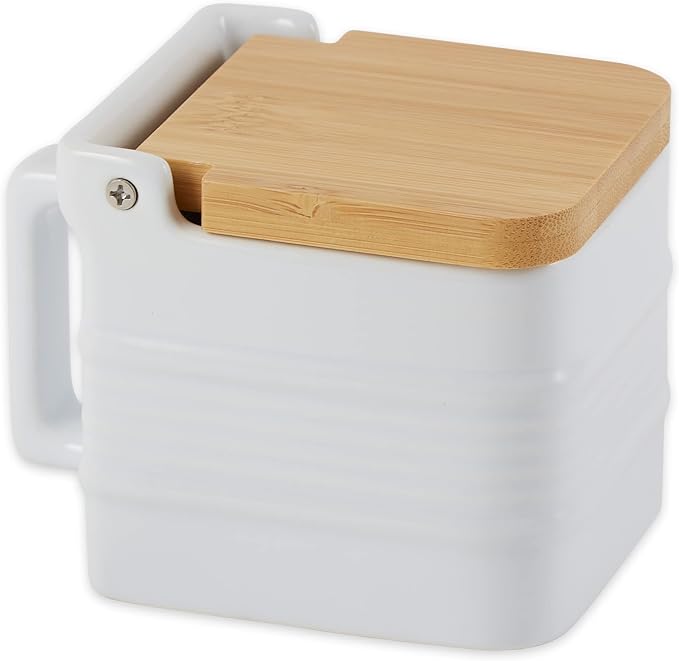
If you buy fine salt or flakes that are already the size you want, a salt box removes the need for a grinding mechanism. RSVP’s model has a stoneware body and hinged bamboo lid, giving you a simple place to keep salt beside the stove. You can pinch out a little with clean, dry fingers or use your own spoon.
This is our starting recommendation because the task is straightforward: store and serve salt. You do not need this particular box if a food-safe bowl or jar you already own does the job. The product is a convenience purchase, not a necessary health upgrade.
Trade-offs: It will not change coarse crystals into fine salt, and the lid is not advertised as an airtight seal. RSVP specifies hand-washing and drying. We have not verified a complete bill of materials for the hinge or lid finish.
RSVP’s material and care details.
Check price on AmazonFor occasional grinding · no burr assembly
HIC Kitchen Porcelain Mortar and Pestle, 4.25-inch
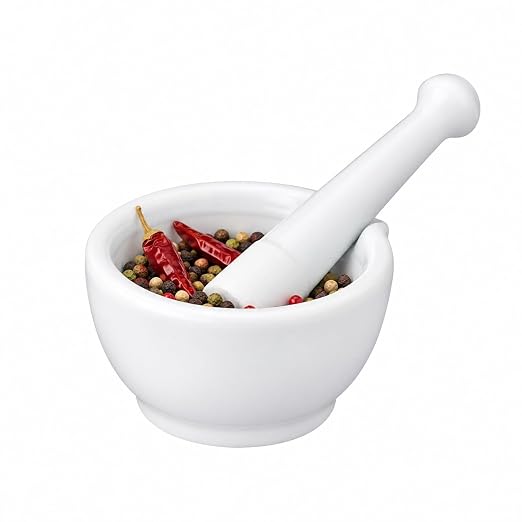
For someone who already has coarse salt and only needs to crush small batches, the HIC 4.25-inch porcelain mortar and pestle is a practical alternative to a mill. Its pour spout helps transfer the crushed salt to a bowl. The linked listing identifies both the bowl and pestle as porcelain and specifies dishwasher-safe care.
You control the texture by hand, so this suits occasional prep more than seasoning a whole table one-handed. It can also earn its cupboard space crushing cooking spices.
Trade-offs: It takes more effort than twisting a mill, and porcelain can chip if dropped or struck hard. Inspect it before use and replace damaged pieces. Choosing porcelain avoids a plastic burr assembly; it does not prove that grinding releases no particles of any kind.
The link below is the 4.25-inch version with a pour spout; other sizes share the Amazon product family.
Check price on AmazonFor a ceramic mechanism · still contains plastic
Kyocera Adjustable Ceramic Mill, White
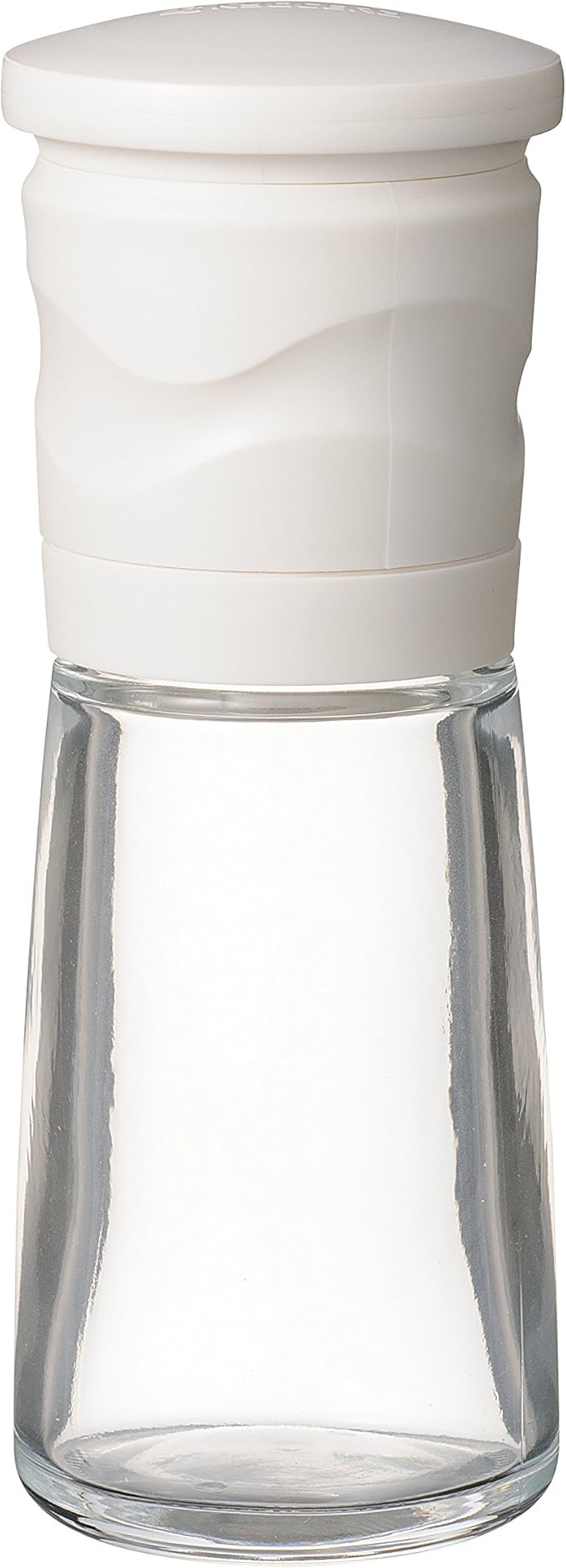
Kyocera documents an adjustable ceramic grinding mechanism and refillable glass jar. It is an option if you want a mill and are replacing plastic burrs. The white version linked here is the single mill, not the dual-ended design.
The important qualification: this is not a fully plastic-free salt grinder. Kyocera’s materials documentation lists plastic in the CM-15N housing. A ceramic mechanism is a specific material choice, not evidence that every part touching salt is ceramic or that the assembled product has passed a shedding test.
Trade-offs: Keep looking if your priority is avoiding all plastic components. Otherwise, it offers an adjustable grind with a removable jar. Kyocera identifies the jar as dishwasher-safe; do not extend that instruction to the complete assembly.
Kyocera’s product specifications · Model-specific materials catalog (PDF).
Check price on AmazonFor dry rock salt · steel grinding mechanism
Peugeot Line Natural Salt Mill, 12 cm
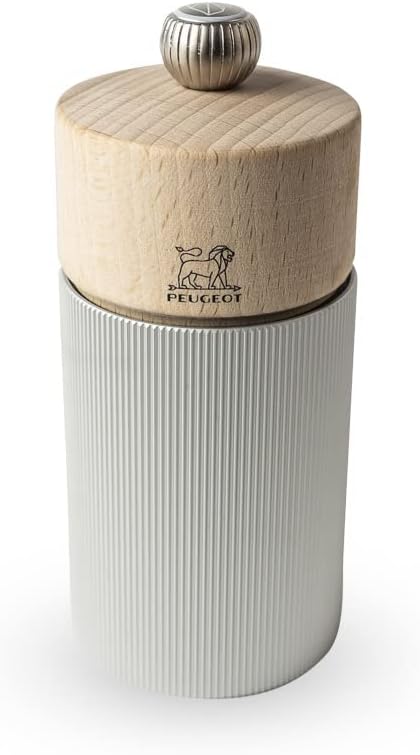
The Peugeot Line Natural salt mill, 12 cm / 4.75 inches, is the steel-mechanism option on this list. Peugeot documents a steel grinding mechanism for model 39899; the matching Amazon listing specifies stainless steel. The exterior combines aluminum and wood, with grind adjustment at the top.
Its compatibility matters: Peugeot specifies dry rock salt with crystals no larger than 4 mm, and says not to use wet sea salt, even after drying. It is a narrower choice than a general spice grinder.
Trade-offs: Buy it for the documented salt mechanism and table-mill format, not an assumption that every internal component is metal. The published information does not establish a completely plastic-free assembly or a measured microplastic-reduction percentage. Specifications for a different Peugeot range should not be substituted for this model’s.
Peugeot’s model and salt-compatibility details.
Check price on AmazonUse and care
- Keep salt and its storage area dry. Let washed containers dry fully before refilling.
- Hand-wash and dry the RSVP box as instructed; avoid soaking its bamboo lid.
- Follow the HIC listing’s dishwasher instructions for the porcelain set and inspect it for chips.
- For Kyocera, distinguish the removable glass jar from the grinding assembly when cleaning.
- Use only compatible salt in the Peugeot Line mill. Do not force it through oversized or damp crystals.
- If a tool is visibly damaged, replace or repair the affected part according to its maker’s instructions. A home visual check cannot measure microplastic release.
Frequently asked questions
Do plastic salt grinders release microplastics?
Studies have detected particles released by tested plastic grinding mechanisms. The amount varies with the materials and test conditions; it is not a single number that applies to every grinder.
Is a ceramic salt grinder completely plastic-free?
Not necessarily. Ceramic describes the grinding material, while the housing, adjustment parts, or supports may still contain plastic. The Kyocera example here has a ceramic mechanism and a plastic housing.
Does Himalayan salt have fewer microplastics than sea salt?
The studies discussed here do not establish a reliable shopping ranking of salt types. Check the grinder independently of the salt’s origin, and do not treat pink, sea, or rock salt as a guarantee of zero contamination.
What is the simplest alternative to a plastic salt grinder?
Use salt in the grain size you already need and serve it from a food-safe bowl or salt cellar. You can use a container you own; a new product is optional.
Can a glass salt grinder still have plastic grinding parts?
Yes. Glass describes the reservoir, not necessarily the burrs or their supports. Look for a materials description of the grinding mechanism for the exact model.
Can I use a pepper mill to grind salt?
Only if its manufacturer explicitly allows it. The Peugeot Line salt mill listed here is designed for dry rock salt up to 4 mm; that does not make a Peugeot pepper mill interchangeable with it.
Sources and editorial method
Researched October 7, 2026. We compared published study findings, manufacturer specifications, and the exact Amazon variants linked above. This is a materials-based buying guide, not a laboratory comparison. We have not measured particle release, durability, or changes in anyone’s exposure from these products.
- Yang et al. (2026): Investigating microplastic release from plastic grinder heads during salt grinding, Science of the Total Environment, 1021, 181608. Experimental counts above follow the abstract’s results.
- Schymanski, Humpf and Fürst (2020): particle abrasion from five salt grinders, Food Additives & Contaminants: Part A, 37(8), 1238–1252. DOI.
- RSVP International: Stoneware Salt Box, SALT-W — materials and care.
- Kyocera adjustable ceramic mills and 2024 kitchen catalog — mechanism, jar, and housing materials.
- Peugeot Line Natural, model 39899 — mechanism and compatible salt.
- HIC porcelain materials and care are taken from the linked 4.25-inch Amazon product listing. We did not independently test those claims.
Keep swapping
For the rest of your prep routine, compare alternatives to plastic cutting boards and wood, steel, and silicone kitchen utensils. For leftovers, see our glass food-storage guide.