Plastic-Free French Press Coffee Makers: What to Buy & Check
A steel carafe does not tell you what is under the lid. Compare two French presses, inspect the small parts, and choose a brewer that meets your definition of plastic-free.
As an Amazon Associate we earn from qualifying purchases. We may earn a commission through our links at no extra cost to you. Recommendations are based on the documented criteria in this guide. Check the selected size, lid, seller, and current price before buying.
Which plastic-free French press should you choose?
Our first choice is the Frieling stainless steel French press because its manufacturer explicitly describes it as having no plastic parts. The Secura 34 oz is an alternative with documented steel walls and filter components, but its shorter materials description is less explicit about every part. Decide how strict your no-plastic requirement is before comparing.
We reviewed specifications and product listings, not brewed-coffee particle measurements. Neither option comes with a microplastic-free coffee guarantee from us.
| French press | Documented construction | What to check |
|---|---|---|
| Frieling brushed, 36 oz | Manufacturer explicitly says no plastic; stainless construction | Pick the size and finish you want |
| Secura SFP-34DS, 34 oz | Steel interior, exterior, and filter assembly | Confirm all small parts if absolutely no plastic is essential |
How to check a French press for hidden plastic
“Stainless steel French press” can describe only the vessel. Before buying, ask for a photo of the underside of the lid and a materials list for the full plunger assembly. An external handle or knob is easy to see; a concealed lid liner or screen support is easier to miss.
- Carafe: verify the inner wall, including any coating.
- Lid: inspect the underside and the guide around the plunger rod.
- Filter assembly: check the mesh, support plate, spring, and attachment pieces.
- Pouring path: check whether coffee passes through a plastic insert at the spout.
- Seal: distinguish a silicone gasket from an all-metal assembly if that matters to you.
A glass beaker with a stainless frame is not enough evidence on its own. The same inspection applies to expensive models and budget ones. If a seller cannot answer, treat the unspecified part as unknown rather than assuming it is steel.
Our pick: explicit no-plastic construction
Frieling Double-Walled French Press, Brushed (36 oz)
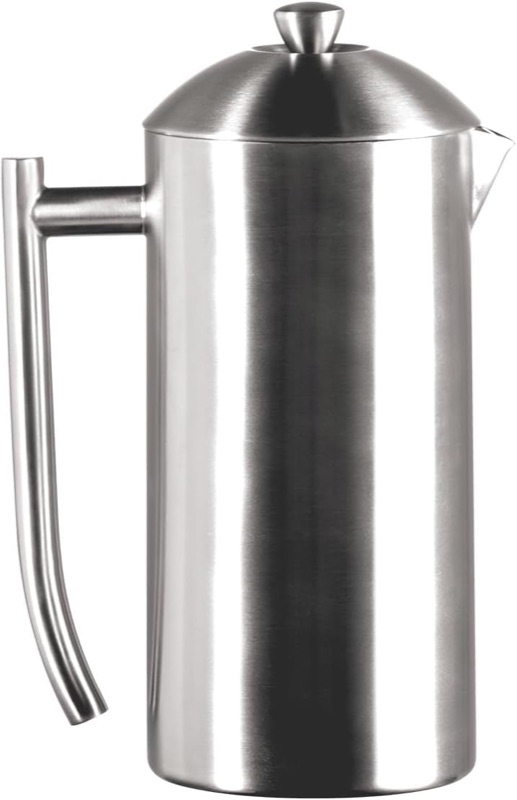
Frieling’s product documentation identifies stainless steel construction and a three-piece filter, with replacement parts available. Its explicit no-plastic statement gives it the strongest materials match in this comparison. The linked Amazon listing is the brushed 36 oz version; check the selected variation before ordering.
Why choose it: you can keep using a metal brewer without replacing a glass beaker, and replace filter components when needed. The reusable screen avoids a disposable filter at each brew.
The tradeoff: you still need to clean the filter assembly and manually brew each batch. We have not tested heat retention, sediment, or durability, so we do not assign it a performance score. Choose the capacity for what you actually brew, not the largest model available.
Check price on AmazonAlternative: confirm the complete assembly
Secura SFP-34DS French Press, Silver (34 oz)
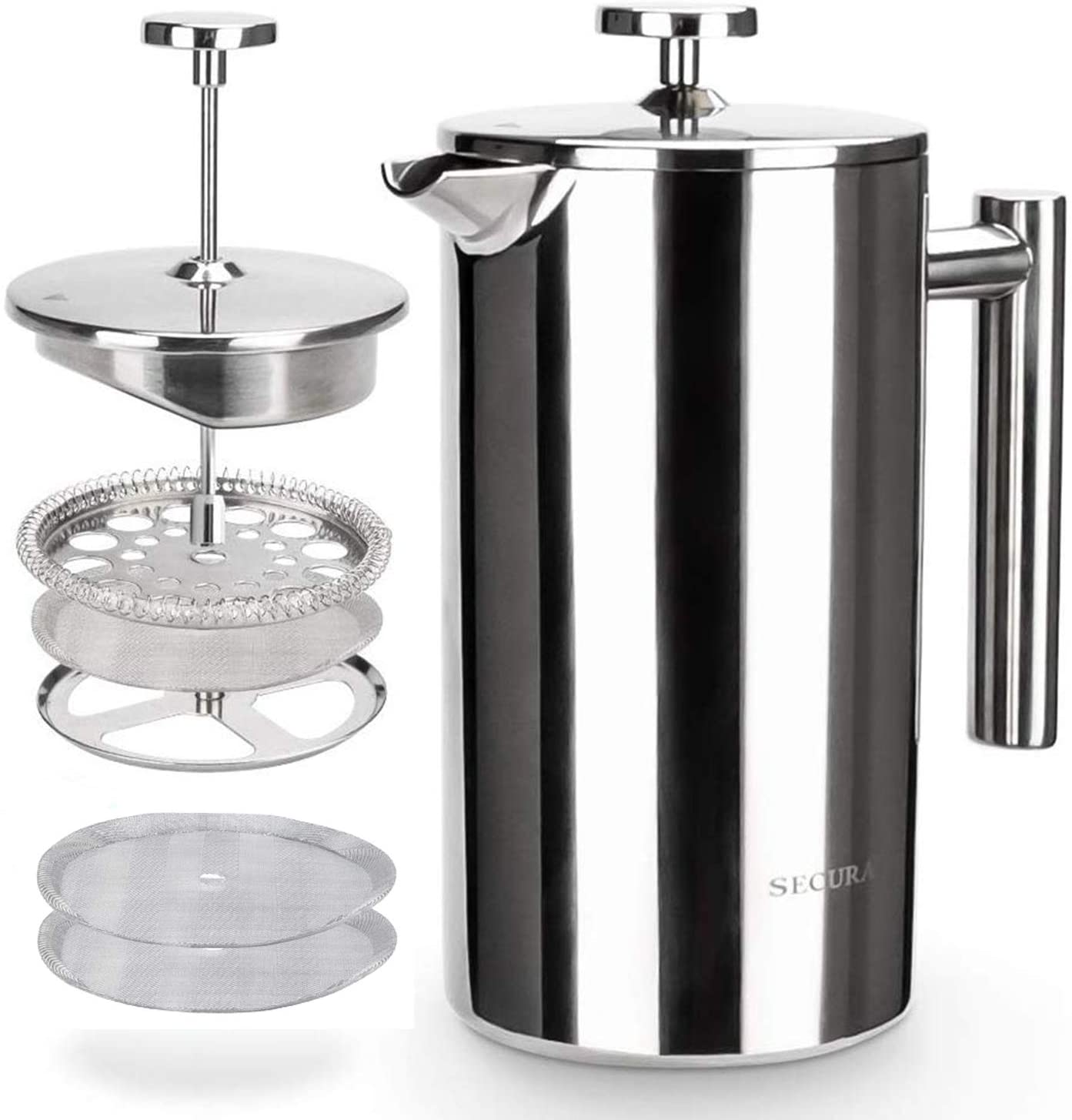
Secura lists stainless steel inner and outer walls and a layered steel filter for the 1-liter SFP-34DS. Its manufacturer page links to the same silver 34 oz Amazon listing used here. This makes the identity of the model easier to check than a generic marketplace press.
Why consider it: the documented water-contact walls and filter are steel, and the screen can be disassembled for cleaning. Compare its current total cost with the Frieling, including replacement parts you may need.
The tradeoff: the page does not make the same explicit, complete no-plastic statement as Frieling. If your requirement includes every knob, guide, and concealed piece, confirm those details with Secura before buying. We are listing it as an alternative with a narrower documented claim.
Check price on AmazonChoose capacity and maintenance before extra features
Measure the amount your usual mugs hold and compare that with the manufacturer’s usable brewing guidance. Grounds and the plunger need room; filling to the rim is not a useful capacity target. A 34 or 36 oz label should not be read as a promise to fill several large mugs.
Check whether you can obtain a replacement mesh screen and whether the filter comes apart without special tools. A press that is frustrating to clean is unlikely to remain your everyday brewer. A simpler model with available parts may suit you better than one with more filtration layers.
Keep plastic out of the rest of the brewing setup
The press is only one component. Inspect the kettle, stirring utensil, and the lid of any travel mug you pour into. Use the manufacturer’s brewing instructions, leave appropriate headroom, and do not force a blocked plunger.
After brewing, empty the grounds, separate the filter as directed, wash the parts, and dry them before reassembly. Do not treat the screen as a water-purification filter: its purpose is to separate coffee grounds. For other methods, see our guide to plastic-free coffee with ceramic and glass brewers.
Frequently asked questions
What is the best plastic-free French press coffee maker?
Our materials-based first choice is the Frieling stainless steel French press because its manufacturer explicitly states that it contains no plastic. We have not compared these products in hands-on brewing or particle-release tests.
Are all stainless steel French presses plastic-free?
No. The label may describe only the carafe. Check the lid underside, plunger guide, mesh supports, spout insert, and seals before treating the whole press as plastic-free.
Is the Secura French press completely plastic-free?
Secura documents steel inner and outer walls and filter components for the SFP-34DS. Its product page is less explicit about every small part, so confirm the full assembly if your requirement is no plastic anywhere.
Does a French press filter remove microplastics from water?
Do not assume that. A coffee screen separates grounds and is not a substitute for a drinking-water filter with documented particle-reduction performance.
Is a glass French press a plastic-free option?
It can be, but the glass beaker alone does not establish that. Inspect the lid and filter assembly just as you would on a steel press.
Sources and editorial method
We reviewed manufacturer specifications and the sources below on September 21, 2026. This is a research-based guide; we have not conducted hands-on product tests or measured particle release from these products. Material descriptions and laboratory results have different limits, which we identify in the recommendations.