Does Hydro Flask Have Microplastics? Body, Lids & Straws
Hydro Flask’s steel body and its plastic-containing lids are different parts of the story. Here is what the materials tell us, what they cannot prove, and what to check before changing bottles.
As an Amazon Associate we earn from qualifying purchases. We may earn a commission through our links at no extra cost to you. Recommendations are based on the documented criteria in this guide. Check the selected size, lid, seller, and current price before buying.
Does Hydro Flask have microplastics? The short answer
A Hydro Flask has a stainless steel body, but many cap designs contain plastic. That is not evidence of a measured quantity of microplastics in your drink. We did not find a Hydro Flask-specific particle-shedding study in the sources reviewed for this article. We cannot promise zero shedding or tell you how many particles a particular bottle releases.
Hydro Flask’s materials report identifies 18/8 stainless steel vessels and food-contact plastics used in lids. Its BPA-free claims address a chemical, not whether a lid is made from plastic. If you searched “does hydroflask have microplastics,” separating those two questions is the most useful first step.
Which parts should you check?
| Part | What to establish | Why it matters |
|---|---|---|
| Bottle interior | The exact bottle model and interior material | A steel wall is different from a plastic container |
| Cap underside | Material touching the stored water | The cap can touch water when the bottle tips |
| Straw and spout | Materials and replaceable parts | These surfaces contact water during drinking |
| Seal or gasket | Material, condition, and cleaning instructions | A steel-looking lid can still include a polymer seal |
Inspect the cap that actually came with your bottle. Product families, mouth sizes, and lid generations are not interchangeable. A photo of the outside cannot establish the material on the inside.
Plastic parts are not a bottle-specific exposure measurement
To estimate shedding, a study would need to identify the bottle and cap, test use and cleaning conditions, control laboratory contamination, and report the particle sizes it could detect. A count from a different container or a heated plastic experiment cannot be assigned to a Hydro Flask.
The FDA summarizes uncertainties in measurement and health effects. That leaves room for a practical preference: you can choose fewer plastic contact surfaces without claiming that an existing bottle has been shown to be dangerous. Neither “BPA-free” nor “stainless steel” establishes that your finished drink contains zero particles.
Can you get a Hydro Flask with a stainless steel cap?
Hydro Flask sells a Wide Mouth Stainless Steel Cap. The manufacturer specifies 18/8 stainless steel and compatibility with its Wide Mouth bottles. It is not listed as a cap for the 21 oz Standard Mouth bottle.
Before treating any replacement as a completely plastic-free solution, confirm the underside, threads, seal, and compatibility. The product description alone does not provide a particle-shedding test or a full independent audit of every component. A stainless color option on another lid should not be treated as the same product.
Keep your bottle, change the lid, or choose a different design?
- Keep it: if the bottle suits you, inspect the cap and clean it as directed. The sources reviewed do not establish a reason to discard every Hydro Flask.
- Replace a part: worn seals or damaged lids may be replaceable. Match the exact mouth size and generation.
- Change the design: if minimizing conventional plastic contact is your priority, choose a documented steel-interior cap and accept any insulation or convenience tradeoff.
Insulated option with a plastic straw and lid
Hydro Flask Wide Mouth with Flex Straw Cap, Shale Gray (32 oz)
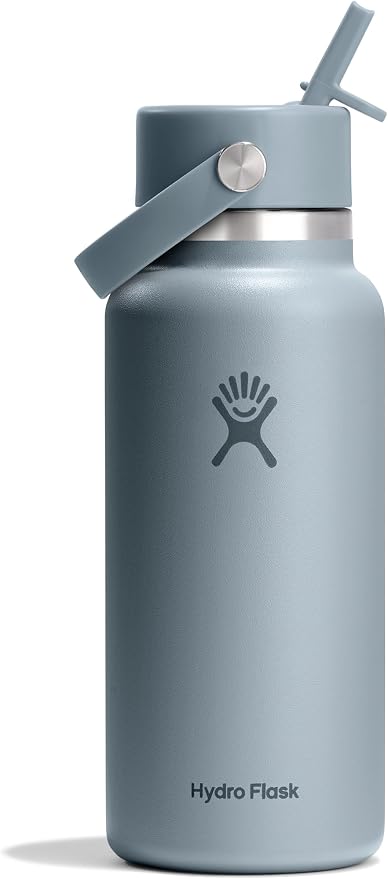
If insulation and drinking through a straw suit your routine, this 32 oz Hydro Flask has a stainless steel body and a closeable Flex Straw Cap. The product listing specifies up to 24 hours cold; that is a manufacturer claim, not our test result.
The material tradeoff: the lid and straw contain plastic. This is an insulated convenience option, not a plastic-free bottle or a guarantee of microplastic-free water. The linked model is the 32 oz Wide Mouth in Shale Gray, distinct from the 21 oz Standard Mouth with an ordinary Flex Cap in our bottle comparison.
Check 32 oz Flex Straw bottle on AmazonAn alternative with a simpler material list
Klean Kanteen Reflect with Bamboo Cap (27 oz)
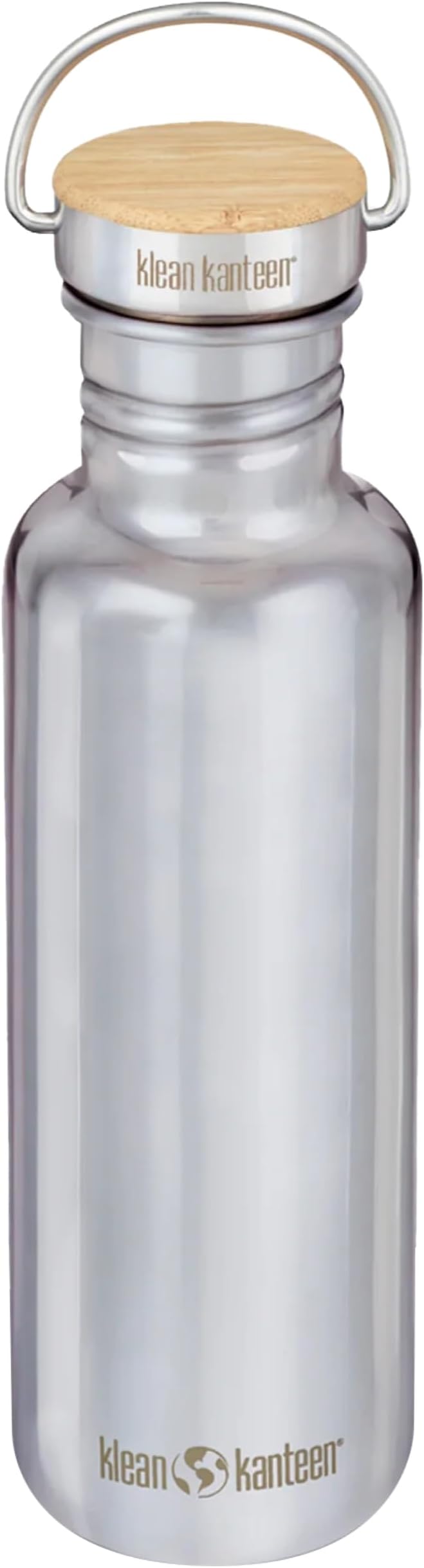
Klean Kanteen lists steel, bamboo, and silicone for the Reflect. Its steel-facing cap makes it worth comparing if avoiding a conventional plastic lid matters more to you than insulation. It is single-wall and still has a silicone seal; those details are part of the recommendation.
Compare it with insulated options in our stainless steel water bottle guide. Changing the bottle will not remove particles already present in the water; our water-filter guide addresses that separate question.
Check price on AmazonFrequently asked questions
Is a Hydro Flask completely plastic-free?
Not with many common lids. Hydro Flask documents stainless steel vessels and food-contact plastics in lids. Check the exact bottle, cap, straw, and seal rather than treating the brand name as a complete materials list.
Does a Hydro Flask straw release microplastics?
The presence of a plastic component alone cannot tell us how many particles it releases. We did not find a Hydro Flask-specific shedding study in the sources reviewed, so we cannot quantify release or guarantee zero.
Does BPA-free mean there are no microplastics?
No. BPA-free is a claim about bisphenol A, not an absence of plastic parts or a particle test result.
Will the Wide Mouth Stainless Steel Cap fit a Standard Mouth bottle?
Hydro Flask lists that cap for Wide Mouth bottles. Do not buy it for a Standard Mouth bottle without explicit manufacturer compatibility guidance.
Sources and editorial method
We reviewed manufacturer specifications and the sources below on September 21, 2026. This is a research-based guide; we have not conducted hands-on product tests or measured particle release from these products. Material descriptions and laboratory results have different limits, which we identify in the recommendations.