Best Water Filters for Microplastics: Pitchers & More
Some water filter pitchers and jugs have documented microplastic-reduction claims. Compare the exact filters, replacement costs, and limits before choosing one for your tap water.
As an Amazon Associate we earn from qualifying purchases. We may earn a commission through our links at no extra cost to you. Recommendations are based on the documented criteria in this guide. Check the selected size, lid, seller, and current price before buying.
Best water filter pitchers for microplastics
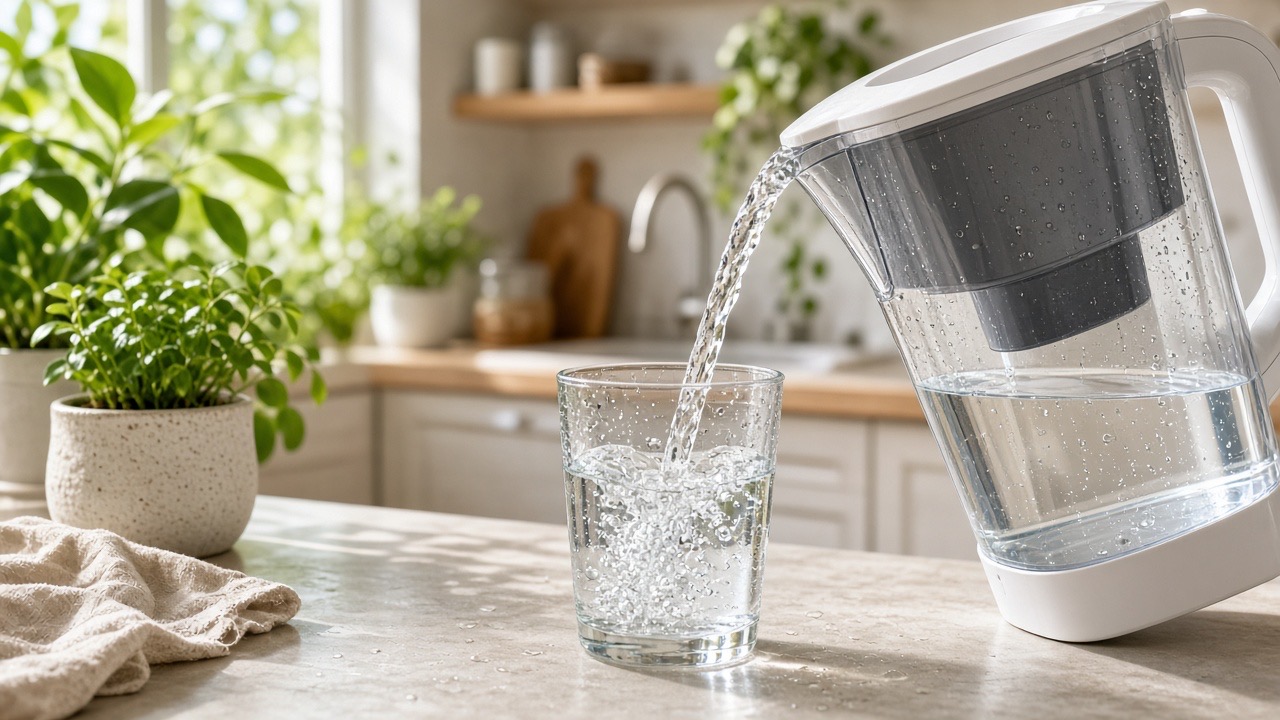
For treated tap water, our starting pick is the 10-cup Brita Tahoe pitcher with an Elite OB06 cartridge. It pairs a defined particle-reduction claim with a lower listed replacement cost than the Clearly Filtered pitcher. Choose Clearly Filtered if its additional contaminant test results fit your water-treatment needs. This is a comparison of published evidence and ownership costs; we have not tested the pitchers ourselves.
| Pitcher and cartridge | Microplastic evidence | Capacity and upkeep | Main tradeoff |
|---|---|---|---|
| Brita Tahoe + Elite OB06 | 99.6% reduction for 0.5–1 µm particles in the performance sheet | 10 cups; 120-gallon filter rating, about six months at the maker's average use | Plastic vessel; no result for every smaller particle |
| Clearly Filtered + CF-PRF | Published additional lab testing includes microplastics; distinct from NSF certification | 10 cups; 100-gallon filter rating, with changes based on use and water conditions | Plastic vessel; higher listed replacement cost |
Need more stored water? See the 27-cup UltraMax dispenser. For filtration while carrying water, see the LifeStraw Go bottle. Those serve different needs from a pourable jug.
Do water filter jugs remove microplastics?
Some do, within a documented particle-size range. “Jug” and “pitcher” describe the vessel; the cartridge determines the reduction claim. Check a performance sheet for the exact filter and system, rather than assuming that better-tasting water means fewer plastic particles.
These recommendations use US-market model names. If you shop elsewhere, check the local cartridge and its own documentation. A familiar brand name does not establish that a regional filter has the same specification.
How to compare filters for microplastics
- Match the cartridge and vessel. Look for both model numbers in the performance documentation.
- Read the actual claim. Certification for chlorine or lead does not automatically include microplastics.
- Check the test's size range. A reduction percentage without particle sizes cannot answer every microplastic or nanoplastic question.
- Separate a lab test from certification. Read the certification listing and additional test reports on their own terms.
- Plan the upkeep. Compare replacement availability, cost, volume rating, and the maker's time limit.
What will replacement filters cost?
Manufacturer price snapshots checked October 1, 2026: one Elite replacement is listed at $19.99; one Clearly Filtered replacement is $65 for a one-time purchase. Prices, packs, subscriptions, tax, and shipping can change.
At the full rated volume, that is about $0.17 per gallon for Elite and $0.65 for Clearly Filtered in filter media alone. Actual costs rise if you replace a cartridge before using its rated volume. To budget a year, divide your annual filtered gallons by the cartridge rating, round up, and multiply by the current price per filter; also allow for any earlier time-based replacement. The initial pitcher purchase is separate.
Pitchers, a dispenser, and a portable option
Our starting pitcher pick
Brita Tahoe with Elite Filter: 10 cups
The Tahoe is pitcher model OB60, sold with an Elite filter. Its size suits someone who wants a jug to lift and pour. At review, Brita listed the bundle at $41.99; check the retailer's selected cartridge before buying, because Tahoe is also sold with other filters.
We favor it here for a traceable claim and lower listed filter cost, rather than a claimed win in our own testing. It still has plastic components and needs cleaning and cartridge changes. Check fridge clearance using the manufacturer's dimensions.
View Tahoe with Elite at BritaAlternative with additional lab data
Clearly Filtered Water Pitcher: 10 cups
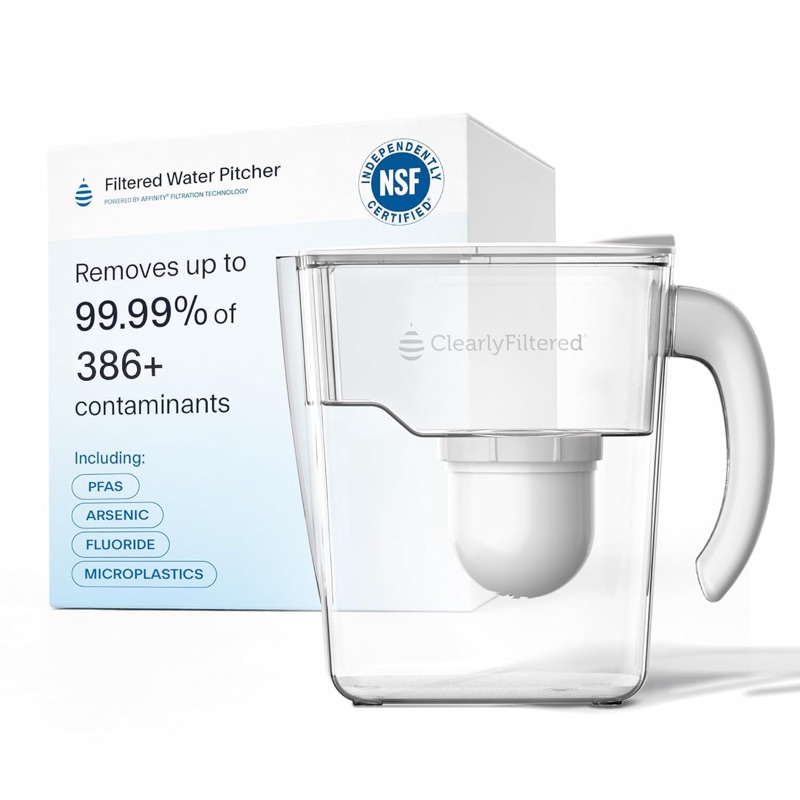
The 10-cup pitcher uses the CF-PRF replacement. Its performance page separates NSF/ANSI 42 and 372 certification from additional lab testing, which includes microplastics. The page reports maximum reductions under controlled conditions; do not treat its percentages as a head-to-head comparison with Brita.
The 100-gallon rating is a volume limit, not a fixed number of months. Its higher filter cost is worth weighing against any other contaminants you need addressed. The pitcher and cartridge include plastic. Ask for the particle-size details behind the lab result before using it to make a nanoplastic claim.
Check price on AmazonFor more stored water
Brita UltraMax with Elite Filter: 27 cups
This is a dispenser with a tap, rather than a jug you lift to pour. The linked bundle includes the Elite cartridge; confirm the selected version before checkout. Choose it for its storage format and available shelf space, not an assumption that a larger vessel filters more effectively.
Check UltraMax with Elite on AmazonFor a portable filter
LifeStraw Go Series Bottle (1 L)
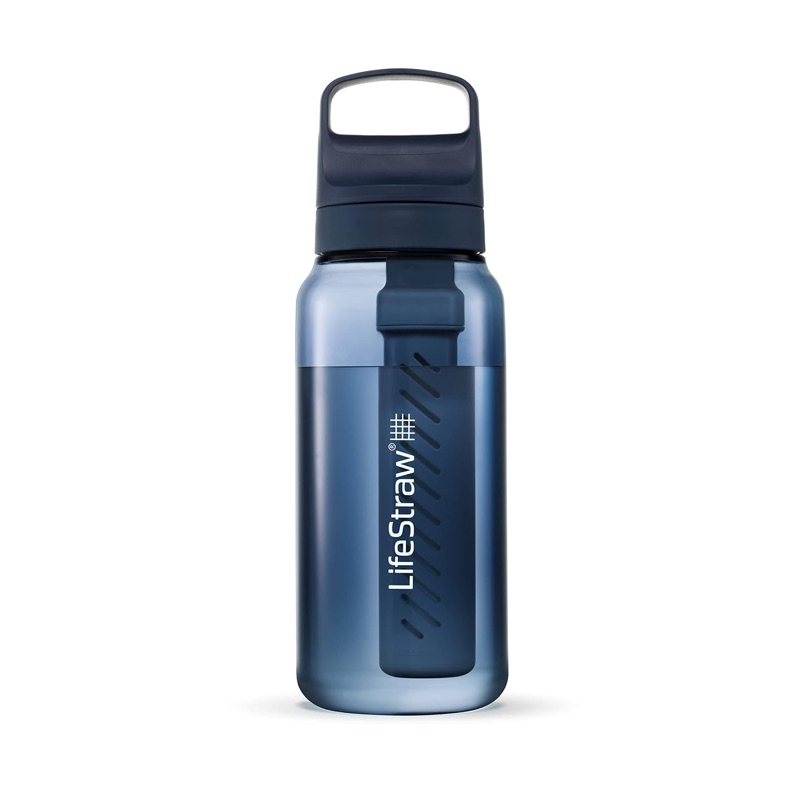
LifeStraw lists microplastics among the contaminants reduced by the Go Series membrane. Its carbon stage serves a different role, including taste improvement. Choose the Go if you need filtration in the bottle rather than preparing all your water at home.
The tradeoff: this linked version uses a plastic bottle and filter assembly, so it is not a plastic-free vessel. Do not assume it removes every chemical, salt, or virus; compare the manufacturer’s limitations with your water source. The carbon and membrane components also have separate maintenance requirements.
If portable filtration is unnecessary, fill a steel bottle from an appropriate home filter instead.
Check price on AmazonDoes Brita Elite remove microplastics?
Yes, for the tested size range. The Elite OB06 performance sheet names a 99.6% reduction for 0.5–1 µm particles and identifies certification for its listed claims and systems. The sheet includes Tahoe OB60.
This does not establish the same result for Original, Refillable, or every regional Brita cartridge. Read the specification for the cartridge you will actually buy.
Can water filters remove nanoplastics?
Yes, filtration can reduce nanoplastics under tested conditions, but that is not a verified claim for every household filter. A 2022 pilot drinking-water treatment study reported 88.1% removal of the tested polystyrene nanoplastics through sand and granular activated-carbon filtration without coagulation. That treatment-plant result does not establish the performance of a kitchen pitcher.
For the household products compared here, we have not verified complete removal across all nanoplastic sizes. A filter’s result is only as broad as its test; missing evidence is not proof that every smaller particle passes through.
Size labels can differ between studies and product claims. Read the numbers: the Elite result above covers 0.5–1 µm, or 500–1,000 nanometers. It does not establish what happens to a 50-nanometer particle. A larger reduction percentage from another test is not automatically a better result for smaller particles.
For a pitcher, reverse-osmosis unit, or ultrafiltration system, ask for three details before buying specifically for nanoplastics:
- The smallest particle size actually measured, and the plastic materials tested.
- Results for water leaving the complete device, rather than only a membrane specification.
- The test method, reporting limit, and evidence across the cartridge's service life.
If these details are missing, treat nanoplastic performance as unverified. A “not detected” result means below that test's detection limit; it does not establish zero particles of every size.
What about reverse osmosis and 1-micron filters?
Do not select an entire installed system from a pore-size number alone. For a reverse-osmosis unit, ask for model-specific performance data, the contaminants covered, installation requirements, replacement stages, and wastewater use. A general statement about membrane technology is not a test of the water leaving that complete unit.
The same rule applies to a “1-micron” countertop filter. Ask whether that is a nominal or absolute rating and what reduction was actually measured. A pore-size claim alone is insufficient evidence for a model-specific microplastic recommendation. We have not verified model-specific microplastic results for the APEC ROES-50 or Home Master Mini Plus in this update.
What bottled-water research can and cannot tell you
A 2024 study summarized by NIH found an average of about 240,000 micro- and nanoplastic particles per liter across the bottled-water samples studied. Most detected particles were nanoplastics. That finding does not establish a count for every brand, your tap water, or the output of any filter above.
Different detection methods capture different size ranges, so comparing numbers across unrelated studies can mislead. The FDA notes remaining uncertainty about health effects. A reduction percentage is a water-treatment result, not evidence that a filter prevents disease.
Maintain the whole system
Follow the installation and flushing directions for the exact cartridge. Replace it at the stated capacity or time limit, whichever the instructions require. Use the specified water temperature and clean the vessel as directed; do not assume a filter pitcher can be sanitized with boiling water.
Record the cartridge model and installation date. Keep a copy of its performance sheet so a later cartridge change does not silently change the claims you relied on. For coffee preparation, see our guide to reducing plastic contact during brewing.
Frequently asked questions
What is the best water filter pitcher for microplastics?
Our starting pick is the 10-cup Brita Tahoe with the Elite OB06 filter, based on its documented reduction claim and lower listed replacement cost. Clearly Filtered is an alternative with additional published lab testing. We have not run a head-to-head test.
Do water filter jugs remove microplastics?
Some have documented reduction claims. Check the exact cartridge, tested particle sizes, and replacement instructions; a jug that improves taste is not automatically verified for microplastics.
Does Brita Elite remove microplastics?
Its performance sheet reports 99.6% reduction of 0.5–1 µm particles in listed systems. That result does not establish performance for every Brita cartridge or for smaller particles.
Can water filters remove nanoplastics?
Experimental filtration systems have reduced nanoplastics, including in a pilot drinking-water treatment study. That does not establish a result for every home filter. For a specific product, ask for testing of the complete system and the smallest particle sizes you want to reduce.
Does NSF/ANSI 401 certification cover all microplastics?
Read the specific certified claim and listed models. A standard number alone does not mean a filter covers every contaminant or every particle size.
Can a plastic pitcher still reduce microplastics?
Yes, materials and filtration performance are different questions. Judge the complete device by its measured reduction claim; a plastic-free vessel alone does not filter the water placed inside it.
Can I use these pitchers with untreated water?
The Brita and Clearly Filtered options here are for appropriately treated tap water. Do not use them as a substitute for disinfection of microbiologically unsafe water. Follow local water advisories.
Sources and editorial method
Updated October 1, 2026 with a pitcher comparison, replacement-cost snapshots, and clearer microplastic and nanoplastic limits. This is a research-based guide; we have not conducted hands-on product tests or measured particle release from these products. Material descriptions and laboratory results have different limits, which we identify in the recommendations.
- Brita Tahoe with Elite: model, capacity, and bundle
- Brita Elite replacement-filter prices
- Clearly Filtered replacement capacity and prices
- Brita Elite OB06 performance data and certification statements (PDF)
- Brita filter compatibility and replacement instructions
- Clearly Filtered pitcher performance data and testing limits
- LifeStraw Go Series product specifications
- Pilot treatment-plant study: removal of polystyrene nanoplastics (2022)
- NIH: plastic particles in bottled water
- FDA: microplastics and nanoplastics evidence