Does Stanley Have Microplastics? Lids, Straws & Lead
A Stanley Quencher pairs a steel cup with a plastic lid and straw. Here is what Stanley documents, what the research can and can’t tell you, and what Stanley says about lead.
We may earn a commission when you buy through our links, at no additional cost to you. As an Amazon Associate we earn from qualifying purchases. These are research-based recommendations; we have not performed hands-on or particle-shedding tests.
Does Stanley have microplastics? The short answer
A Stanley Quencher has a stainless steel cup, but its FlowState lid and reusable straw are plastic. That tells you which parts touch your drink, not how many microplastic particles end up in it. We found no Stanley-specific particle-release study in the sources reviewed for this research-based guide, so we can’t put a number on shedding or promise zero.
Stanley lists the Quencher H2.0 FlowState body as 90% recycled 18/8 stainless steel and BPA-free. Its product pages describe the lid and straw by what they do, not by what polymer they are made from. Stanley’s FAQ says every contact surface is BPA- and BPS-free, and that its products carry the #7 “other” plastics code because they combine several materials. BPA-free is a claim about one chemical. It does not mean no plastic touches your water.
Which Stanley parts are steel, and which are plastic?
| Part | What the maker documents | Touches the drink? |
|---|---|---|
| Cup interior | 90% recycled 18/8 stainless steel with double-wall vacuum insulation | Yes, the largest contact surface |
| FlowState lid | Screw-on lid with a rotating three-position cover; polymer not named | Yes, when you tip the cup or drink from the opening |
| Reusable straw | Included straw; replacement straws are sold as BPA-free; polymer not named | Yes, on every sip through it |
| Straw seal and cover | A seal holds the straw in place (Stanley EU); a Canadian listing for the Fluted version calls the lid’s rotating cover silicone | Yes, around the straw opening |
| Base seal | Vacuum-sealing pellet under a stainless steel layer | No, according to Stanley (see the lead FAQ) |
Stanley’s bottles follow the same pattern. Its FAQ says bottle stoppers use BPA-free polypropylene for the outer plastic, and its IceFlow bottles use flip-straw lids. A steel body does not make the cap or straw steel. If you own one, inspect the lid you actually use; lid generations and sizes differ.
What bottle-cap research shows, and what it doesn’t
Most evidence about plastic closures comes from single-use bottles. In Winkler et al. (2019), researchers opened and closed PET mineral-water bottles with HDPE caps 1, 10 and 100 times, then examined the caps and bottlenecks with scanning electron microscopy. Particles on those surfaces increased with use, most clearly on caps after 100 cycles, and cap abrasion differed widely between brands. Squeezing the bottles for up to 10 minutes did not significantly raise particle counts in the water.
Singh (2021) reported 553 ± 202 microplastics per liter for each open-and-close cycle of disposable bottles, counting particles larger than 4.7 µm, with wide variation between bottles from the same lot. Closer to a straw cup, Burhani et al. (2026) stored water in toddler bottles with polypropylene bodies and simulated sipping and straw biting. They found polypropylene particles of 20–50 µm in the water, but no silicone (PDMS) particles within their method’s detection range.
None of these studies tested a steel tumbler, a screw-on tumbler lid or a Stanley. Their methods and size cutoffs differ, so their counts cannot be transferred to a Quencher. They support a narrower point: plastic parts that rub, twist or get chewed can shed particles under test conditions. The FDA notes that methods for measuring microplastics, and evidence on health effects, are still developing.
Stanley vs. Owala, YETI and Hydro Flask
This comparison uses manufacturer documentation only. It is not a ranking by shedding, because we found no published brand-specific particle data for any of these lids.
| Brand (model) | Body | Lid and straw materials | Documented steel-lid option |
|---|---|---|---|
| Stanley (Quencher H2.0 FlowState) | 90% recycled 18/8 stainless steel | Plastic lid and straw; polymer not named; contact surfaces stated BPA- and BPS-free | None found for the Quencher |
| Owala (FreeSip) | Stainless steel (a Tritan plastic version is also sold) | Plastic lid, spout and built-in straw; Owala names BPA-free Tritan | None found |
| YETI (Rambler) | 18/8 stainless steel | Plastic MagSlider lid, Chug Cap and straw lids, described as shatter-resistant and BPA-free | No sipping lid found; a steel cocktail shaker lid fits some tumblers |
| Hydro Flask (Wide Mouth) | 18/8 stainless steel | BPA-free food-contact hard plastics in lids | Wide Mouth Stainless Steel Cap (18/8) |
The main difference is the lid. Hydro Flask documents a steel cap for its Wide Mouth bottles; we did not find a documented steel lid for the Quencher. Read our explainers on Owala, YETI and Hydro Flask for each brand’s details.
Keep it, change how you use it, or switch?
- Keep it: if your Quencher suits you, nothing in the sources reviewed shows a reason to throw it away. Clean the lid and straw as directed and replace parts that crack, cloud or get chewed.
- Change how you drink: using the drink opening instead of the straw takes the straw out of the path, but the lid still touches the drink.
- Switch: if fewer plastic contact surfaces matter most, a bottle with a steel-lined cap is a closer fit. Expect a different drinking style, usually without a straw.
- Check the water too: changing the cup will not remove particles already in your water. Our microplastic water filter guide covers that question.
The popular pick · plastic lid and straw
Stanley Quencher H2.0 FlowState Tumbler, Cream 2.0 (40 oz)
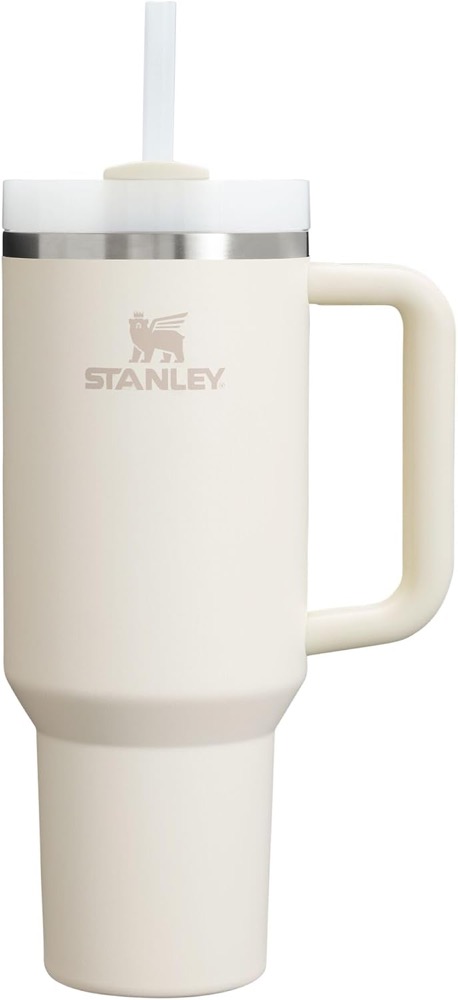
If you want a large insulated cup with a handle and straw, this is the model most people mean by “a Stanley.” Stanley documents a 90% recycled 18/8 stainless steel body, double-wall vacuum insulation, a dishwasher-safe cup and lid, and a narrow base designed for car cup holders.
The material tradeoff: the FlowState lid, straw and straw seal are polymer parts in the drink path, and Stanley does not name those polymers on its product pages. Buy it for convenience and insulation, not as a plastic-free cup. The linked listing is the 40 oz in Cream 2.0; other sizes and finishes are separate listings.
Check price on AmazonFewer plastic contact surfaces · no straw, no insulation
Klean Kanteen Reflect with Bamboo Cap (27 oz)
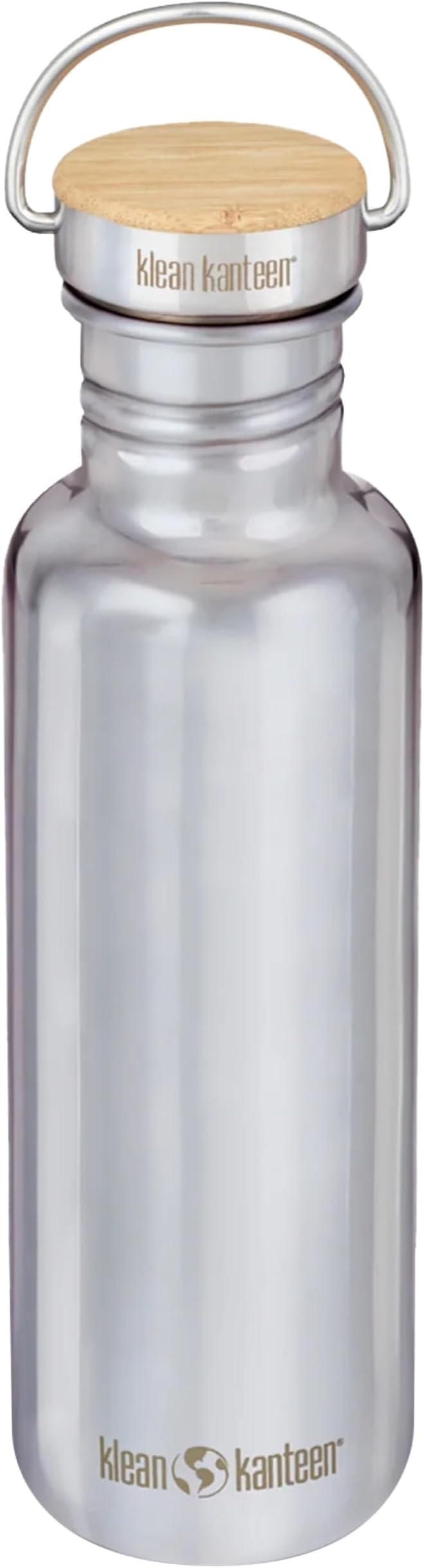
Klean Kanteen lists stainless steel, bamboo and food-grade silicone as the Reflect’s materials, and says the steel underside of its bamboo cap gives the bottle a fully stainless interior. It is the closest swap here if fewer plastic contact surfaces matter more to you than a straw.
Trade-offs: it is single-wall, so it won’t keep drinks cold for hours, and it has no straw or handle. The seal is still silicone, a synthetic polymer, so “plastic-free” here does not mean free of every polymer. Klean Kanteen recommends hand-washing the bamboo cap. Compare insulated options in our stainless steel water bottle guide.
Check price on AmazonComparing brands? See the Owala, Stanley, YETI and Hydro Flask materials table for the differences between specific lids, straws and drinking habits.
Frequently asked questions
Is a Stanley cup plastic-free?
No. Stanley documents a stainless steel cup, but the Quencher’s lid and straw are plastic. Stanley says its contact surfaces are BPA- and BPS-free, which is a chemical claim, not a plastic-free claim.
Do Stanley straws have microplastics?
We found no study that measured particles from a Stanley straw. Research on other plastic straw bottles found particles after simulated sipping and biting, but those results cannot be applied to a Stanley straw. Replace a straw that is cracked or chewed.
Do Stanley cups have lead?
Stanley’s FAQ says the pellet that seals the vacuum insulation at the base contains lead, that a stainless steel layer covers it, and that no lead is on surfaces that touch you or your drink. Stanley says a base cap that comes off in ordinary use is covered by its warranty. This is a separate issue from microplastics, and we have not tested any Stanley product.
Do Stanley water bottles have microplastics?
Stanley bottles also pair steel bodies with plastic caps, stoppers or straw lids. Stanley says its stoppers use BPA-free polypropylene for the outer plastic. We found no Stanley-specific particle test for its bottles.
Does BPA-free mean no microplastics?
No. BPA-free describes one chemical. It does not mean a part contains no plastic, and it is not a particle test result.
Sources and editorial method
We reviewed manufacturer pages and the studies below on October 15, 2026. This is a research-based guide: we have not conducted hands-on product tests or measured particle release or lead from these products. Material lists come from the manufacturers, and we note where a maker does not name a material.
- Stanley 1913: Quencher H2.0 FlowState Tumbler, 40 oz: body material, lid and straw features.
- Stanley 1913 FAQ: steel grade, BPA/BPS statement, #7 code, stopper plastic, and the lead statement.
- Stanley 1913: Quencher replacement straws: BPA-free replacement straws.
- Stanley 1913 EU: Quencher H2.0 FlowState: straw seal and lid description.
- Stanley 1913 Canada: Quencher H2.0 Fluted Tumbler: silicone cover on the FlowState lid.
- Winkler A, et al. (2019). Does mechanical stress cause microplastic release from plastic water bottles? Water Research, 166, 115082.
- Singh T. (2021). Generation of microplastics from the opening and closing of disposable plastic water bottles. Journal of Water and Health, 19(3).
- Burhani D, et al. (2026). Assessing the release of microplastics from reusable plastic water bottles and their exposure to toddlers. Environmental Pollution, 407, 128743.
- FDA: microplastics and nanoplastics in foods.
- Comparison table: Owala FreeSip, Owala FAQ, YETI Rambler 20 oz Tumbler, YETI Rambler Cocktail Shaker Lid, Hydro Flask materials report and Hydro Flask Wide Mouth Stainless Steel Cap.
- Klean Kanteen Reflect with Bamboo Cap: materials and care.