Are Laundry Detergent Sheets Plastic? The PVA Evidence, 11 Brands and PVA-Free Swaps
Almost every sheet and pod is held together by polyvinyl alcohol, a synthetic polymer that dissolves in water. Here is what it is, what each side of the biodegradation fight has actually shown, what 11 brands say about it, and what to use if you would rather skip it.
We may earn a commission when you buy through our links, at no additional cost to you. As an Amazon Associate we earn from qualifying purchases. This is a research-based guide; we have not tested any detergent’s cleaning performance, dissolution or biodegradation.
Most laundry detergent sheets are not plastic-free in the strict sense. Ten of the 11 brands we checked use polyvinyl alcohol (PVA, also written PVOH), a synthetic, water-soluble polymer, in their sheets or pods; the eleventh, Blueland, sells film-free tablets. PVA dissolves in the wash, so it is not a microplastic particle under the definitions the EPA and the European Commission use. The real dispute is what happens after it dissolves: industry-run lab tests say detergent-grade PVA biodegrades during wastewater treatment, a Blueland-funded model estimated that most of it leaves treatment plants intact, and the EPA sided with industry in 2023. Nobody has published measurements from real US treatment plants. If you would rather avoid PVA, a tablet or powder with no film does that, and independent lab tests found sheets clean poorly anyway.
The brand table reports what each company says, not our own analysis. Jump to the brands or the studies.
PVA-free laundry swaps at a glance
| Option | Best fit | What to know |
|---|---|---|
| Blueland Laundry Tablets, Free & Clear | Pod-style convenience without a film | No PVA in the listed ingredients; Blueland also funded the main PVA-critical study. |
| Meliora Laundry Powder, Unscented | The shortest ingredient list | Soda and coconut soap in a paper-and-steel canister; no enzymes. |
| Smart Sheep Wool Dryer Balls, XL 6-pack | Replacing polyester dryer sheets | 100% wool; Consumer Reports has not tested dryer balls. |
These are not ranked by measured cleaning or environmental performance. We chose them for documented ingredients and packaging.
Which laundry sheets and pods contain PVA? 11 brands checked
We classified each brand only from its own website, ingredient list or FAQ, linked in the last column, on October 27, 2026. Where a brand lists PVA but says nothing about whether it is plastic or biodegradable, we wrote No PVA statement found rather than guess. Formulas change, and scents or sizes within one brand can differ.
| Brand / product | Format | What the brand says | Source |
|---|---|---|---|
| Blueland laundry tablets | Uncoated tablet | Says PVA-free. Lists PVA among ingredients it does not use and calls the PVA in sheets a petroleum-based plastic that does not readily biodegrade. Blueland funded the Rolsky and Kelkar study and co-led the 2023 EPA petition. | Blueland product page and FAQ |
| Clean People laundry sheets | Sheet | Lists PVA; no PVA statement found. Polyvinyl alcohol is the first listed ingredient. The brand’s newer tablets (listed July 2026) are sold as plastic-free and list no PVA. | Brand’s Amazon listing; we found no working brand website |
| Dropps laundry pods | Pod | Uses PVOH; says it is not a microplastic. Calls PVOH a synthetic polymer, says its film fully dissolves and biodegrades, and cites OECD 301 results on its own pod film. | Dropps “Are pods plastic?” |
| Earth Breeze sheets | Sheet | Uses PVA; says it is not a microplastic. Describes PVA as the dissolvable film in its sheets and cites the EPA, EU rules and the American Cleaning Institute. | Earth Breeze FAQ |
| ECOS laundry sheets | Sheet | Lists PVA; no PVA statement found. Polyvinyl alcohol (CAS 9002-89-5) appears second, after water. “Plastic-free” on the page refers to the packaging. | ECOS Free & Clear sheets |
| Freddie laundry sheets | Sheet | Lists PVA; no PVA statement found. Polyvinyl alcohol is listed as the film former in every laundry sheet scent. | Freddie ingredients page |
| Grove Co. laundry sheets | Sheet | Lists PVA; no PVA statement found. Polyvinyl alcohol is the first listed ingredient. | Grove Co. sheets page |
| Kind Laundry sheets | Sheet | Uses PVA; says it is not a microplastic. Says PVA is fully biodegradable by acclimated organisms and that the dissolved film does not break into microplastics. Cites outside sources, not tests of its own sheets. | Kind Laundry “What is PVA” |
| Sheets Laundry Club | Sheet | Lists PVA; no PVA statement found. Polyvinyl alcohol appears in the published ingredients. | Sheets Laundry Club product page |
| Tide PODS | Pod | Uses PVA; says it is not a microplastic. Says the film dissolves into individual molecules and biodegrades in standard tests (OECD 301B and 302B). | Tide “PVA in Tide PODS” |
| Tru Earth Eco-Strips | Strip | Lists PVA; no PVA statement found. Polyvinyl alcohol (CAS 25213-24-5) is listed as a structuring agent in every laundry strip. | Tru Earth ingredients page |
Two patterns stand out. No sheet brand we checked claims its sheet contains no PVA, and the brands that do address it all argue it is not a microplastic. Separately, “plastic-free” on a sheet box usually means the packaging. A brand’s position is not a test result in either direction.
What PVA (PVOH) actually is
Polyvinyl alcohol is a synthetic polymer made by hydrolyzing polyvinyl acetate, according to the EPA’s 2023 review. It is not one material. How completely it is hydrolyzed and how long its chains are change whether it dissolves in cold water and how readily it degrades. The EPA says PVA dissolves best in cold water when it is 87 to 89 percent hydrolyzed, while fully hydrolyzed, high-molecular-weight PVA is crystalline and does not dissolve in cold water. The PVA allowed in EPA Safer Choice products is 87 to 89 percent hydrolyzed, with average molecular weights of 70,000 to 215,000 daltons.
That variety matters when you read headlines. PVA identified in environmental plastic surveys has often been fibers, and an industry-authored review argues those likely came from less soluble grades used in fishing lines, not detergent film. Other PVA grades are used in eye drops and as a coating for food-supplement tablets.
Is it plastic? Chemically, it is a synthetic polymer, the family plastics belong to, and critics call it plastic for that reason. Dropps concedes the chemistry but argues the everyday word “plastic” implies something that persists. Both framings are definitional. What matters for the environment is whether dissolved PVA breaks down completely.
Is PVA a microplastic? What each side actually claims
| Question | Critics (Blueland, the 2023 petitioners) | Industry and the EPA |
|---|---|---|
| Is it plastic? | Yes: a synthetic, petroleum-derived polymer used as a plastic film. | A synthetic polymer, but water-soluble and biodegradable, so not plastic pollution. |
| Is it a microplastic? | Blueland says over 75 percent of PVA “persists as microplastic particles.” | It dissolves to single molecules with no solid surface. The EPA says detergent PVA does not meet the European Chemicals Agency’s microplastic definition, and the European Commission excludes soluble materials from its microplastics restriction. |
| Does it biodegrade in treatment plants? | Only with PVA-adapted microbes and time that ordinary plants may not provide. | Yes: it passes standard ready-biodegradability tests using sludge from domestic plants, and was 97 percent removed in a simulated plant. |
| Can it carry pollutants or build up in animals? | It could carry heavy metals and toxic chemicals up the food chain. | The EPA says the cited studies concerned solid microplastics, and a guideline fish study found negligible bioconcentration of a soluble PVA. |
Our read: dissolved detergent PVA is not a particle, so calling it a microplastic stretches the usual definition. Blueland’s “microplastic particles” wording also goes further than the study it funded, which modeled the mass of PVA leaving treatment plants, not particles. But “not a microplastic” does not settle whether the dissolved polymer fully biodegrades. A 2025 review from KTH Royal Institute of Technology treats water-soluble synthetic polymers as their own under-studied pollution category and recommends regulating those that do not biodegrade.
Does PVA biodegrade? The studies, with funding disclosed
Rolsky and Kelkar 2021: the 75 percent figure
The number behind most “pods are plastic” claims comes from Rolsky and Kelkar in the International Journal of Environmental Research and Public Health. Arizona State University researchers combined a 527-person online survey with a literature review to estimate that about 17,200 ± 5,000 metric tons of PVA from laundry and dish pods are used each year in the US, with 10,500 ± 3,000 tons reaching treatment plants. Their model put about 61 percent of that PVA into sewage sludge and about 15.7 percent into treated water, intact: roughly 77 percent in all.
It was a model, not a measurement. It assumed 20 percent degradation in activated sludge and 10 percent in anaerobic digestion, based on studies with sludge not adapted to PVA, and set aside faster rates seen in adapted sludge. The paper says it was funded in part by Blueland, which sells PVA-free products, and one author was also affiliated with Plastic Oceans International, which later co-signed the EPA petition.
The industry response
The American Cleaning Institute, the trade group for US cleaning-product makers, called the model flawed in July 2021. It said the paper overstated pod sales, borrowed wastewater data from India and used worst-case data from PVA grades not designed for detergents.
Its main evidence is Byrne et al. (2021), written by scientists from the European detergent association A.I.S.E., Henkel, Reckitt, Unilever, Procter & Gamble, McBride and Kuraray, a PVA maker. They pooled anonymized ready-biodegradability tests on six commercial pod films run between 2010 and 2018. On average 60.4 percent had biodegraded after 28 days (range 38 to 86 percent). Two films missed the 60 percent mark at 28 days but passed when the test was extended to 60 days. Because of confidentiality, the paper does not identify the films or their individual results.
In April 2023, SciPinion, a commercial firm that convenes expert panels, reported that eight experts rated the Rolsky paper 3.9 out of 10 and that seven of eight thought PVA should pass as readily biodegradable. Its public summary does not name who sponsored the review, and it is not a peer-reviewed study.
The EPA petition and the EPA’s answer
On January 26, 2023, Blueland, Plastic Pollution Coalition and 15 partner groups, including Plastic Oceans International and Beyond Plastics, petitioned the EPA. They asked it to order PVA makers in the Safer Choice program to fund independent health and environmental testing, and to downgrade PVA on the Safer Chemical Ingredients List from a green circle to a gray square in the meantime.
The EPA denied both requests in a response published April 27, 2023. It said the petition relied mainly on one modeling study and ignored other data. It said the model’s low degradation rates came from textile wastewater and starch-PVA food-packaging blends, and that standard tests with unadapted sludge show the needed microbes are already present in ordinary plants. It also judged those tests more conservative than real plants, partly because their inoculum is up to 10,000 times less concentrated. The agency acknowledged that degradation can vary with the PVA structure and the environment. After the petition, Procter & Gamble gave the EPA previously unreleased test data, which the agency posted to the docket.
On toxicity, the EPA reported mixed data: P&G’s tests found low toxicity to algae, invertebrates and fish embryos, while an older published study of a PVA-based detergent raw material suggested high concern for algae and invertebrates. It concluded the PVA grades used in Safer Choice products still meet its criteria because they degrade quickly. When we checked the Safer Chemical Ingredients List on October 27, 2026, both PVA entries (CAS 9002-89-5 and 25213-24-5) still carried a green circle.
Newer studies, 2022 to 2026
Most new biodegradation data come from industry scientists; most new effects data come from university groups.
| Study | Who | Finding | Limits |
|---|---|---|---|
| Menzies et al. 2023 | Procter & Gamble scientists | PVA grades 79 and 88 percent hydrolyzed fully mineralized (over 80 percent) in two standard OECD tests. Exploratory river-water tests found variable numbers of microbes able to degrade the polymers. | Lab screening tests, not plant measurements |
| McDonough et al. 2023 | Authors from P&G, BASF, Henkel, Dow, Kuraray, A.I.S.E. and others; tests at eight labs | PVA 18-88 reached 85 ± 7.4 percent mineralization across labs; slower in river water. | One PVA grade; lab tests |
| McDonough et al. 2024 | P&G scientists | In a lab simulation of a treatment plant (OECD 303A), average removal by biodegradation was 97.4 ± 7.1 percent once removal had stabilized. Acute effect levels for algae, invertebrates and fish embryos were above 1,000 mg/L. | One grade; small lab units, not a full-scale plant |
| Gummel et al. 2025 | P&G with the University of Florence | Dissolved detergent-grade PVA exists as single coiled molecules (radius of gyration about 14 nm), without the solid surface of a nanoplastic particle. | Shows dissolution, not degradation |
| Alonso-López et al. 2021 | University of Vigo; no conflicts declared | In seawater without adapted microbes, pure PVA barely biodegraded in 28 days; glycerol blends reached 5.3 to 8.4 percent. Toxicity to sea urchin larvae was negligible. | Marine conditions, not a treatment plant |
| Nigro et al. 2022 | University of Milan | No significant effects on water fleas or zebrafish embryos at up to 1 mg/L. | Short exposures; standard PVA and fishing bags, not pod film |
| Caorsi et al. 2026 | Universities of Milan and Messina; no conflicts declared | A commercial dishwasher-pod film (70 percent PVA, 30 percent additives) at 0.1 mg/L caused subtle changes in zebrafish embryos; the additives contributed much of the effect. | One film; lab exposure at a concentration the authors consider environmentally relevant |
Two more university papers point the same cautious way. A 2024 Cardiff University study found that PVA and another soluble polymer generally reduced guppy growth over 45 days, with effects depending on dose and time, though it judged PVA the less harmful of the two; the American Cleaning Institute argues the PVA tested was not a detergent grade. A 2025 University of York study catalogued 339 polymers in household products and found fate or toxicity data lacking for several of the 30 with the highest estimated emissions.
What is genuinely unknown
- Real-plant measurements. We found no published measurement of detergent PVA in actual US treatment plant effluent or sludge. Industry pages say none has been detected in the environment; part of the reason is that methods for measuring dissolved polymers in wastewater are still being developed, as a 2024 Cardiff methods paper notes.
- Acclimated microbes. Standard tests use sludge from domestic plants and show PVA degrading. The Rolsky model assumed slower, unadapted rates, and even Kind Laundry describes PVA as biodegradable by acclimated organisms. How fast the microbes in a given plant handle detergent PVA, at its real concentration, retention time and temperature, has not been measured directly.
- Sludge and the sea. Whatever survives treatment would mostly sit in sewage sludge, some of which is spread on farmland, or reach rivers and the sea. Biodegradation in seawater without adapted microbes was very slow in the Vigo study.
- Which PVA is in your sheet. Brands do not publish the grade, and industry test data are anonymized, so a test on one film does not automatically cover another brand’s sheet.
- Effects of the whole product. The 2026 Milan study suggests additives in pod film can matter as much as the PVA itself. Few studies test finished films.
For your own body, this is mostly an environmental question rather than a direct exposure one. For what the research says about microplastics in people, see our evidence review on removing microplastics from the body.
Do detergent sheets work?
Independent testing says not very well. In Consumer Reports’ tests (updated August 2024), sheets from six brands (Earth Breeze, Ecos, Ecowise, Kind, Sheets Laundry Club and Tru Earth) were washed in cold water on a heavy-soil setting against stains such as blood, body oil, coffee and grass. The best sheet, Earth Breeze, scored 29 out of 100 and Tru Earth scored 11, against 84 for the top liquid and 78 for the top pod. CR said the sheets were especially poor on coffee but may be adequate for lightly soiled loads.
By its March 2026 roundup, CR said sheets “test so poorly in our labs that we don’t recommend them.” It also found powders overall weaker than the top liquids and pods, though most were decent on body oil and blood. We did not find CR results for the tablet and powder we pick below, and we have not tested them ourselves.
Dryer sheets: the other laundry sheet
A dryer sheet is a fabric sheet coated with softener, and in the best-known brand that fabric is polyester. Procter & Gamble’s ingredient label for Bounce Outdoor Fresh lists a polyester sheet first, followed by a cationic softener, fatty acids, clay and fragrance. Each sheet is used once and thrown away.
We found no study measuring particles shed by dryer sheets themselves. The better-documented plastic source in the dryer is your clothes: a small 2020 study at two homes found polyester fleece fibers landing up to 30 feet from dryer vents (one author co-owns Cora Ball, a microfiber-catching product). Wool dryer balls replace the single-use polyester sheet; they do not stop clothes shedding. For fibers in the wash, see our washing machine microfiber filter guide, and for airborne fibers indoors, our air purifier guide.
PVA-free detergent and dryer picks
We picked two film-free detergents with full ingredient lists and one dryer-sheet replacement. None has been independently tested for cleaning by a body we could find. Product photos show the linked listings; the header image is an illustration. Use the Amazon buttons for current price and availability.
Pod convenience, no film
Blueland Laundry Detergent Tablets, Free & Clear, 60 count
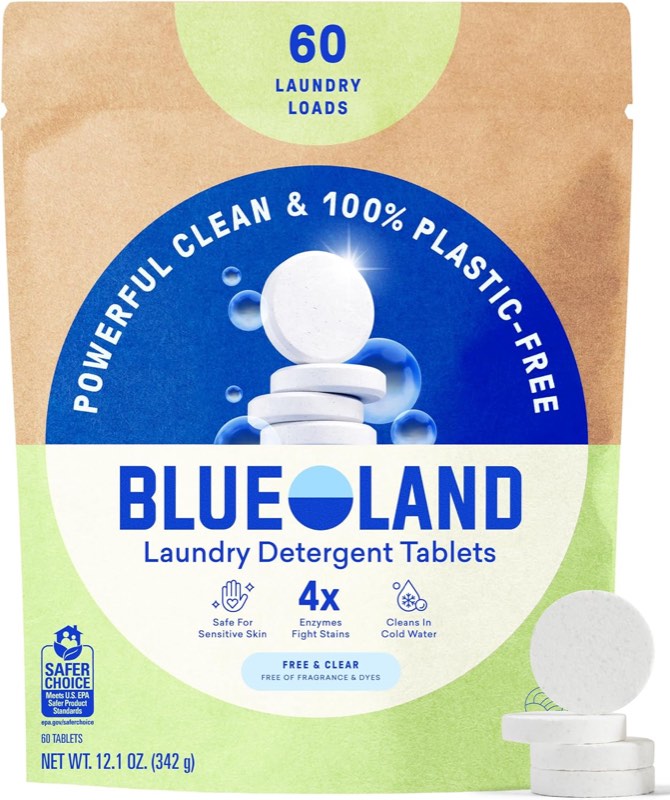
These are pressed tablets with no wrapper: you drop one in the drum, or two for a large load. The listed ingredients are sodium carbonate, citric acid, microcrystalline cellulose, several enzymes, plant-derived surfactants, sodium citrate and silica, with no polyvinyl alcohol and no other synthetic polymer we could identify. Blueland lists PVA among the ingredients it avoids, and the pack carries the EPA Safer Choice label.
Trade-offs: Blueland is not a neutral party. It funded the main PVA-critical study, co-led the EPA petition and campaigns against PVA, so its marketing reflects that position. We found no independent cleaning test of these tablets. Blueland says its refill pouch is designed to be industrially compostable but does not name the pouch material on the product page.
Blueland’s ingredient and packaging details.
Check price on AmazonShortest ingredient list · plastic-free canister
Meliora Laundry Powder, Unscented, canister with scoop
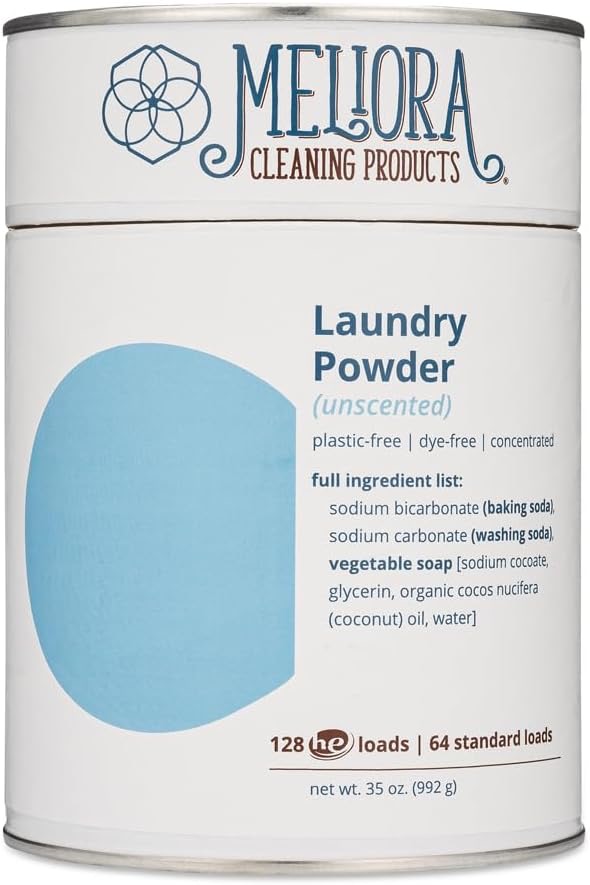
Meliora’s unscented powder is baking soda, washing soda and coconut-oil soap, and nothing else, according to the label. It comes in a paper canister with steel ends and a stainless steel scoop, and Meliora sells paper refills. The company says the canister holds 128 loads in a high-efficiency washer, or 64 in a standard machine.
Trade-offs: There are no enzymes, so protein and food stains may need pre-treating. It is a soap-and-soda formula, a different approach from the synthetic surfactants in most detergents, and we found no independent cleaning test of it. Add it to the drum, not the dispenser drawer, as Meliora instructs.
Meliora’s ingredients and packaging page.
Check price on AmazonReplaces polyester dryer sheets
Smart Sheep Wool Dryer Balls, XL 6-pack
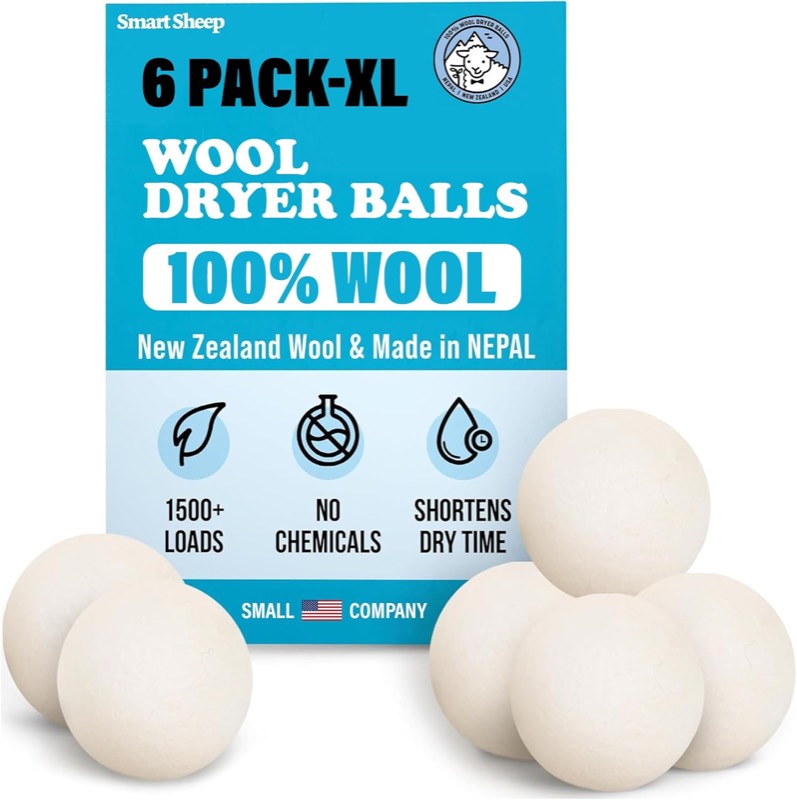
Smart Sheep says its dryer balls are 100% New Zealand wool with no fillers, felted by hand in Nepal. They tumble with your laundry to separate items and are reused for many loads, so there is no single-use polyester sheet to throw away. Smart Sheep suggests three balls for small or medium loads and five or six for large ones.
Trade-offs: Consumer Reports says it has not tested how well wool dryer balls work, and notes they can turn hard and scratchy after a year or two. Claims that they cut drying time come from the maker. CR does not say whether they reduce static; for static it suggests a ball of aluminum foil or air-drying, which also keeps synthetic fibers out of the dryer vent. On Amazon the listing is sold by a third-party seller, Mama Moon Boutique, through the Smart Sheep store.
Smart Sheep’s materials and sourcing.
Check price on AmazonWhat about PVA-free sheets? A few newer brands bind sheets with alginate, a seaweed-derived thickener, instead of PVA. The ones we found on Amazon US were first listed in 2026 and have little track record, so we have not picked one. If you try one, check its ingredient list for polyvinyl alcohol.
How to check a detergent label for PVA
- Look for the names. Polyvinyl alcohol, PVA, PVOH, or the CAS numbers 9002-89-5 and 25213-24-5. ECOS and Freddie list the first number and Tru Earth the second.
- Separate the box from the product. “Plastic-free packaging” describes the carton, as on the ECOS page.
- Ask which biodegradation test. “Biodegradable” alone tells you little. A named test, such as OECD 301B, run on the finished film is more useful.
- Remember that PVA-free is not polymer-free. Many conventional liquids and powders contain other water-soluble synthetic polymers, such as acrylate copolymers, which raise similar questions and have even less data.
- Weigh cleaning too. A detergent that needs rewashing uses more water and energy. Consumer Reports’ sheet results are the strongest independent data we found.
Frequently asked questions
Are laundry detergent sheets plastic-free?
Usually not. All eight sheet brands we checked list polyvinyl alcohol (PVA or PVOH), a synthetic polymer that dissolves in water. Claims such as plastic-free packaging describe the box, not the sheet.
Is PVA a microplastic?
Not under the usual definitions. Detergent-grade PVA dissolves into individual molecules rather than solid particles, and the EPA and European Commission do not treat soluble polymers as microplastics. The open question is whether the dissolved PVA fully biodegrades in real treatment plants.
Are ECOS laundry sheets plastic-free?
ECOS lists polyvinyl alcohol in its laundry sheets, second after water in its full ingredient list. Its plastic-free wording describes the packaging.
Are Freddie laundry sheets plastic-free?
Freddie’s ingredient page lists polyvinyl alcohol as the film former in each laundry sheet scent. We found no statement on its site that the sheet itself is plastic-free.
Do laundry detergent sheets work?
Not as well as liquids or pods in Consumer Reports’ lab tests. Its six tested sheet brands scored 11 to 29 out of 100 on tough stains, against 84 for the top liquid, and in 2026 it said it does not recommend sheets. They may be enough for lightly soiled loads.
Are laundry pods made of plastic?
Pod film is made from the same family of water-soluble PVA as most sheets. Tide and Dropps both confirm PVA films and say they biodegrade and are not microplastics; critics say PVA is a plastic that may not fully break down in treatment plants.
Are there PVA-free laundry sheets?
A few newer brands bind sheets with seaweed-derived alginate instead of PVA. The ones we found on Amazon US launched in 2026 with little track record, so we suggest a film-free tablet or powder instead, and checking any sheet’s ingredient list for polyvinyl alcohol.
Is PVA safe for people?
The dispute is mainly about the environment. The EPA cited reviews finding orally administered PVA has low toxicity and is poorly absorbed, and PVA is used in eye drops and pill coatings. We found no study of human exposure from laundry use, and this is not medical advice.
Sources and editorial method
Reviewed October 27, 2026. This is a research-based guide. We read the papers, regulatory documents and brand pages below, classified each brand only by its own published wording, and checked the exact Amazon listings linked above. We have not tested any detergent, measured PVA in water or sludge, or verified brands’ biodegradation claims in a laboratory. Where we could read only an abstract, we limited our description to what it states.
- Rolsky and Kelkar (2021): Degradation of polyvinyl alcohol in US wastewater treatment plants and subsequent nationwide emission estimate, International Journal of Environmental Research and Public Health 18(11):6027. Funded in part by Blueland. Full text (PMC).
- Byrne et al. (2021): Biodegradability of polyvinyl alcohol based film used for liquid detergent capsules, Tenside Surfactants Detergents 58(2):88–96. Industry authors.
- American Cleaning Institute (July 27, 2021): response to Rolsky and Kelkar, and ACI PVA fact page (updated April 6, 2026).
- SciPinion (April 21, 2023): expert panel public summary on Rolsky and Kelkar. Sponsor not named.
- US EPA: Polyvinyl alcohol; TSCA section 21 petition; reasons for agency response; denial of requested rulemaking, 88 FR 25590 (April 27, 2023). Docket EPA-HQ-OPPT-2022-0923.
- US EPA Safer Chemical Ingredients List, entries for CAS 9002-89-5 and 25213-24-5, checked October 27, 2026.
- European Commission: Regulation (EU) 2023/2055 on intentionally added microplastics, scope note on soluble materials.
- Menzies et al. (2023): Water soluble polymer biodegradation evaluation using standard and experimental methods, Science of the Total Environment 858:160006.
- McDonough et al. (2023): Multi-laboratory evaluation of the reproducibility of polymer biodegradation assessments, Science of the Total Environment 901:166339.
- McDonough et al. (2024): Application of standardized methods to evaluate the environmental safety of polyvinyl alcohol disposed of down the drain, Integrated Environmental Assessment and Management 20(5):1693–1705. Abstract only.
- Gummel et al. (2025): Defining the conformation of water-soluble poly(vinyl alcohol) in solution, ACS Omega 10(18):18840–18847.
- Alonso-López, López-Ibáñez and Beiras (2021): Toxicity and biodegradability of PVA-based materials in marine water, Polymers 13(21):3742.
- Nigro et al. (2022): Are “liquid plastics” a new environmental threat? The case of polyvinyl alcohol, Aquatic Toxicology 248:106200.
- Caorsi et al. (2026): Ecotoxicological effects of PVA-based dishwasher pods, Journal of Hazardous Materials 515:143192.
- Robison-Smith et al. (2024): Water-soluble polymer pollution impacting a freshwater host-pathogen system, Science of the Total Environment 907:168086.
- Nilsson et al. (2025): Environmental concerns on water-soluble and biodegradable plastics, a review, Science of the Total Environment 958:177926.
- Brunning, Sallach and Boxall (2025): Emissions of water-soluble polymers from household products to the environment, Environmental Toxicology and Chemistry 44(2):563–588.
- Tarring et al. (2024): Water-soluble polymers detected, separated and quantified by a GPC/MALDI-TOF method, Environmental Pollution 340:122888.
- Consumer Reports: Do laundry detergent sheets work as well as liquid? (updated August 24, 2024) and Best and worst laundry detergents (updated March 31, 2026).
- Consumer Reports: Why fabric softener is bad for your laundry (updated March 7, 2025), on dryer sheets and wool dryer balls.
- P&G SmartLabel: Bounce Fabric Softener Sheets, Outdoor Fresh, 240 count, ingredients.
- Kapp and Miller (2020): Electric clothes dryers, an underestimated source of microfiber pollution, PLOS ONE 15(10):e0239165.
- Blueland: Are laundry pods and sheets plastic?, source of the “microplastic particles” claim.
- Brand statements, all checked October 27, 2026: Blueland; Clean People (Amazon listing); Dropps; Earth Breeze; ECOS; Freddie; Grove Co.; Kind Laundry; Sheets Laundry Club; Tide; Tru Earth.
- Product materials: Meliora Laundry Powder; Smart Sheep Dryer Balls; Blueland and Meliora ingredient lists also matched the linked Amazon listings.
Keep swapping
Detergent film is a debated, dissolved polymer; synthetic clothing fibers are a measured, solid one. If you want to cut what your laundry sends down the drain, a washing machine microfiber filter targets that larger source. For fibers that end up in indoor air and dust, see our air purifier guide, and for what is known about microplastics inside people, our evidence review.