Do Air Purifiers Remove Microplastics? What HEPA Can and Can’t Do
Indoor air carries plastic fibers and fragments, and HEPA filters are built to catch particles that size. Here is what has been measured, the one real-room test, and the purifiers and vacuums we would consider.
We may earn a commission when you buy through our links, at no additional cost to you. As an Amazon Associate we earn from qualifying purchases. These are research-based recommendations; we have not performed hands-on, filtration or particle-shedding tests.
Probably some, from the air that passes through the filter, but only one study has tested an air cleaner against microplastics in a real room. A HEPA filter under the US standard captures at least 99.97% of 0.3-micron test particles, and the airborne microplastics measured indoors so far are larger than that, so a well-sized HEPA purifier should trap them in principle. A 2026 office study found lower indoor-to-outdoor microplastic ratios with an air cleaner running. No study shows a purifier lowers the plastic in anyone’s body, and plastic fibers also settle into dust, so vacuuming, damp dusting and ventilation matter too. See the studies and product sources.
Already own a decent purifier? Run it continuously in the room you use most and change the filter on schedule. Buying one? The checklist below matters more than any “microplastic” claim on the box.
Air purifiers and HEPA vacuums at a glance
| Option | Best fit | What to know |
|---|---|---|
| Honeywell HPA304 | Rooms up to 465 sq ft | Filtration only, no ionizer; takes three HEPA filters. |
| Winix D360 | Rooms up to 361 sq ft | Filtration only; sold by Winix, not found on Amazon US. |
| Winix 5520 | Rooms up to 392 sq ft, app control | Has PlasmaWave, an electronic add-on the filter doesn’t need. |
| Miele Classic C1 Turbo Team | Bagged vacuuming | Ships with a standard filter; Miele’s HEPA filter is extra. |
| Shark Navigator Lift-Away NV352 | A bagless upright with a sealed-system claim | Empty the dust cup outdoors. |
No consumer model has been tested for microplastic removal, so none of these is ranked that way. We chose purifiers with a maker-documented HEPA filter and an AHAM-verified clean air delivery rate, and vacuums whose makers document HEPA filtration.
What has actually been measured in indoor air
Indoor air studies are small, use different methods and count different particle sizes, so their numbers don’t add up to one exposure figure. Each found plastic particles in indoor air.
| Study | What was sampled | What it found |
|---|---|---|
| Dris et al., 2017 | Two apartments and an office, plus outdoor air and vacuum-bag dust | Indoor fibers 1.0 to 60.0 per m³, outdoors 0.3 to 1.5; about a third of indoor fibers were petrochemical. |
| Vianello et al., 2019 | Three Danish apartments, a breathing manikin, particles 11 µm and up | Microplastics 1.7 to 16.2 per m³ in all samples; 81% polyester. |
| Torres-Agulló et al., 2022 | Homes, workplaces, buses and subways | Homes averaged 4.8 ± 1.6 per m³; mostly polyamide and polyester. |
| Yakovenko et al., 2025 | Seven samples from three Toulouse apartments and five from two cars, particles 1 µm and up | Median 528 per m³ in homes and 2,238 in cars; about 94% were 1 to 10 µm. |
The jump from single digits to hundreds per cubic meter is mostly about method: Yakovenko et al. counted particles down to 1 micron, while Vianello et al. stopped at 11. Both studies are small, and both found microplastics in their blank samples, a reminder of how hard contamination is to control.
Dust is the other half of the picture. Dris and colleagues measured fibers settling at 1,586 to 11,130 per square meter per day and building up in vacuum-bag dust at 190 to 670 per milligram. They judged most too large to inhale, with exposure more likely through swallowed dust, especially for young children. A study of 286 dust samples from 12 countries found PET-based microplastics in every one, and in 32 dust-fall samples from Sydney homes, polyethylene, polyester, polyamide, acrylic and polystyrene fibers were more abundant where carpet was the main flooring.
A 2022 study of 13 human lung tissue samples found 39 microplastics in 11 of them, which supports inhalation as a route of exposure. It did not measure health effects. Lab work on how plastic particles behave is moving fast, as in the October 2026 Nature water study we broke down, but none of it measures what happens in your living room. For the wider picture, see our evidence review on removing microplastics from your body.
Has anyone tested an air purifier against microplastics?
Barely. The one real-room study we found is Yeh and Jung (2026) in Environmental Pollution; its authors say no earlier study had tested air cleaners against indoor microplastics in a real indoor environment. In a series of experiments in an office in Taichung, Taiwan:
- Most particles were fragments of 3 to 25 µm, mainly polyamide (nylon), with or without the air cleaner.
- Indoor-to-outdoor microplastic ratios were lower with the air cleaner running, with windows open or closed, and also when the air conditioner was on.
- Running electric fans alongside the air cleaner gave higher ratios than having no air cleaner at all.
That is encouraging but narrow: one office, one research group, and a measure of air, not of people. We could read only the abstract, which gives neither the filter type nor the size of the reduction. A 2024 review called much of the evidence on filtration and indoor microplastics equivocal. Manufacturer-run chamber tests with latex beads exist, but they aren’t independent and beads aren’t real fibers, so we haven’t relied on them.
Filters clearly do collect plastic. Split air-conditioner filters from living rooms, dormitories and offices held 147 to 2,140 fibers per square centimeter, 27.7% to 35.0% of them plastic, mostly polyester, and filters lined with PET fibers released them back into the air. A Raman imaging study of two indoor air filters estimated 73 to 88,000 plastic fibers per filter over about six months. A loaded filter is a sink and a possible source, so change filters on schedule and don’t shake them out indoors.
What HEPA actually means
The US definition comes from the Department of Energy’s HEPA filter specification: a minimum efficiency of 99.97% when tested with an aerosol of 0.3-micron particles. It was written for glass-fiber filters in DOE nuclear facilities, not home appliances.
The EPA explains that 0.3 microns is the most penetrating particle size, the hardest to catch; larger and smaller particles are trapped even more efficiently. The airborne microplastics measured so far, from 1 µm fragments to long fibers, are larger than that worst case. That is the honest basis for saying HEPA can trap microplastics: particle physics, not a microplastic test.
Home products aren’t held to the DOE test. The EPA’s residential air cleaner summary says there is no widely accepted definition of HEPA performance in consumer products, although filters sold as HEPA usually perform at very high levels. Read the labels accordingly:
- “HEPA-type,” “HEPA-like,” “HEPA-grade.” No standard defines these. Treat them as “not claiming HEPA.”
- “True HEPA.” Usually a claim to the 99.97% at 0.3 µm benchmark; check who tested it. Levoit’s Core 300S-P page used “3-Stage Filtration” when reviewed October 27, 2026. A proposed class settlement concerns “True HEPA,” “HEPA” and “H13” claims on Levoit Core and EverestAir purifiers and filters bought in the US from August 29, 2019 to August 4, 2023. Vesync denies wrongdoing; the notice says the court has not decided the allegations. The administrator’s published claim deadline was November 3, 2026, which has passed. Check the official settlement website for current case updates.
- Other numbers. Winix rates its D360 filter at 99.99% down to 0.003 µm on a vehicle cabin-filter test, Dyson cites the European H13 class, and Blueair’s 99.97% applies to an electrostatic-plus-mechanical system. Different tests; don’t compare them directly.
Above all, a filter’s efficiency is not the machine’s. Air can leak around a filter, and a purifier cleans only what it pulls in. Honeywell’s own footnote says there is no guarantee that all of the air in a room will pass through the filter. That is why CADR matters more.
CADR and room size: the numbers to compare
The clean air delivery rate, or CADR, measures how much particle-free air the whole purifier delivers, in cubic feet per minute. It comes as three figures, smoke, dust and pollen, which the EPA’s air cleaner guide says stand in for small, medium and large particles. None is measured on microplastics.
- Size it to the room. AHAM’s rule of thumb is a smoke CADR of at least two-thirds of the floor area: a 120 sq ft room needs at least 80. The EPA’s chart matches, from 65 cfm for 100 sq ft to 390 cfm for 600 sq ft, assuming 8 ft ceilings. Go bigger for high ceilings or open plans.
- Prefer verified numbers. AHAM Verifide models have their CADR checked by an independent lab and appear in AHAM’s public directory. A CADR printed only by the maker is harder to check.
- Run it, and mind the fan. The EPA notes that higher speeds and longer run times filter more air. In the office study, electric fans running alongside the air cleaner pushed indoor microplastic ratios up.
Heavier fibers tend to settle before a purifier can draw them in. The ones on the floor are a cleaning job.
Avoid ozone generators, and know what an ionizer is
Some “air purifiers” make ozone on purpose. The EPA says inhaled ozone can damage the lungs, that ozone does not remove particles such as dust and pollen, and that no federal agency has approved these devices for occupied spaces. An ozone generator can’t remove microplastics, so skip it.
Ionizers, electrostatic precipitators, plasma and UV features aren’t built to make ozone, but the EPA notes they may emit some. Air cleaners sold in California must be certified by the state’s Air Resources Board, which labels each model “mechanical” (filtration only, no ozone or ions) or “electronic” (tested to emit no more than 0.050 parts per million of ozone). The filter is what catches microplastics, so we favor mechanical units, or electronic features you switch off.
The plastic in the purifier
An air purifier is mostly a plastic box. The EPA lists bonded glass fibers, synthetic fibers, cellulose, wool felt and cotton-polyester blends among the media used in pleated filters. Filters are replaced, often yearly for the HEPA stage and sometimes sooner for carbon, and the old ones go in the bin. We found no study measuring particles shed by a purifier’s own housing or new filter, and a plastic part is not a measured exposure. Still, a purifier adds plastic to your home and to landfill: it is a trade-off, not a plastic-free swap. Bag used filters gently rather than tapping them clean indoors.
Dust, vacuums and cheaper steps
Because so much plastic settles, cleaning is where most people can make a dent, with or without a purifier.
- Vacuum with a machine that holds what it picks up. A study of 21 vacuum cleaners found particle emissions varied enormously, and the differences were largely not explained by dust bags, exhaust filters, price or age. A HEPA filter helps only if air can’t leak around it, which is what “sealed system” claims are about. Bagged machines also spare you tipping an open bin.
- Damp-dust and wet-mop. A damp cloth picks dust up instead of flicking it into the air. No study has measured this for microplastics; it is reasoning from how dust behaves. Microfiber cloths are usually synthetic, so cotton is a sensible choice.
- Ventilate. The EPA’s first advice is to reduce sources and bring in outdoor air; filtration doesn’t replace either. Dris measured outdoor fiber levels well below indoor ones.
- Handle laundry lint. A study of a vented dryer drying a polyester fleece blanket measured 1.6 ± 1.8 of the blanket’s blue fibers per m³ while it ran, against 0.17 ± 0.27 in the room blank. Clean the lint screen into a bag, vent dryers outdoors and air-dry fleece. For the washer, see our washing machine microfiber filter guide and our look at detergent sheets and PVA.
- Consider fabrics when you replace them. Polyester dominated the plastics in Vianello’s apartments, and the Sydney homes with carpet had more plastic fibers. Natural-fiber rugs and throws shed lint that isn’t plastic.
Three air purifiers worth considering
We chose these for a maker-documented HEPA filter, an AHAM-verified CADR and how CARB classes their features. Product photos show the linked models; the header image is an illustration.
Our first choice · large rooms, filtration only
Honeywell Allergen Plus HEPA Air Purifier, HPA304, White
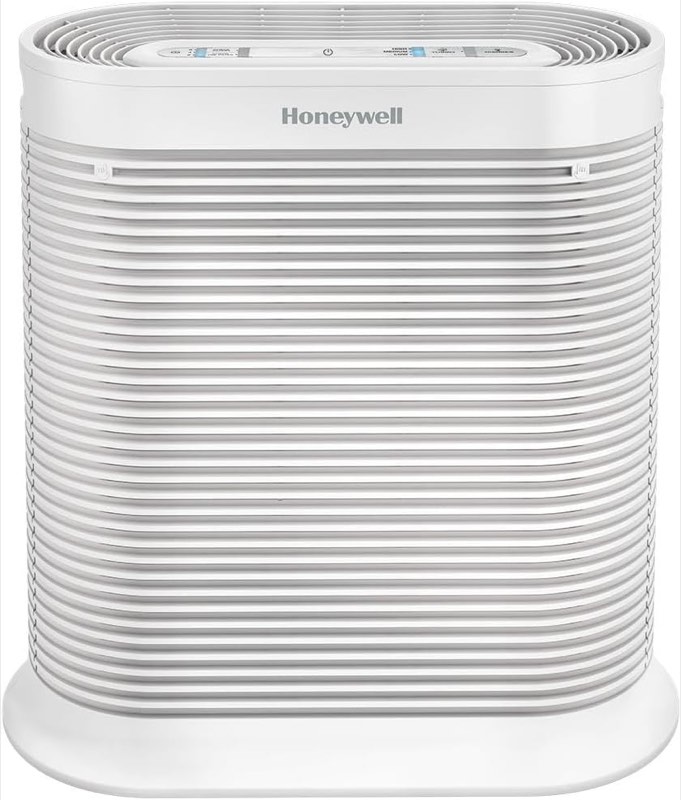
The HPA304 is the white version of Honeywell’s long-running HPA300 series: a fan and filters, with no ionizer. AHAM verifies it for 465 sq ft, with CADRs of 300 for smoke, 320 for dust and 300 for pollen. Honeywell says its R filters capture up to 99.97% of particles 0.3 microns and larger from the air that passes through them, and CARB lists the series as mechanical under the name “True HEPA Allergen Remover.”
It is our first choice because it pairs the largest verified room size here with filtration only. Honeywell’s current pages say HEPA rather than True HEPA; we found no explanation for the change.
Trade-offs: It takes three HEPA R filters plus an odor-reducing A pre-filter, so replacements and plastic add up. The housing is plastic. Check that the Amazon listing says HPA304.
Honeywell’s HPA304 page · AHAM directory.
Check price on AmazonFor mid-size rooms · no ionizer
Winix D360 3-Stage True HEPA Air Purifier
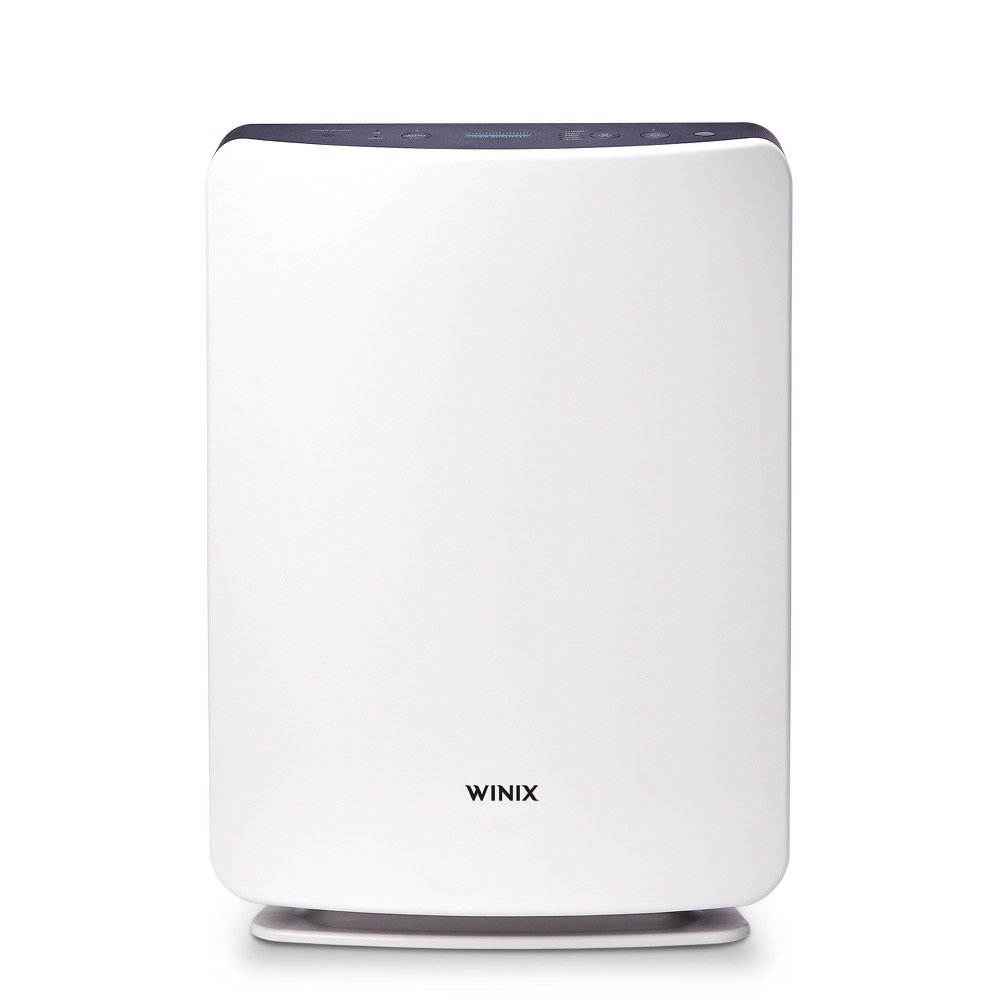
The D360 is Winix’s filtration-only model: a washable fine-mesh pre-filter, an activated carbon filter and a True HEPA filter, with no PlasmaWave. AHAM verifies it for 361 sq ft, with CADRs of 233 for smoke, 232 for dust and 238 for pollen, and CARB lists it as mechanical. Winix gives the HEPA filter a 12-month life and the carbon filter three months.
Winix’s 99.99% down to 0.003 microns claim comes from an independent lab report using a vehicle cabin-filter test standard, not the DOE method, so treat it as the maker’s figure.
Trade-offs: We didn’t find the D360 on Amazon US, so this link goes to Winix and earns us nothing. Winix’s spec table lists slightly different CADRs from AHAM’s directory; we used AHAM’s. The carbon filter needs changing four times as often as the HEPA filter.
See the D360 at WinixFor app control · PlasmaWave optional
Winix 5520 Air Purifier, Black
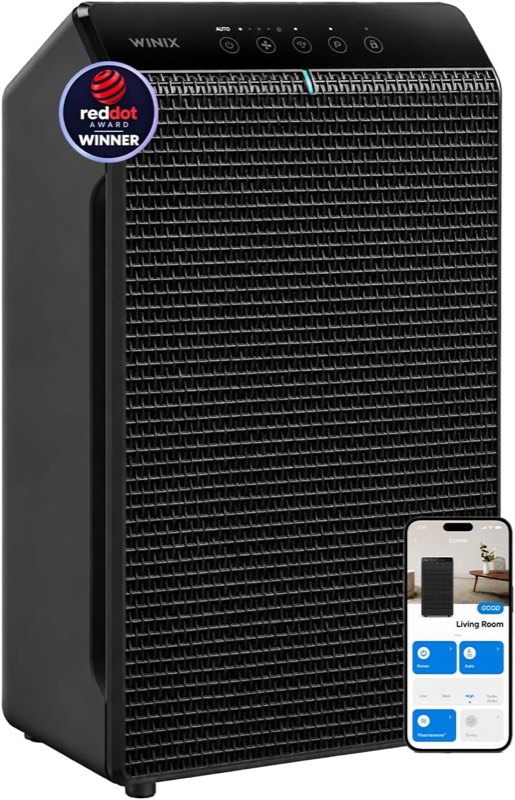
The 5520 is part of Winix’s 55 series; Winix’s Amazon listings describe sibling models as the new generation of its popular 5500-2. AHAM verifies it for 392 sq ft, with CADRs of 253 for smoke, 252 for dust and 247 for pollen. Winix says the True HEPA filter removes 99.99% of particles at 0.1 to 0.3 microns, tested to the IEST-RP-CC0007 method, and rates the HEPA and AOC carbon pellet filters for 12 months each. It adds Wi-Fi and app control.
It also has PlasmaWave, which CARB classes as electronic. Winix reports an eight-hour average ozone level of 0.22 parts per billion in a 30 m³ test chamber, far below CARB’s 50 ppb limit. Catching microplastics doesn’t depend on it; the HEPA filter does that work.
Trade-offs: For filtration only, check the manual for how to switch PlasmaWave off, or choose the D360. The housing is plastic, and the app makes it another connected device.
Check price on AmazonTwo vacuums with HEPA filtration
We looked for HEPA filtration the maker documents and a design that keeps dust inside. Neither maker publishes a microplastic test, and the 21-vacuum study shows filters alone don’t predict emissions.
Our first choice · bagged, with a HEPA upgrade
Miele Classic C1 Turbo Team PowerLine, Tech Blue
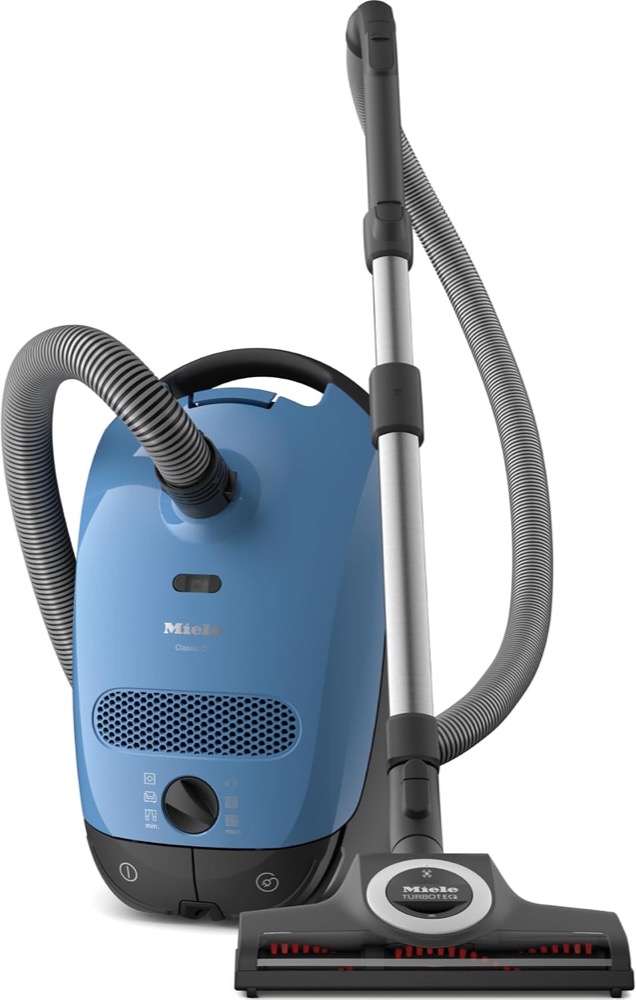
A bagged canister keeps dust in a closed bag you lift out and bin, rather than a bin you tip. Miele’s C1 filters in three stages: the FilterBag, a motor protection filter and an exhaust filter. The Turbo Team version adds Miele’s TurboTeQ turbo brush, and Amazon lists it for hard floors and low to medium pile carpet.
The key detail: Miele’s product sheet shows it ships with the standard AirClean exhaust filter, not HEPA. Miele sells the HEPA AirClean SF-HA 30 for the Classic C1, rated HEPA class 13 under EN 1822 at 99.95%, to be changed once a year. Buy it with the vacuum if HEPA is why you chose it.
Trade-offs: Bags and filters are ongoing purchases, and the body is plastic. Miele’s current US pages for the C1 don’t use the phrase “sealed system,” so we can’t point to a Miele sealing claim for this model.
Miele’s C1 Turbo Team product sheet (PDF).
Check price on AmazonFor a bagless upright · sealed-system claim
Shark Navigator Lift-Away NV352, Lavender
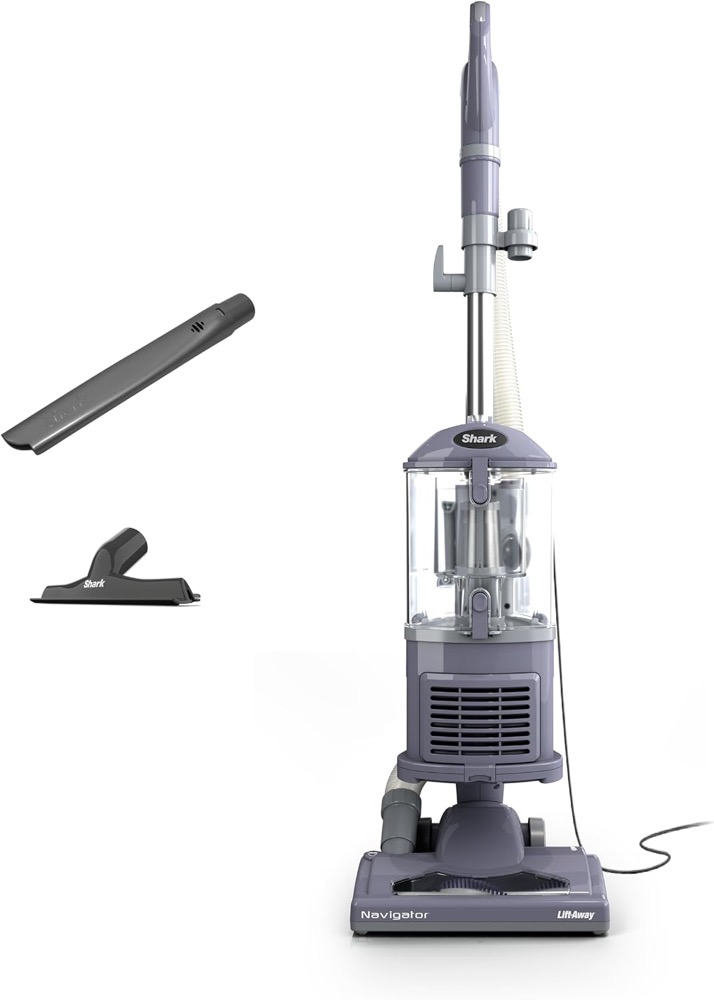
The NV352 is an upright with a detachable Lift-Away pod for stairs and furniture. SharkNinja describes a completely sealed system with a HEPA filter, branded Anti-Allergen Complete Seal, and lists washable HEPA and foam filters and a 1.04 L dust cup. The Amazon listing says the seal and HEPA filter trap 99.9% of dust and allergens inside the vacuum, a manufacturer claim with no test method given.
Trade-offs: Bagless means emptying an open cup, which can put fine dust back in the air, so empty it outdoors into a bin bag. Wash the filters as the manual directs and dry them fully. The Amazon bullet points mention features SharkNinja doesn’t list for the NV352, so rely on SharkNinja’s page for specs.
Check price on AmazonWhat about Coway, Levoit, Blueair and Dyson?
These are popular for good reasons. Here is what we could verify, and why they aren’t on our list.
| Model | What checks out | Why it isn’t a pick |
|---|---|---|
| Coway Airmega AP-1512HH (Mighty) | Coway’s manual describes a True HEPA filter and an ionizer with its own on/off button. Coway lists CADRs of 233, 246 and 240 for 361 sq ft. | No Coway model appeared in AHAM’s directory when we searched, and CARB lists the AP-1512HH as electronic. If you own one, you can switch the ionizer off. |
| Levoit Core 300S and Core 400S | AHAM-verified for 223 sq ft (Core 300S-P) and 358 sq ft (Core 400S). | The October 27 product-page review found no True HEPA claim. Earlier HEPA labeling is addressed in the proposed settlement above. |
| Blueair Blue Pure 211i Max | AHAM-verified for 674 sq ft, with a smoke CADR of 435. | Its 99.97% claim is for an electrostatic-plus-mechanical system tested on PM2.5, and CARB lists it as electronic. |
| Dyson Purifier Cool TP07 | Dyson says the HEPA filter captures 99.97% of particles down to 0.3 µm and the whole machine is sealed to H13; CARB lists it as mechanical. | Dyson uses its own POLAR room test, and we found no Dyson model in AHAM’s directory to size it against. |
Frequently asked questions
Do air purifiers remove microplastics?
They can capture airborne microplastic particles that pass through a high-efficiency filter, but the evidence in homes is thin. The only real-room study we found, in an office in Taiwan, reported lower indoor-to-outdoor microplastic ratios with an air cleaner running. No study has shown that a purifier lowers the microplastics in anyone’s body.
Do HEPA filters remove microplastics?
In principle, yes. A HEPA filter under the US Department of Energy standard captures at least 99.97% of 0.3-micron test particles, and the airborne microplastics measured indoors so far have been larger than that. The filter only cleans the air that reaches it, so room size, airflow and filter changes matter as much as the label.
Does a Dyson air purifier remove microplastics?
No study has tested a Dyson purifier against microplastics. Dyson says the HEPA filter in models such as the Purifier Cool TP07 captures 99.97% of particles as small as 0.3 microns and that the whole machine is sealed to the HEPA H13 standard, so it should capture airborne particles in the measured microplastic size range from the air that passes through it. Dyson rates coverage with its own POLAR test, and we found no Dyson model in AHAM’s CADR directory.
What is the best air purifier for microplastics?
No purifier is rated for microplastics. Look for a maker-documented HEPA filter, an AHAM-verified CADR that matches your room, mechanical filtration without an ionizer you can’t switch off, and filters you will actually replace. On those criteria we picked the Honeywell HPA304 for large rooms and the Winix D360 and Winix 5520 for mid-size rooms.
Do HEPA vacuums help with microplastics?
They are a sensible way to pull plastic fibers out of household dust, but no study has measured whether a HEPA vacuum lowers microplastic exposure. A study of 21 vacuums found large differences in the particles they blew back into the room that were largely not explained by bags, exhaust filters, price or age, so a well-sealed machine and careful emptying matter too.
Do furnace and HVAC filters remove microplastics?
They trap some. Studies of air-conditioner filters found plastic fibers building up on them. The EPA suggests a MERV 13 or higher filter if your system can handle it, but central systems filter air only while the fan runs, which in many homes is less than a quarter of the time in heating and cooling seasons.
Can air purifiers remove nanoplastics?
The EPA says HEPA filters trap particles smaller than 0.3 microns even more efficiently than 0.3-micron particles, so nanoscale particles that reach the filter should be captured well. But nanoplastics in indoor air have not been reliably measured yet, so there is no direct evidence either way.
Sources and editorial method
The settlement timing was checked November 4, 2026. Product specifications, directory checks and the research review below are dated October 27, 2026.
Researched October 27, 2026. We read the studies and standards below, checked each purifier in AHAM’s Verifide directory and CARB’s certified air cleaner list, read the manufacturers’ product pages, sheets and manuals, and checked the exact Amazon variants linked above. This is a research-based buying guide, not a laboratory comparison. We have not tested these purifiers or vacuums, measured particle capture or emissions, or evaluated noise and running costs. For Yeh and Jung (2026) we could access only the abstract.
- Yeh and Jung (2026): Impact of air cleaner on indoor microplastic pollution in a real indoor environment, Environmental Pollution, 397, 128003. PubMed.
- Yakovenko et al. (2025): Human exposure to PM10 microplastics in indoor air, PLOS ONE, 20(7), e0328011.
- Vianello et al. (2019): Simulating human exposure to indoor airborne microplastics using a Breathing Thermal Manikin, Scientific Reports, 9, 8670.
- Dris et al. (2017): A first overview of textile fibers, including microplastics, in indoor and outdoor environments, Environmental Pollution, 221, 453–458.
- Torres-Agulló et al. (2022): Airborne microplastic particle concentrations and characterization in indoor urban microenvironments, Environmental Pollution, 308, 119707.
- Zhang, Wang and Kannan (2020): Microplastics in house dust from 12 countries and associated human exposure, Environment International, 134, 105314.
- Soltani, Taylor and Wilson (2021): Quantification and exposure assessment of microplastics in Australian indoor house dust, Environmental Pollution, 283, 117064.
- Jenner et al. (2022): Detection of microplastics in human lung tissue using μFTIR spectroscopy, Science of the Total Environment, 831, 154907.
- Chen et al. (2022): Air conditioner filters become sinks and sources of indoor microplastics fibers, Environmental Pollution, 292, 118465.
- Fang et al. (2024): Characterising microplastics in indoor air: Raman imaging analysis of air filter samples, Journal of Hazardous Materials, 464, 132969.
- Gaylarde, Baptista Neto and da Fonseca (2024): Indoor airborne microplastics: human health importance and effects of air filtration and turbulence, Microplastics, 3(4), 653–670.
- Knibbs et al. (2012): Vacuum cleaner emissions as a source of indoor exposure to airborne particles and bacteria, Environmental Science & Technology, 46(1), 534–542.
- O’Brien et al. (2020): Airborne emissions of microplastic fibres from domestic laundry dryers, Science of the Total Environment, 747, 141175.
- US Department of Energy: DOE-STD-3020-2015, Specification for HEPA filters used by DOE contractors — HEPA definition and scope.
- EPA: What is a HEPA filter?; EPA: Guide to air cleaners in the home; EPA: Residential air cleaners, a technical summary (3rd ed., PDF); EPA: Ozone generators that are sold as air cleaners.
- AHAM Verifide: Air filtration standards and the two-thirds rule; AHAM directory of certified room air cleaners, searched October 27, 2026.
- California Air Resources Board: List of CARB-certified air cleaning devices — mechanical and electronic classifications and the 0.050 ppm ozone limit.
- Sen et al. v. Vesync (US) Corp. settlement website — scope, dates and Vesync’s denial.
- Manufacturer pages: Honeywell HPA304; Winix D360; Winix 5520; Miele Classic C1 Turbo Team product sheet and HEPA AirClean SF-HA 30; SharkNinja NV352; Coway AP-1512HH; Levoit Core 300S-P; Blueair Blue Pure 211i Max; Dyson Purifier Cool TP07.
- The Coway True HEPA and ionizer-button details come from the AP-1512HH owner’s manual. The Shark 99.9% figure comes from the linked Amazon listing. We did not independently test those claims.
Keep swapping
Air is one route; water and food are others. Compare water filters with documented microplastic claims, see how laundry adds fibers in our washer filter guide, and see our look at the “credit card of plastic a week” claim.