Plastic-Free Mixing Bowls: Stainless Steel vs Glass
Choose a bowl for the food you prepare. Compare the whole assembly, the working space and the care instructions.
As an Amazon Associate we earn from qualifying purchases. This guide compares manufacturer documents and care instructions. We have not tested these bowls for mixing performance, durability or particle release.
For a plastic-free mixing bowl, start with plain stainless steel or an undecorated glass bowl, then check the base, rim and any lid. A steel interior does not mean the whole bowl is metal. Choose a shape and size that give your whisk, spoon or scraper room to work, rather than buying the set with the most pieces.
This is a guide to food preparation: stirring batter, folding ingredients and organizing a recipe. For containers whose main job is holding leftovers and reheating them, use our glass food-storage guide.
Steel or glass: choose for the task
On small screens, scroll the table sideways to read all columns.
| Format | Useful for | Check before choosing |
|---|---|---|
| Plain steel bowl | A larger batch or room to toss and fold ingredients | Diameter, depth, rim, base stability and exact tool permissions |
| Nesting glass bowls | Several small prep tasks and seeing ingredients through the sides | Each bowl's capacity, lifting weight and damage or temperature limits |
| Steel with an outer shell or grip | Someone who values an insulated exterior or non-slip base | The shell may be plastic; a steel contact surface is a narrower claim |
These are different construction choices, not a ranking of the safest material. Changing a bowl replaces that contact surface; it does not establish a measured reduction in your overall microplastic exposure.
Read beyond “stainless steel” on the label
Inspect four parts: the inside, the outside, the base and the cover. A listing can accurately describe the interior as steel while using another material underneath or around it. If your preference excludes silicone and rubber as well as plastic, check those parts explicitly.
For example, OXO's white three-piece set, SKU 1107600, has a stainless interior, a plastic exterior and a non-slip base, according to the maker. OXO describes the shell as insulation for your hands. It is a useful example of why the product name alone cannot establish an all-metal assembly; we do not list it as a fully plastic-free choice.
Likewise, count lids separately. A lid can make a bowl more convenient for storage, but its material and cleaning instructions need their own check. If you only need a mixing vessel, an unlidded bowl avoids buying a cover you will rarely use. Packaging and optional accessories are separate from the bowl itself.
Two bowl options for different routines
One larger bowl · plain steel construction
Winco MXB-500Q, 5-quart economy mixing bowl
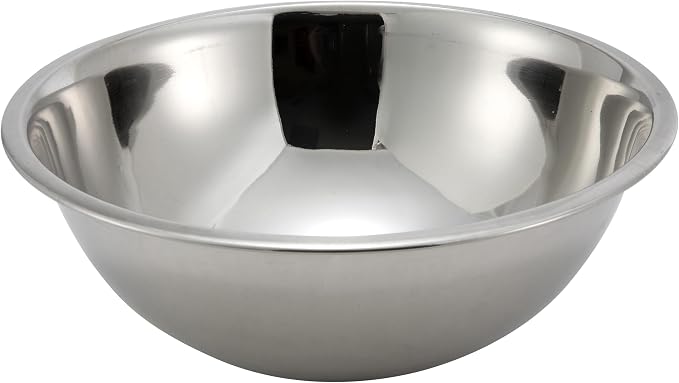
Product listing photo: the single 5-quart stainless steel option, checked November 2, 2026.
Winco specifies stainless steel, a reinforced rim, an 11.5-inch diameter and a 3.5-inch height. It lists dishwasher cleaning. The specification describes the bowl without a fitted lid or an added grip base; confirm the same model and contents when shopping.
The Amazon.com listing checked for this comparison is ASIN B001VZ6ONK with 5 Quart, Stainless Steel and Number of Items: 1 selected. Its description identifies MXB-500Q. Other sizes and multipacks share the listing, so check the selected option before ordering.
Consider it for: a prep routine that needs one larger, open vessel. Its listed dimensions make it worth comparing when access across the top matters more than tall sides. This is an inference from its shape, not our result from whisking or tossing food.
Tradeoff: five quarts is nominal capacity, not five quarts of batter you can vigorously stir without spilling. Allow working room. Check whether the footprint fits your cabinet, sink and scale. The page does not specify this model's steel grade or gauge, so we do not label it 18/8 or borrow those details from another Winco range.
Three smaller bowls · visible contents
Pyrex 3-piece Mixing Bowl Set, SKU 1118441
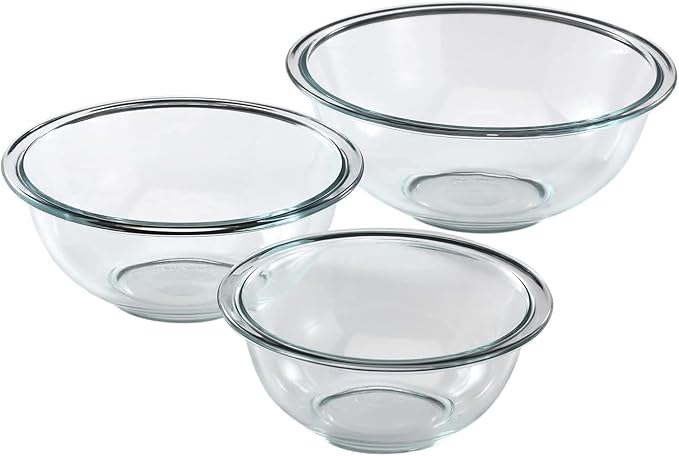
Product listing photo: the 1-, 1.5- and 2.5-quart Essentials set, checked November 2, 2026.
Pyrex lists one each of 1-, 1.5- and 2.5-quart tempered-glass bowls. The largest is approximately 10 inches across and 4 inches high. These nest, and the set contents list three bowls without lids.
The Amazon.com option checked is 3 PC Mixing Bowl Set, ASIN B00LGLHUA0. Its item details identify model 1118441 and the same three capacities. Check those details before ordering: the newer tinted Colors set linked on the page is a different product.
Consider it for: a recipe with separate ingredients or several smaller hand-mixing tasks. Clear sides let you see the mixture without lifting the bowl. Three vessels give you more separation; they do not give you a single five-quart working space.
Tradeoff: the largest bowl has half the nominal capacity of the Winco above. Glass also needs protection from impact and abrupt temperature changes. The maker permits dishwasher and microwave use subject to its instructions; do not translate that into permission for every heating method.
The product page identifies tempered glass without specifying its underlying chemistry. Pyrex's FAQ says the brand makes both soda-lime and borosilicate products. The Amazon listing labels this set borosilicate, but that does not resolve the missing manufacturer confirmation. We do not infer glass chemistry from the brand name or logo.
Capacity is only the first measurement
Start with a recipe you repeat, then consider its busiest mixing step. Folding a loose salad, stirring a thick dough and whisking a small dressing need different amounts of room around the ingredients. There is no universal bowl-size rule that covers all three.
- Depth and width: compare both dimensions. A wide opening gives access across the mixture; taller sides change how far a tool must reach. The same advertised capacity can come in different shapes.
- Rim and grip: think about how you hold the bowl while stirring and how you will pour from it. We have not tested the rims for comfort or grip.
- Scale fit: a broad bowl can hide a scale's display. Check platform space and the combined weight of the bowl and ingredients against the scale's limit.
- Storage: measure the largest diameter and the complete nested stack, including any covers. Nesting is useful only if the stack fits the cupboard you will actually use.
One large bowl plus a smaller bowl you already own may serve you better than replacing everything with a matching set. If you frequently need several bowls at once, compare their individual sizes rather than the bundle's total volume.
Match the tool and the care routine
Check both the bowl's instructions and the appliance manual before using an electric hand mixer. A general mixing-bowl label is not a compatibility statement for every beater or appliance. A loose prep bowl is also not a replacement for a stand mixer's specified locking bowl.
For hand mixing, our spatula and utensil guide distinguishes wood, steel and silicone contact surfaces. A flexible scraper and a rigid spoon do different jobs; choose tools that the bowl maker permits rather than assuming one material suits everything.
Pyrex's care guidance prohibits striking utensils against its glassware and using pieces that are chipped, cracked or severely scratched. It also warns against abrupt temperature changes, adding liquid to hot glass and placing hot glass on wet or cool surfaces. Follow the full directions for heating and cleaning, including keeping pieces from knocking together in the dishwasher.
The Winco specification establishes dishwasher permission, not a microwave or stovetop rating. This guide recommends it as a prep bowl, not as a pan. For a vessel intended for direct cooking heat, use our cookware guide and the exact product's instructions.
Plastic-free mixing-bowl questions
Are stainless-steel mixing bowls completely plastic-free?
Some are plain steel, while others add plastic shells, grip bases or lids. Read the complete construction description. OXO's white steel mixing-bowl set, for example, has a plastic exterior.
Is glass better than steel for mixing?
It depends on the task. Glass lets you see through the sides; plain steel offers another construction without a breakable glass body. Compare size, shape, handling and tool instructions rather than assuming one material wins every job.
Does a five-quart mixing bowl hold five quarts while whisking?
Advertised capacity is not a guarantee of usable mixing space. Leave room for the tool, movement and expansion of the mixture. The amount of spare room depends on the recipe and mixing method.
Can I use any glass mixing bowl in the microwave?
No. Use only a bowl whose specific instructions permit microwave use, following its temperature-change, food and cover restrictions. A glass appearance or brand name is not enough to establish permission.
Sources and comparison method
Manufacturer pages and care guidance were reviewed November 1, 2026; the two makers' product specifications were rechecked November 2. The cited model numbers, dimensions and use permissions come from those sources. Our task and fit comparisons are editorial judgments from the documented designs, not hands-on tests. Both Amazon.com variants and product photographs were checked November 2, and affiliate links were generated through Amazon Associates SiteStripe for those exact options. Prices and stock can change.
We have no product-specific evidence that either bowl eliminates particles or produces a health benefit. The useful choice here is a documented material and a bowl that fits your preparation routine. Keep storage and reheating decisions separate with the food-storage guide.