Non-Toxic Cookware: Is Ceramic Safe? What to Use Instead of Nonstick
Compare cooking surfaces, handles and lids, then choose a pan for the job. Plastic-free wording and non-toxic claims need more detail than a material name.
We may earn a commission when you buy through our links, at no additional cost to you. As an Amazon Associate we earn from qualifying purchases. These are research-based recommendations; we have not cooked with, lab-tested or measured particle release from these pans.
For cookware without a PTFE cooking surface, compare seasoned cast iron, carbon steel, stainless steel and enamel. Enamel is a bonded coating, and seasoned iron has a layer of baked-on oil; neither should be described as bare metal. For a plastic-free pan, check the handle, lid and accessories as well as the cooking surface. A material label alone does not establish a health benefit. See the studies and product sources.
You don’t need to replace everything at once. One cast iron or carbon steel skillet covers most nonstick jobs, and stainless or enamel handles acidic sauces. This is a research-based guide; we did not test any pan ourselves.
Plastic-free pans: check the whole assembly
Decide what you want to exclude before comparing products. Avoiding a PTFE cooking surface, avoiding synthetic handle coatings and choosing an entirely metal assembly are different requirements. A pan can meet one without meeting the others.
- Cooking surface: distinguish bare stainless steel, seasoned iron, porcelain enamel and proprietary ceramic nonstick. Lodge describes seasoning as polymerized cooking oil. It is a surface layer, but it is not PTFE.
- Handles and lid: check coatings, knobs and grips separately. A metal pan body does not identify those parts, and the most restrictive component can limit oven use.
- Accessories: an optional handle sleeve, lid seal or storage protector needs its own materials and care information. Do not assume it can go into the oven because the pan can.
For a skillet, start with the food you fry and the maintenance you will do. For a saucepan or stockpot, lid construction, capacity and simmering needs may matter more than easy release. The comparison below keeps those decisions on one page; the five products are not all presented as entirely plastic-free.
Non-toxic cookware at a glance
On small screens, scroll the comparison sideways to read every column.
| Pan | Surface and other parts | Best fit | What to know |
|---|---|---|---|
| Lodge 10.25-inch skillet | Seasoned cast iron | Searing, roasting, everyday frying | Heavy; keep acidic cooking short. |
| de Buyer Mineral B, 11-inch | Carbon-steel body; epoxy-coated handle | Seasoned stovetop frying | Not an entirely bare-metal assembly; brief oven use only. |
| All-Clad D3 3-quart saucepan | Stainless surface and lid; aluminum core | Sauces, grains, boiling | Check the supplied model's care instructions. |
| Lodge Essential Enamel, 6-quart | Porcelain enamel; stainless lid knob | Braises, soups, tomato sauce, bread | Coated, not bare iron; protect the enamel. |
| Caraway 10.5-inch fry pan | Proprietary ceramic coating on aluminum | Low-heat eggs with easy release | Maker's PFAS-free claim does not make it uncoated. |
Not ranked by measured exposure or health benefit; choose by the cooking you do.
Do nonstick pans release microplastics?
Polytetrafluoroethylene (PTFE) is the plastic used in Teflon nonstick coatings. The studies below examine particle release under different experimental conditions.
The scratched-pan study
Australian researchers used Raman imaging and electron microscopy on scratched nonstick surfaces. The 2022 paper’s abstract says “thousands to millions” of Teflon micro- and nanoplastics “might be released during a mimic cooking process.” The headline figures come from the university’s release: about 9,100 particles from one surface crack, and about 2.3 million micro- and nanoplastics from broken coating.
These estimates describe an experimental process, not measured intake from meals. The full methods were not available in our review, so we do not reconstruct the test from news coverage. No clinical health effect was measured.
The food-simulant study
A 2024 study used jelly as a food simulant during heating, cooling, cutting, whisking and storage. According to the research team’s account, stainless-steel and glass equipment did not add detectable microplastics in that setup, while new and used plastic equipment, including PTFE-coated pans, increased contamination. Its method targeted particles larger than about 15 µm; this was not a test for all nanoplastics. The authors projected 2,409–4,964 particles a year if one meal were prepared daily using their method. That is a scenario estimate, not measured annual intake or a demonstrated health effect.
Heat, fumes and “PFOA-free”
Poison Control says PTFE coatings start to break down above about 500°F, that the fumes can cause flu-like “polymer fume fever” and kill pet birds, and that you should not preheat nonstick cookware.
PFOA-free does not mean PTFE-free. PFOA was used as a processing aid in fluoropolymer production. The EPA says the eight participants in its 2010/2015 program reported meeting its elimination goals; that statement does not cover every manufacturer worldwide. A PFOA-free claim alone does not identify the coating or show that all PFAS are absent.
The FDA describes authorized PFAS nonstick applications and negligible migration from properly made coatings. That addresses chemical migration, not every question about scratching or overheating. Separately, Minnesota restricts sales of cookware with intentionally added PFAS from January 2025, including PTFE nonstick surfaces. Its current guidance exempts products whose PFAS are only in electronic or internal components. These sources address different regulatory questions; neither is a head-to-head health test of the pans below.
The practical precautions are to replace damaged nonstick, avoid heating it empty and follow its heat limits. Particle detection and a product materials claim do not, on their own, establish a clinical health outcome.
Is ceramic cookware safe? It depends which “ceramic”
- Ceramic nonstick: a coating on a metal pan, often made by a sol-gel process using inorganic compounds such as silica. Check the exact manufacturer’s composition and PFAS claims; “ceramic” alone is not a full ingredients list.
- Solid glazed ceramic: the pot itself is fired clay. The question is lead in the glaze.
- Porcelain enamel: glass fused onto cast iron or steel. The questions are pigments and chips.
Ceramic nonstick: composition and wear differ
A 2025 study compared five sol-gel ceramic coatings with PTFE on aluminum test plates. Researchers measured the force needed to detach a model pancake over 90 cooking cycles and tested abrasion separately. PTFE retained nonstick performance better overall, while ceramic results varied by formulation and wear test. These were coating specimens, not a lifespan test of the retail pans below, and the study did not compare health outcomes.
A 2017 study examined specific commercial coatings containing titanium dioxide and quartz in a silicone polymer matrix. Water and acidic-simulant tests ran for two hours at 100°C and detected migrating titanium-containing particles; mechanical tests also indicated possible nanoparticle release. The thermal analysis did not show matrix degradation under foreseeable use conditions. Those findings concern the tested formulations, not every ceramic coating or the Caraway model below, and do not establish comparative health effects.
Glazed ceramics: lead
The FDA warns that some traditional glazed pottery can leach lead. Warning signs include a crude handmade look, antiques, worn pieces, flea-market finds and bright orange, red or yellow decoration. If a test finds leachable lead, the FDA advises against food use; washing or boiling won’t remove lead from the pottery.
Enameled cast iron: color and care
Lodge’s California AB 1200 disclosure for its enameled lines lists antimony compounds for all colors and cadmium compounds for red and orange items only, and says its cookware meets FDA food-contact standards. That shows what is present, not what leaches. Lodge’s care guide recommends wooden, silicone or nylon utensils because metal can scratch the enamel.
Do uncoated pans leach metals?
Metal transfer has been measured, with amounts depending on the food, cooking time, material and pan history. It should not be assumed identical for every pan or meal.
Stainless steel: nickel and chromium
A 2013 study measured nickel and chromium transfer into tomato sauce. Most experiments heated small sauce samples with standardized stainless-steel chips; a separate test used a new saucepan for 20 hours at 85°C. The widely quoted tenth-cycle figures—88 µg nickel and 86 µg chromium per 126 g serving—were calculated from the chip experiment, not ten meals cooked in that saucepan. These results show that transfer is possible, but do not predict your intake from a particular pan.
A 1998 study of 11 menus found that the difference between glass and stainless cookware was small relative to the meals’ existing metal content. Together, these studies illustrate why food and test conditions matter. Neither establishes a universal safety ranking for today’s cookware. If you follow a prescribed low-nickel diet, ask your clinician whether cookware is relevant to it.
Iron cookware: iron transfer
In a 1986 study of 20 foods, 90% contained significantly more iron when cooked in iron utensils; acidity, moisture and cooking time all mattered. If you have been told to limit iron, mention your cookware to your clinician. Lodge advises keeping acidic ingredients in cast iron under about 45 minutes.
Which material for which job
| Job | Good fit | Why |
|---|---|---|
| Eggs, pancakes, delicate fish | Seasoned carbon steel or cast iron; a coated pan if you prefer | Seasoning improves with use. Keep coated pans at low to medium heat. |
| Searing, smash burgers, cornbread | Cast iron or carbon steel | No PTFE cooking surface; oil, seasoning and handles still have heat limits. |
| Stir-frying | Carbon steel | Lighter and quicker to respond than cast iron. |
| Tomato sauce, wine braises, long simmers | Enameled cast iron or stainless | Bare iron reacts with acid over long cooks. |
| Pasta, grains, stock | Stainless | Non-reactive for everyday boiling. |
| Bread, oven stews | Enameled Dutch oven | Holds heat; Lodge rates its enamel to 500°F. |
Five pans worth considering
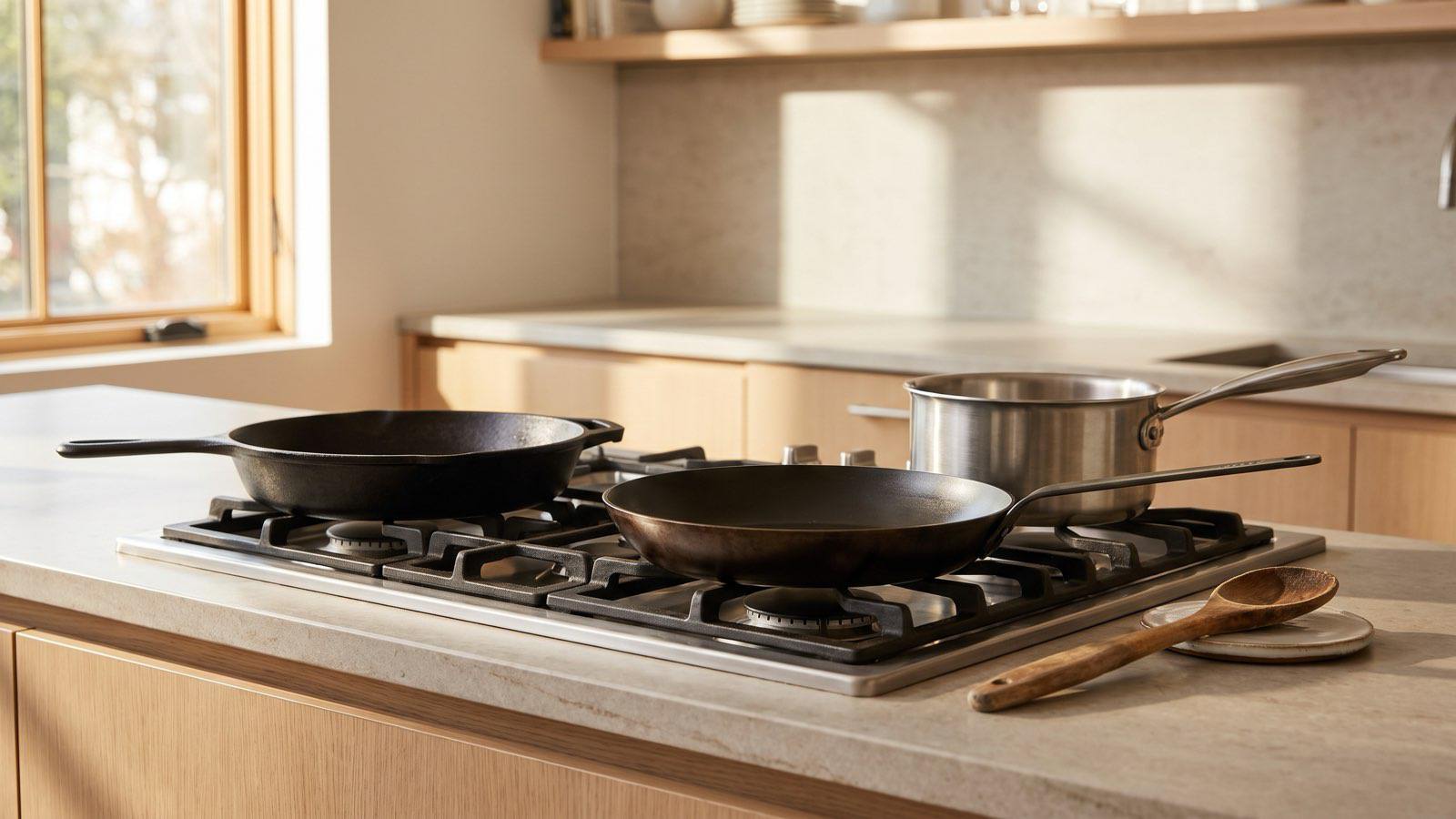
We chose models with documented construction and different cooking uses. Product photos show the linked models; the header image is an illustration. Use the Amazon buttons for current price and availability.
For searing and roasting · seasoned cast iron
Lodge Classic Cast Iron Skillet, 10.25-inch
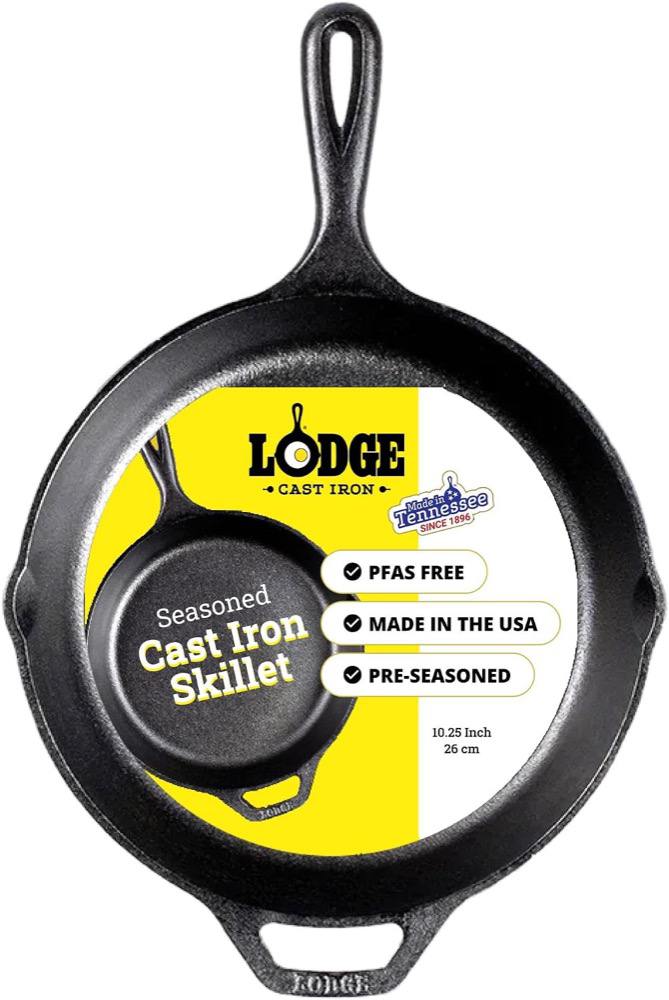
Lodge’s 10.25-inch skillet (L8SK3) is a seasoned-iron option for everyday frying and roasting. Lodge says its seasoned cast iron uses iron and vegetable oil (soybean, per its California disclosure), is made without PFAS in the USA, and suits any stovetop, including induction, plus oven, grill or campfire. Maintaining its baked-on oil layer is part of ownership.
Trade-offs: Lodge lists it at 5.66 lb, and it heats slowly. Hand wash, dry and oil it, and keep acidic dishes short. Lodge says third-party labs verify its cookware is free of PFAS and “dangerous levels” of lead and cadmium; that is the maker’s statement, not our test.
Lodge’s skillet specifications · Lodge’s materials and testing statement.
Check price on AmazonSeasoned cooking surface · coated handle
de Buyer Mineral B Classic Carbon Steel Fry Pan, 11-inch
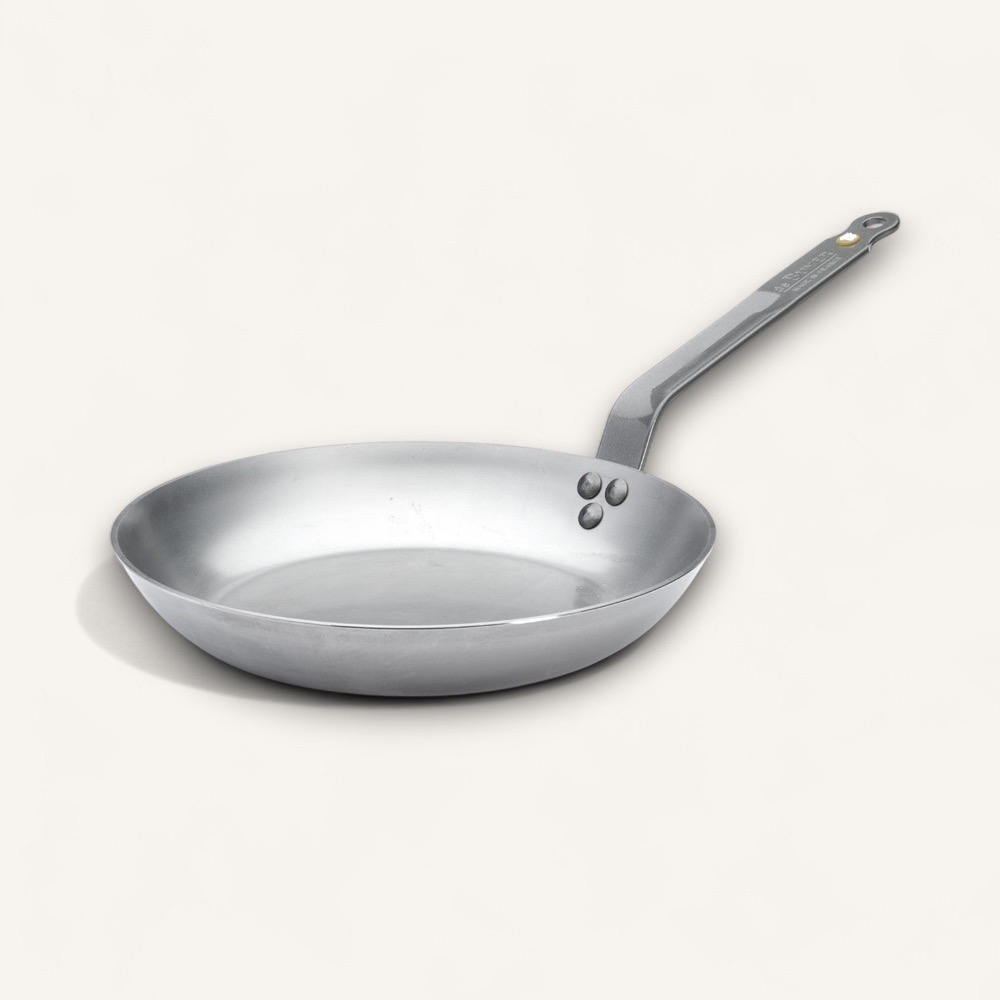
The 11-inch Mineral B Classic (5610.28) has a carbon-steel body and an 8.3-inch cooking surface. It ships with a protective beeswax finish and requires seasoning. The distinction for plastic-free shopping is its epoxy-coated steel handle: the cooking surface and handle have different finishes.
Trade-offs: this is not the choice for an entirely bare-metal assembly. The maker limits oven use to less than 10 minutes at a maximum of 400°F. Follow its seasoning and hand-washing directions; keep it dry and avoid long acidic simmers. Other de Buyer ranges have different handles, so do not transfer their oven ratings to this Classic model.
de Buyer’s materials and care details.
Check price on AmazonFor sauces, boiling and acidic food · stainless tri-ply
All-Clad D3 Stainless 3-Quart Saucepan with Lid
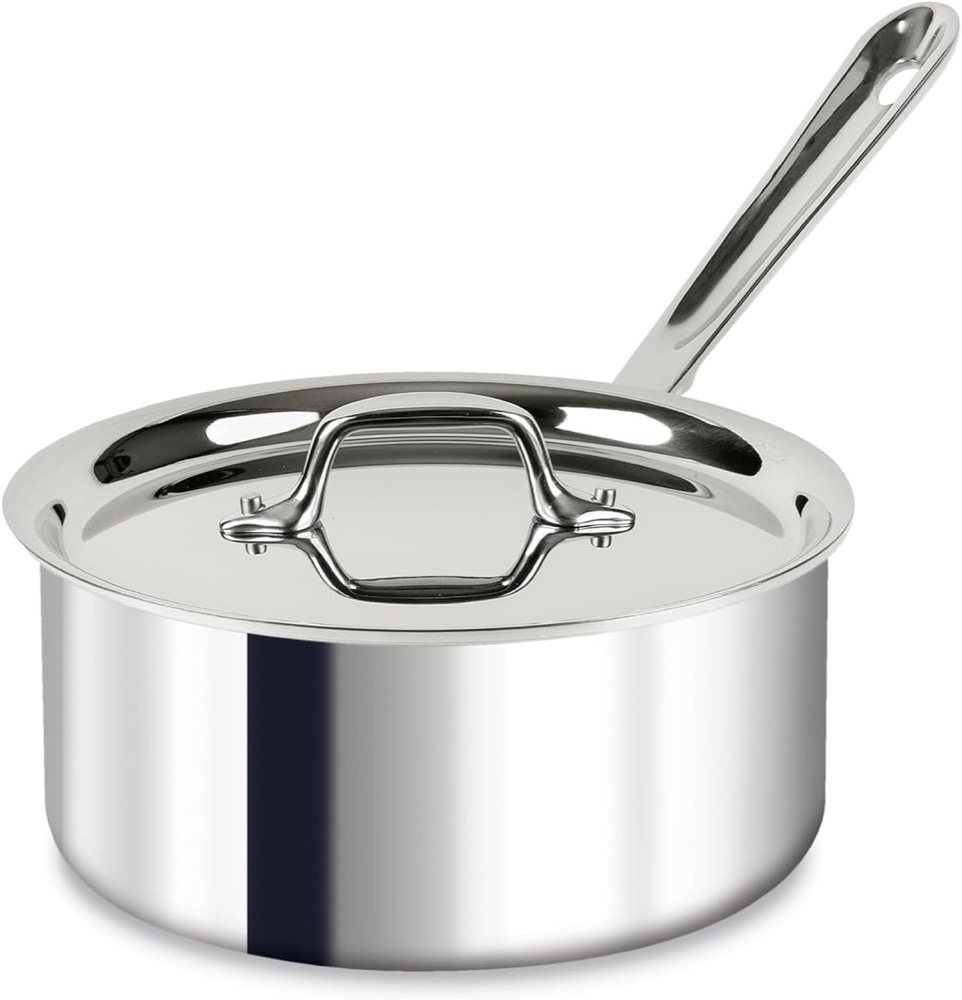
The linked Amazon selection was verified October 15 as the D3 3-quart saucepan, model 4203 / 8701004398, with stainless lid. Its stainless cooking surface and aluminum core suit a different task from a frying pan: boiling, grains and sauces.
Care: All-Clad’s support guidance recommends hand washing. It explicitly lists all D3 versions as oven-safe to 600°F and gives the same limit for stainless steel lids; glass lids have a lower limit. Check the instructions supplied with your piece and use protection when handling hot metal.
Version check: the current manufacturer listing is 4203R SC / 8701005985. We have not established that it is identical to the linked 4203, so its dimensions and weight are not used here. Match the model and lid when ordering. For browning on stainless, technique and fat affect sticking; boiling water does not require an oiled pan.
Check price on AmazonFor braises, soups and bread · enameled cast iron
Lodge Essential Enamel Cast Iron Dutch Oven, 6-Quart, Oyster White
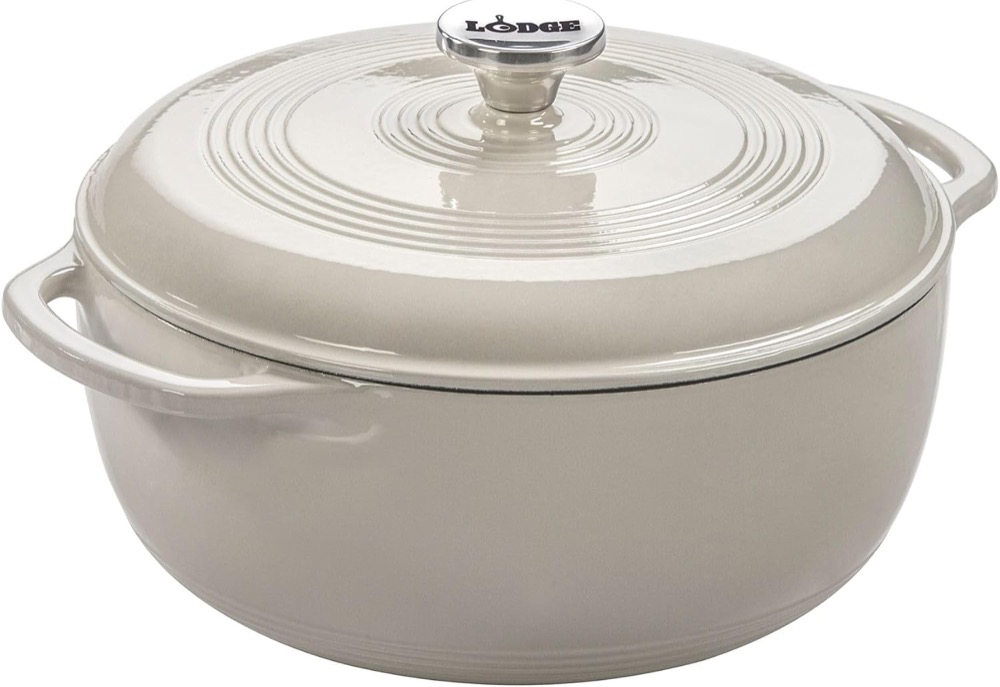
An enameled Dutch oven pairs cast iron with a bonded porcelain surface. Lodge describes it as suitable for acidic ingredients and fridge storage, lists a stainless steel lid knob, and permits oven use to 500°F. It does not need seasoning. The linked variant is 6-quart Oyster White; a materials disclosure alone does not establish that one color gives lower exposure or a health advantage.
Trade-offs: Lodge lists it at 13.52 lb. It recommends hand washing, no metal utensils and no heating the pot empty on the stovetop. Enamel can chip if dropped or knocked.
Lodge’s Dutch oven specifications · AB 1200 materials disclosure.
Check price on AmazonIf you still want slick nonstick · ceramic coating, with caveats
Caraway Non-Stick Ceramic Fry Pan, 10.5-inch, Cream
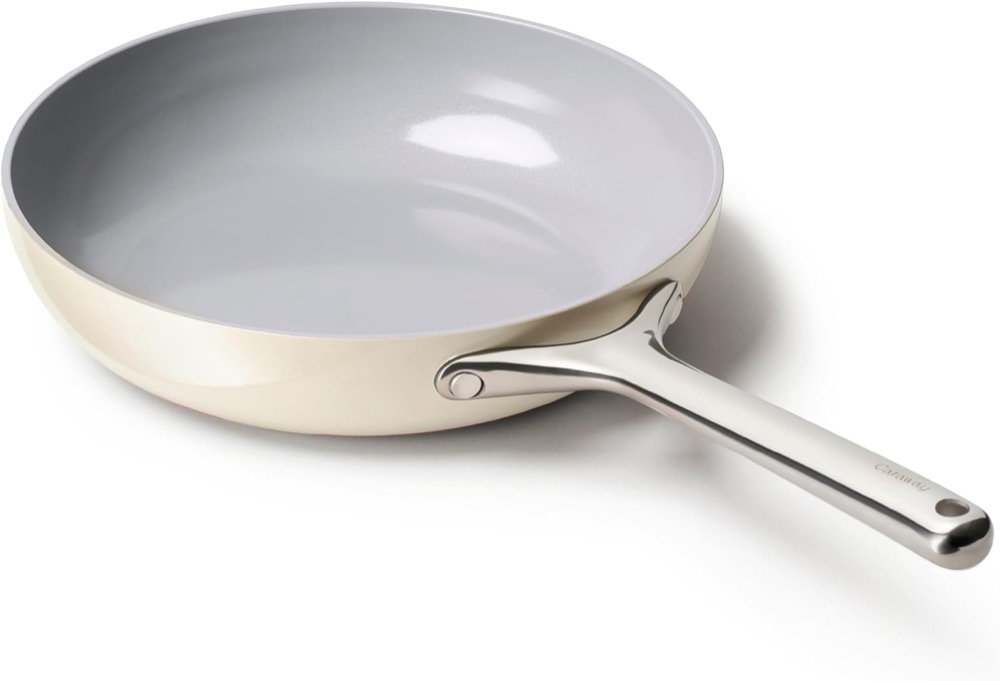
If you want eggs to slide without seasoning a pan, this is the PTFE-free coated route. Caraway describes an aluminum body with a ceramic-coated cooking surface and stainless steel handles and base plate. Its current product page describes the coating as made without PTFE, PFOA and PFAS. The maker also links third-party testing, but does not disclose the full coating formulation on the product page. Caraway rates it oven-safe to 550°F.
Trade-offs: the coating is proprietary, and chemical screening does not establish what wears off during cooking. The 2025 study above tested other coatings; it does not establish this model's lifespan. Caraway specifies low to medium heat and hand washing with a non-abrasive sponge. Follow its damage and care instructions, and assess coating wear separately from a loss of easy release.
Caraway’s materials and care details · Caraway’s testing page.
Check price on AmazonUsing the pans you already have
- Retire nonstick that is scratched, flaking or worn through. Poison Control advises replacing chipped or scratched nonstick. The 2.3 million estimate came from broken coating, not an intact surface.
- Keep the heat moderate. Don’t preheat nonstick empty; sear in cast iron or carbon steel instead.
- Use wood or silicone on coated and enameled surfaces, and hand wash coated pans with a soft sponge. Our plastic-free kitchen utensils guide compares the options. Steel tools are fine on cast iron, carbon steel and stainless.
- Check other coated appliances. Many air fryer baskets are nonstick-coated too; see our air fryer microplastics guide.
Frequently asked questions
What should I check when buying a plastic-free pan?
Check the cooking surface, handle finish, lid knob, seals and included accessories. Avoiding a PTFE cooking surface does not establish that every component is bare metal. Match the construction and care instructions to the exact model.
Is enameled cast iron uncoated?
No. It has a porcelain surface bonded to the iron. That surface differs from both seasoned iron and PTFE nonstick, and it needs its own utensil, heat and cleaning precautions.
Is ceramic cookware safe?
Check what “ceramic” describes: a proprietary nonstick coating, glazed pottery or enamel on metal. Those constructions need different evidence and care. A ceramic label alone does not establish particle release, durability or a health advantage.
Is ceramic cookware safer than Teflon?
A coating verified as PTFE-free avoids that fluoropolymer, but that does not establish an overall health advantage. The studies discussed here measured release performance, abrasion or migration from specific coatings; they did not compare health outcomes for all ceramic and PTFE pans.
Do nonstick pans release microplastics?
Damaged ones can. A 2022 study estimated about 9,100 particles from one surface crack and about 2.3 million from broken coating in a simulated test. A 2024 food-simulant study found PTFE among particles from plastic and nonstick cookware. Neither measured health effects.
What does PFOA-free mean on a nonstick pan?
It is a claim about PFOA, one substance used in some fluoropolymer production. It does not by itself establish that the pan is free of PTFE or all PFAS. The EPA’s 2015 elimination goal applied to participating companies, not every manufacturer.
Should I throw away a scratched nonstick pan?
Poison Control advises replacing chipped or scratched nonstick cookware. The sources we reviewed do not establish a reason to discard an intact pan used at moderate heat with wood or silicone utensils.
Does stainless steel cookware leach nickel?
Nickel transfer has been measured, and the amount depends on the food, cooking conditions and cookware history. The studies discussed here do not establish the amount released by every model. If you have been prescribed a low-nickel diet, ask your clinician whether cookware matters for you.
Sources and editorial method
Original article and Amazon-variant research: October 15, 2026. Component descriptions, selected care guidance and the cited studies’ scope were reviewed November 1; All-Clad’s current model information and D3 support guidance were checked again November 4. This was a targeted source check, not a systematic literature review. Some papers were available only as abstracts or research-team summaries, as identified below. The five Amazon offers retain their October 15 verification date; this was not a new price or stock check. This is a document-based guide: we have not measured particle release, metal leaching, cooking performance or durability for these products.
- Luo et al. (2022): Raman imaging for the identification of Teflon microplastics and nanoplastics released from non-stick cookware, Science of the Total Environment, 851(Pt 2), 158293. PubMed abstract. Particle figures from the Flinders University release (Oct 31, 2022); full methods were not available in our review.
- Cole et al. (2024): Microplastic and PTFE contamination of food from cookware, Science of the Total Environment, 929, 172577. Plymouth Marine Laboratory release; the publisher’s full text was unavailable in this review.
- Guerrero-Vacas, Carrillo-Estepa and Rodríguez-Alabanda (2025): Towards a greener kitchen: Can sol-gel ceramic non-stick coatings replace polytetrafluoroethylene?, Results in Engineering, 26, 105074.
- Golja et al. (2017): Characterisation of food contact non-stick coatings containing TiO2 nanoparticles and study of their possible release into food, Food Additives & Contaminants: Part A, 34(3), 421–433. Abstract reviewed.
- Kamerud, Hobbie and Anderson (2013): Stainless steel leaches nickel and chromium into foods during cooking, Journal of Agricultural and Food Chemistry, 61, 9495–9501. Full-text methods reviewed.
- Accominotti et al. (1998): Contribution to chromium and nickel enrichment during cooking of foods in stainless steel utensils, Contact Dermatitis, 38, 305–310. Abstract reviewed.
- Brittin and Nossaman (1986): Iron content of food cooked in iron utensils, Journal of the American Dietetic Association, 86(7), 897–901. Abstract reviewed.
- FDA: Authorized uses of PFAS in food contact applications · FDA: Questions and answers on lead-glazed traditional pottery · FDA: Lead in food and foodwares.
- EPA (2006): EPA seeking PFOA reductions · EPA: 2010/2015 PFOA Stewardship Program fact sheet · Minnesota Pollution Control Agency: 2025 PFAS prohibitions.
- Poison Control (National Capital Poison Center): Teflon flu — overheating, symptoms and replacement advice.
- Lodge: Classic skillet, 6-quart Essential Enamel Dutch oven, AB 1200 disclosure, materials statement, enamel care and acidic-food guidance.
- de Buyer: Mineral B Classic fry pan — materials, handle, oven limit and care.
- All-Clad: cookware support FAQs — hand-washing recommendation, D3-family oven guidance and separate lid limits. Current 4203R SC manufacturer listing — identifies a different model/SKU from the October 15 Amazon selection; equivalence is not assumed.
- Caraway: 10.5-inch fry pan and third-party testing page — materials claims, heat and care.
Keep swapping
Once the pans are sorted, look at what touches them: our plastic-free kitchen utensils guide and cutting board alternatives. For leftovers, see the glass food-storage guide, and for boiling water, our plastic-free kettle picks. Shopping for someone else? Cast iron and carbon steel lead our plastic-free gift guide.
Choosing dishes for the finished meal is a separate decision from choosing a cooking surface. Our plastic-free dinnerware comparison covers glass plates, glazed ceramic bowls and stainless-steel dishes, including size and care limits.
For baking, shape and outside dimensions matter as well as the cooking surface. Our plastic-free bakeware guide compares sheets, loaf tins and separate liners by recipe size, oven fit and care.