Glass Food-Storage Containers: Microplastics, Lids and Safe Use
A glass base changes the surface touching your food, but the lid and heating instructions still matter. Here is what the research supports and what to check before choosing a container.
We may earn a commission when you buy through our links, at no additional cost to you. As an Amazon Associate we earn from qualifying purchases. This guide reviews published research and manufacturer instructions; we have not performed hands-on leak, durability or particle-shedding tests.
Compare containers, not just pieces
A set's advertised piece count can include its lids. Compare the number of usable containers, their capacities and the lid format before comparing prices.
| Selected set | Containers + lids | Consider for |
|---|---|---|
| Glasslock Blue, 18-piece | 9 + 9 | Mixed shapes and portions |
| Pyrex Simply Store, 12 Pack | 12 + 12 | Repeated portion sizes |
| Amazon Basics, 14-piece | 7 + 7 | A smaller locking-lid set |
| Rubbermaid Brilliance Glass, 9-count | 9 + 9 | Vented locking lids |
What switching to glass changes
A glass base replaces one plastic food-contact surface. It does not remove particles already in food, and a glass container with a plastic lid is not a completely plastic-free system. Choose it for that specific material change rather than a promised percentage reduction in exposure.
Hussain and colleagues' 2023 study tested plastic containers and reusable pouches with deionized water and 3% acetic acid as food simulants. Some tested containers released up to 4.22 million microplastic particles per square centimeter after three minutes of microwave heating. That is a reported laboratory maximum, not a count that applies to every container or meal. The experiment did not compare the four glass products on this page or demonstrate that buying one improves human health.
The FDA describes substantial measurement and health-evidence gaps; detecting particles alone does not establish a health risk. For a separate laboratory finding, our water-radicals study explainer distinguishes experimental chemistry from everyday exposure. Neither study ranks storage containers and bottles as the two largest sources in an individual's diet.
Check the lid before you heat
Read the base and lid markings independently. A glass base's oven rating does not apply to a plastic cover. If you want to avoid heating with a plastic lid, use a separate microwave-safe cover intended for that purpose and follow the dish's instructions. Never heat a sealed container.
Pyrex's current instructions prohibit moving glass directly from the freezer into a hot oven and require preheating the oven. Rubbermaid's Glass Brilliance instructions also prohibit freezer-to-oven or freezer-to-microwave transfer. A borosilicate label is not permission to ignore the exact product's limits.
The selected sets and their tradeoffs
Mixed shapes and capacities
Glasslock Blue: 9 Containers and 9 Lids
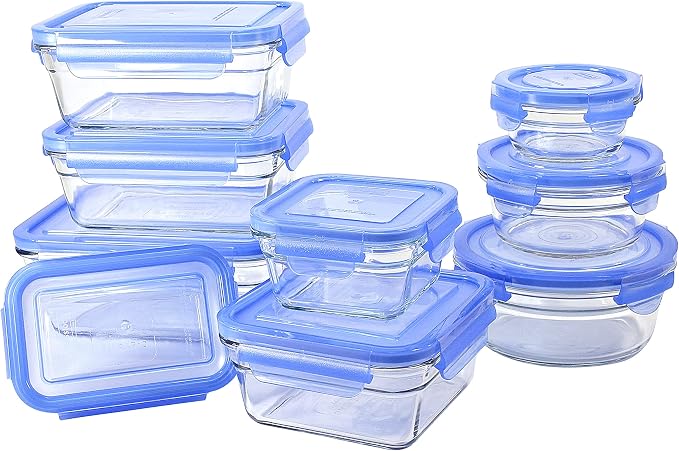
The selected Blue assortment contains nine glass containers and nine locking lids. Its four rectangular containers hold 6.3, 3.5, 3.5 and 1.6 cups; the two squares hold 3.3 and 1.5 cups; the three rounds hold 3.1, 1.6 and 0.7 cups. That mix suits different leftover portions, but the smallest piece is a condiment-size container rather than a full meal box. The listing describes the set as oven-safe; that does not include permission to heat its plastic lids. Glasslock's European care FAQ distinguishes its oven series and excludes lids from oven use. Follow the instructions and markings on the exact US model. Its airtight and leak-proof descriptions are manufacturer claims, not our test results.
Check price on AmazonRepeated portion sizes
Pyrex Simply Store: 12 Containers and 12 Lids
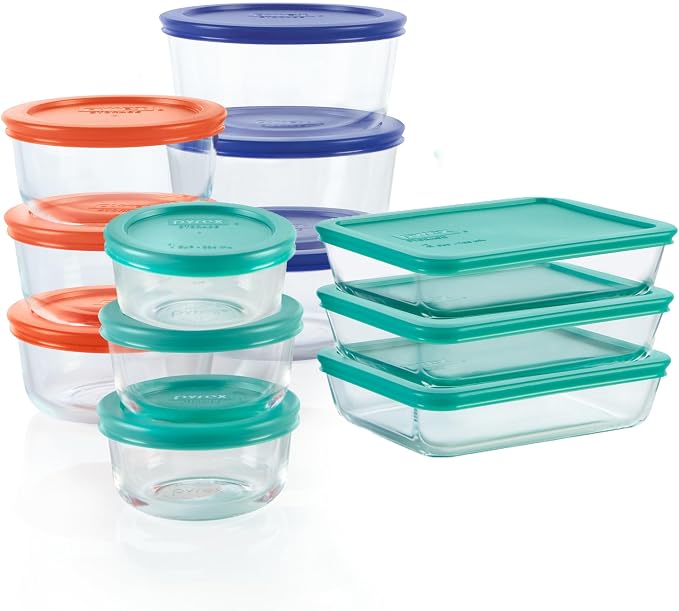
The selected 12 Pack (Medium) contains three 1-cup, three 2-cup and three 4-cup round containers, plus three 3-cup rectangular containers. Each has a plastic lid: twelve containers and twelve lids make 24 pieces. Repeated capacities help when you prepare the same portion for several days; allow space for the full bundle. The brand identifies tempered glass and BPA-free plastic lids. A press-on lid is not, by itself, evidence of leak-proof transport. Follow Pyrex's base and lid instructions separately, including its restrictions on moving frozen glass directly into heat.
Check price on AmazonSmaller locking-lid assortment
Amazon Basics: 7 Containers and 7 Lids
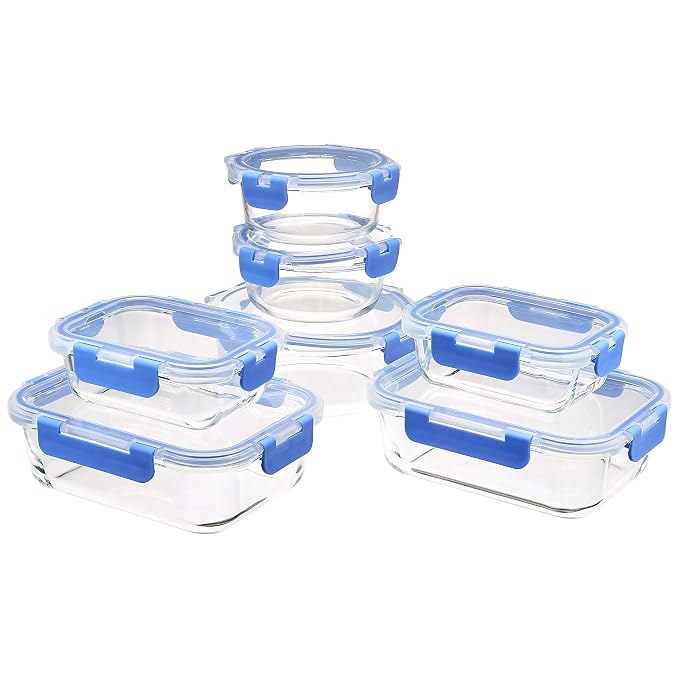
The selected 14-piece set contains seven glass containers with seven matching locking lids. Its product photo shows four rectangular and three round containers. Amazon's brand listing identifies borosilicate glass and a blue silicone sealing ring; the lids still contain plastic. Compare the usable capacities with your portions and check the current price per container. We have not established that this is the cheapest option or independently tested the advertised leak-proof seal. Glass type alone does not establish a safe freezer-to-oven transfer: use the exact model's handling instructions.
Check price on AmazonVented locking lids
Rubbermaid Brilliance Glass: 9 Containers and 9 Lids
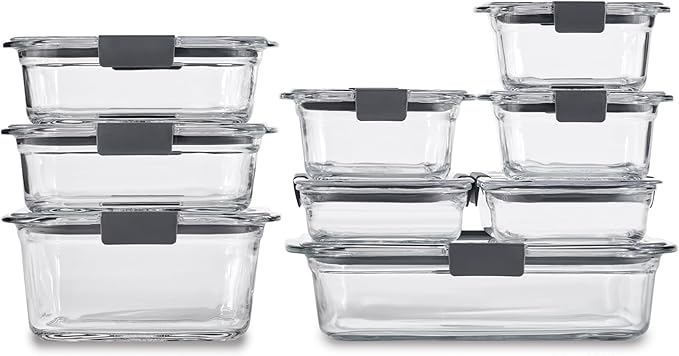
The selected 9 Count assortment lists three 1.3-cup, two 2-cup, two 3.2-cup, one 4.7-cup and one 8-cup glass container, each with a lid: nine bases plus nine lids make 18 pieces. Those listed capacities total 27 cups, which conflicts with the selector's 28.3-cup label; check the package contents if a particular portion size matters. The manufacturer describes vented locking lids and interchangeable lids across matching Brilliance sizes; this does not mean one lid fits every container. The lids contain plastic, so this is a glass-base swap rather than an entirely plastic-free set. Rubbermaid's Glass Brilliance use instructions give glass bases and lids separate heating limits. Follow those directions; the glass base's 450°F oven rating does not apply to its lid. Airtight and leak-proof descriptions are manufacturer claims, not our test results.
Check price on AmazonFrequently Asked Questions
Do glass containers eliminate microplastic exposure?
No. A glass base replaces a plastic contact surface, but lids may still contain plastic and food may already contain particles. We have not measured an exposure reduction or health benefit from these products.
Can glass containers go straight from freezer to oven?
Do not assume so. Pyrex and Rubbermaid Glass Brilliance instructions prohibit direct freezer-to-hot-oven transfer. Follow the exact container's temperature-change and heating instructions; the glass type alone is not permission.
Can I microwave a glass container with its plastic lid?
Only when that specific lid's instructions permit it, using the required venting and heat limits. A glass base's rating does not certify the lid. Never heat a sealed container or put an ordinary plastic storage lid in the oven.
Is borosilicate glass unbreakable?
No. Glass composition and strengthening treatments affect its properties, but neither guarantees against breakage. Pyrex says its soda-lime and borosilicate products still require the specified care. Inspect for damage and follow the instructions for your model.
Care & Maintenance Tips
- Use a dry potholder or trivet under hot glass; keep it off wet or cold surfaces. Do not add cold liquid to hot glass.
- Stop using chipped or cracked glass. Keep pieces from knocking together during washing and storage.
- Follow the separate washing instructions for the base, lid and removable seal; let them dry before storing.
- Protect the food as well as the glass: portion leftovers into suitable shallow containers and refrigerate promptly. Do not leave food on the counter for hours to protect a hot dish.
FoodSafety.gov recommends refrigeration within two hours, or one hour above 90°F. Transfer food to a suitable container when needed to respect both food-safety timing and the hot glassware's care instructions.
Sources and editorial method
Evidence and handling guidance reviewed October 29, 2026. Glasslock, Pyrex and Amazon Basics selected-set contents and photos were checked on their Amazon.com brand listings November 1, 2026; Rubbermaid was checked November 2, 2026. We used the original study, FDA's evidence summary, FoodSafety.gov, and manufacturer use instructions linked above. See also Pyrex's glass-material and lid FAQ. This is document review, not a laboratory or hands-on product comparison. Manufacturer specifications describe intended use; they do not prove zero particle release or a health advantage.
Keep Swapping
For meals carried to work or school, compare lunch boxes by compartment fit, seals and space for cold sources.
For a separate food-contact decision, compare the bodies and lids in our stainless steel bottle guide. Our plastic-wrap alternatives guide covers ways to cover food without buying another rigid container.
For food preparation before storage, compare steel and glass mixing bowls by working space, rim and tool fit. For serving the finished meal, our plastic-free dinnerware guide compares glass plates, ceramic dinner bowls and steel dishes.