Plastic-Free Safety Razors: Which to Buy and How to Shave Safely
Switching is mostly about plastic waste, not a measured microplastic dose. Here is what is in a cartridge and its lubricating strip, how to shave without nicks, and four metal razors worth starting with.
We may earn a commission when you buy through our links, at no additional cost to you. As an Amazon Associate we earn from qualifying purchases. These are research-based recommendations; we have not shaved with, lab-tested or measured particle release from these products.
A metal safety razor is about as close to plastic-free as shaving gets, and it is safe for most people once they learn the basics. The handle and head are metal and last for years; the blades are steel, often sold in paper wrappers and paperboard boxes. To avoid nicks, keep the head at a shallow angle, use almost no pressure and start with a mild razor. See the sources.
Be clear about what the switch buys you. It mainly cuts plastic waste from disposable razors and cartridges. We found no study that measured microplastics released by razors, cartridges or their lubricating strips during shaving, so this is not a proven way to lower your microplastic exposure. A safety razor is also not polymer-free: most blade edges, double-edge blades included, carry a thin PTFE coating. This is a research-based guide; we have not shaved with or tested any of these products.
Safety razors at a glance
| Pick | Type | Best fit | What to know |
|---|---|---|---|
| Merkur 34C HD | Double-edge, closed comb | A first razor with one mild setting | Chrome-plated brass handle and zinc head; short and heavy. |
| Rockwell 6S | Double-edge, adjustable plates | Starting mild and adjusting later | 316L stainless steel; six settings from three reversible plates. |
| Henson AL13, mild | Double-edge, fixed angle | A light razor | Anodized aluminum, made in Canada; 37 g. |
| Leaf Two kit | Pivoting, two half-blades | Switching from cartridges; body shaving | Metal razor; the kit adds a silicone grip sleeve. |
| 40-blade sampler | Double-edge blades | Finding a blade that suits your skin | Eight blade types in paperboard boxes. |
These are not ranked by measured safety, skin outcomes or particle release. Choose by the shave you want and the materials each maker documents.
Is switching about plastic or microplastics?
Mostly plastic. A disposable razor is a plastic handle and head with steel blades and a lubricating strip. A cartridge system keeps the handle, but every refill head is still plastic, steel and strip joined together. That mix is the problem at the end of its life: the Associated Press reported in 2019 that US municipal recycling programs won’t take razors because they are sharp and made of mixed materials, and the City of Burbank, for one, says blades should never go in the recycling bin.
A metal safety razor replaces that stream with a handle and head you keep, plus bare steel blades. That is a real reduction in plastic thrown away. It is not the same as a measured cut in what you take in, and we don’t present it that way. If exposure is your main worry, our review of what the research says about getting microplastics out of your body and our look at the “credit card of plastic a week” claim are better places to start.
Where the “2 billion razors a year” figure comes from
The number traces to an October 1990 EPA booklet, The Environmental Consumer’s Handbook (EPA/530-SW-90-034B). In a list of disposables it says that each year the United States produces “2 billion throwaway razors and blades.” Three things to know before repeating it:
- It counts razors and blades together and describes production, not a measured count of what was thrown away.
- The booklet gives no method or source for it, and it is now 36 years old.
- The EPA told the Associated Press in 2019 that it does not track the environmental impact of disposable razors and has no update on the figure.
The same booklet’s advice was to “use razors with replaceable blades,” which a cartridge razor also satisfies. We treat the figure as a historical marker, not a current count. We found no recent government estimate to replace it.
What is in a razor’s lubricating strip?
The colored strip next to the blades on most cartridges and disposables is a polymer product. A Gillette patent filed in 2000 describes the conventional design as “a water-insoluble polymer matrix, typically polystyrene,” holding a water-soluble shaving aid, typically polyethylene oxide, that “leaches out of the strip during shaving.” The same patent notes that release from conventional strips can drop to negligible amounts after the first four or five shaves.
Current labels show the soluble part. Gillette’s UK page for ProGlide refill blades lists the ingredients as PEG-115M, PEG-7M and PEG-100, followed by silica and antioxidants including BHT. PEG, polyethylene glycol, is the cosmetic-label name for this kind of water-soluble polymer. That list does not name an insoluble matrix, so we can’t say whether this particular strip uses polystyrene.
What follows from that, and what doesn’t:
- The soluble polymer is meant to dissolve into the water on your skin and rinse away. A 2005 safety review of PEGs in cosmetics reported extremely low toxicity and little penetration of intact skin, and concluded the PEGs it covered are safe in cosmetics as intended. Its sensitization reports mainly involved injured or inflamed skin. It did not study razor strips.
- Where there is an insoluble matrix, it is solid plastic that stays in the cartridge and goes to the landfill with it.
- Shedding hasn’t been measured, as far as we can find. We found no peer-reviewed study of particles released from lubricating strips or cartridge housings during shaving. Some razor sellers cite such numbers; we could not trace them to a published paper, so we don’t repeat them.
What a safety razor doesn’t remove
Blade coatings. Another Gillette patent states that razor blade cutting edges have been coated with PTFE for many years, to reduce the force needed to cut hair. PTFE is the fluoropolymer used on many nonstick pans, which we cover in our non-toxic cookware guide. Double-edge blades use edge coatings too: one box in the sampler below, Derby Extra, says its edges are polymer-coated. We found no measurement of whether shaving releases any of this coating.
Packaging and accessories. Some blades come in small dispensers rather than paper, some kits add a silicone grip, and synthetic shaving brushes are plastic. Details are under each pick.
Are safety razors safe?
For most adults, yes, after a short learning curve. The “safety” in the name is the guard, a solid bar or comb in front of the edge, that limits how much blade meets your skin. Nicks usually come from pressing down, holding the handle too steep, a dull blade or going over the same patch again and again. We found no injury data comparing safety razors with cartridge razors, so we can’t say either is safer in general.
For razor bumps, the American Academy of Dermatology’s advice for men with darker skin tones who get them says a single-blade or electric razor is often recommended, that any razor must be sharp, and that a dull blade greatly raises the risk. That is dermatologist guidance rather than a head-to-head trial. If bumps or irritation keep coming back after you change technique, see a dermatologist.
What makes a razor mild or aggressive
- Blade gap: the space between the edge and the guard. A wider gap lets more skin and hair reach the edge.
- Blade exposure: how far the edge stands out past the line between the cap and the guard. More exposure means a closer, less forgiving shave.
- Guard type: a closed comb is a solid or grooved bar; an open comb has teeth instead, which leaves more of the edge in contact with hair.
- Weight: a heavier razor needs less hand pressure, which matters when you’re learning not to press.
- Adjustability and pivot: adjustable razors let you start mild and move up; a pivoting head follows your face or legs instead of relying on your wrist to hold the angle.
The safest safety razor for a beginner is a mild one, not a particular brand. In practice that means a mild, fixed razor such as the Merkur 34C, an adjustable razor on a low setting, or a pivoting razor. Our picks cover all three.
How to shave with a safety razor without cutting yourself
- Soften first. The AAD suggests wetting skin and hair before you shave, ideally right after a shower, then applying a shaving cream, gel or soap lather.
- Find a shallow angle. Rest the top of the head flat on your skin with the handle sticking out, then lower the handle until the blade just starts to cut. Many guides describe about 30 degrees; Henson builds a 30° angle into its head.
- Use almost no pressure. Hold the handle loosely and let the razor’s weight do the work. The AAD advises against putting much pressure on your skin, and Henson warns that pressing forces too much skin against the blade.
- Short strokes, with the grain. Shave in the direction the hair grows. For bump-prone skin, the AAD suggests short strokes and never going over an area more than twice.
- Rinse after every stroke. Run the head under water. Never wipe the blade with a towel or your fingers.
- Slow down on curves. Jawline, chin, upper lip, knees and ankles are where a fixed head is least forgiving. Take shorter strokes there.
- Replace the blade. The AAD says to change it after 5 to 7 shaves; do it sooner if it tugs.
- Dry it. Let the razor dry completely and store it out of the shower, as the AAD recommends.
Plastic-free safety razor blades
Double-edge blades are a standard size, and the three double-edge razors below take standard blades. The Leaf Two takes half blades instead; Leaf says you can snap a double-edge blade in half inside its wrapper. The blades themselves are steel. Packaging varies:
- Paper and paperboard: many brands sell five-blade paperboard tuck boxes, with each blade in a paper wrapper.
- Dispensers: some sell sealed dispensers instead. Feather’s 10-packs, for example, are described as hermetically sealed dispensers rather than paper boxes. Check the listing photos before you buy.
How a blade feels varies from person to person, and we know of no independent ranking. A sampler is a low-cost way to try several before buying a large pack.
Blade banks and safe disposal
Never put loose blades in the trash or recycling. Drop them into a blade bank, a closed metal tin with a slot, or a clean steel can you can seal. Rockwell and Leaf both sell tins; Leaf says to recycle its tin as scrap metal when full.
What happens next depends on your city. Burbank, California, for example, says blades must never go in the recycling bin, allows taped or sealed non-medical blades in the landfill cart, and accepts larger amounts as scrap metal at its recycle center if they’re consolidated in a lidded metal can. Check your own city’s guide before you assume a full tin can go in curbside recycling.
Can you take a safety razor on a plane?
Not with the blade in your carry-on. TSA’s guidance:
- Safety razors may go through the checkpoint without the blade. Remove it before you reach screening; TSA officers are not allowed to take it out for you.
- Razor blades not in a cartridge are prohibited in carry-on bags and allowed in checked bags. Sheathe or wrap them securely.
- Disposable razors are allowed in both carry-on and checked bags.
TSA says the final decision rests with the officer. On a carry-on-only trip, pack the empty handle and buy blades where you land.
Five picks to start with
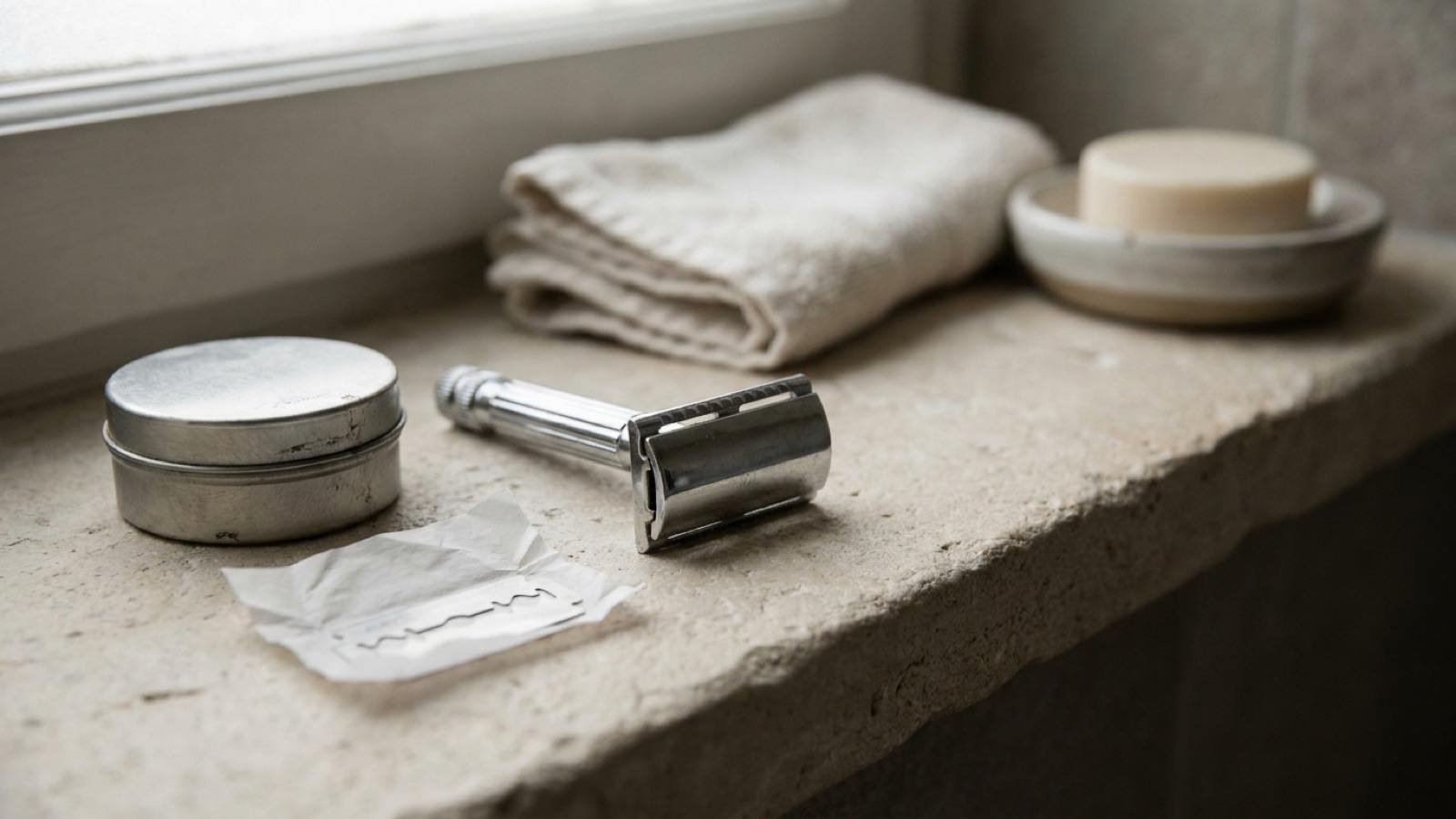
We chose widely sold razors whose makers publish materials information, at different points on the mild-to-adjustable range, plus a blade sampler. Product photos show the linked models; the header image is an illustration. Use the Amazon buttons for current price and availability. A safety razor also makes a practical present; see our plastic-free gift guide for more.
Best first razor · mild, closed comb
Merkur 34C HD Double Edge Safety Razor, Bright Chrome
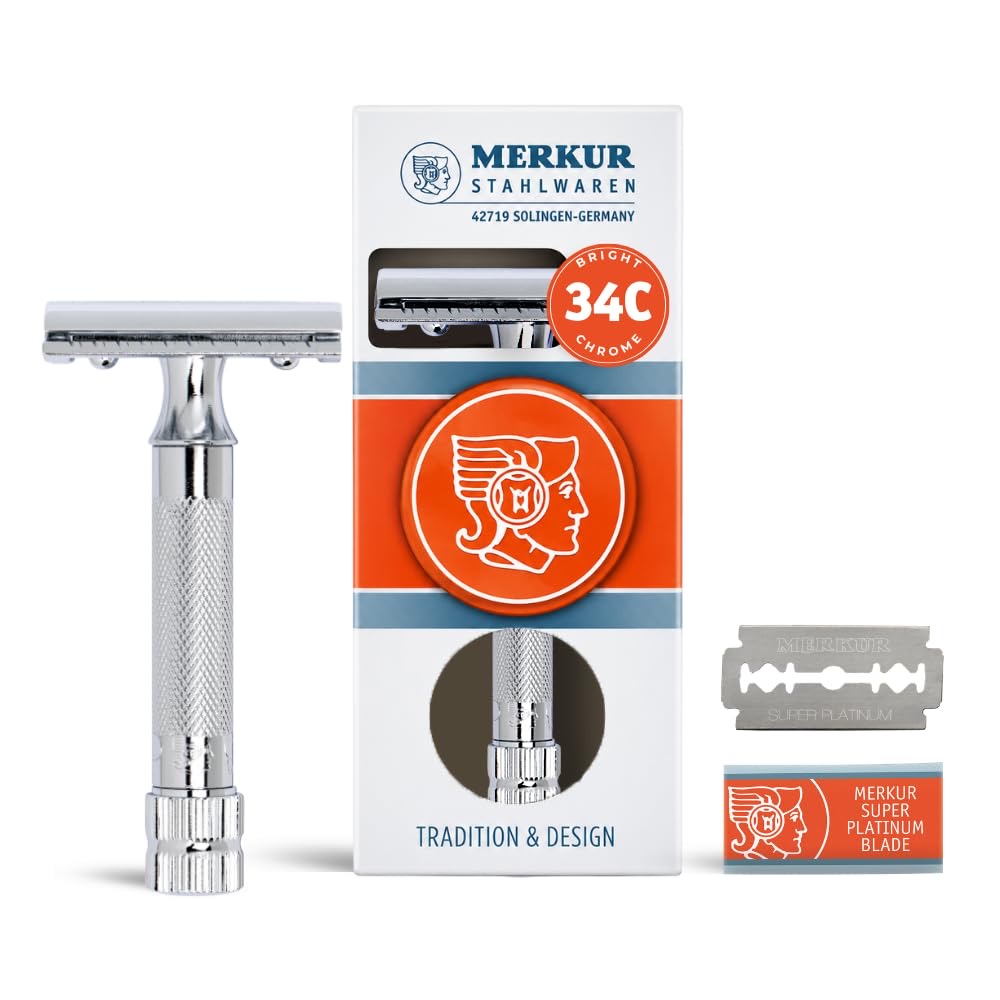
The 34C is the classic starter razor: a closed-comb, fixed-setting double-edge razor from Solingen, Germany. Merkur lists a brass handle and a die-cast zinc head, both chrome-plated, and ships it in a folding box. It is a two-piece design: turning the knob at the bottom of the handle releases the top cap for a blade change. The Amazon listing says it takes any standard double-edge blade.
The short, heavy handle helps you avoid pressing, and with only one setting there is nothing to adjust. That simplicity is why it suits a first-timer.
Trade-offs: you can’t make it milder or more aggressive, so if it feels too gentle for heavy stubble later you would need another razor. The handle is short; people with large hands may prefer Merkur’s long-handled models. Plating is a finish over the metal, not solid stainless steel.
Check price on AmazonFor adjusting as you learn · stainless steel
Rockwell 6S Adjustable Safety Razor, Matte Stainless Steel
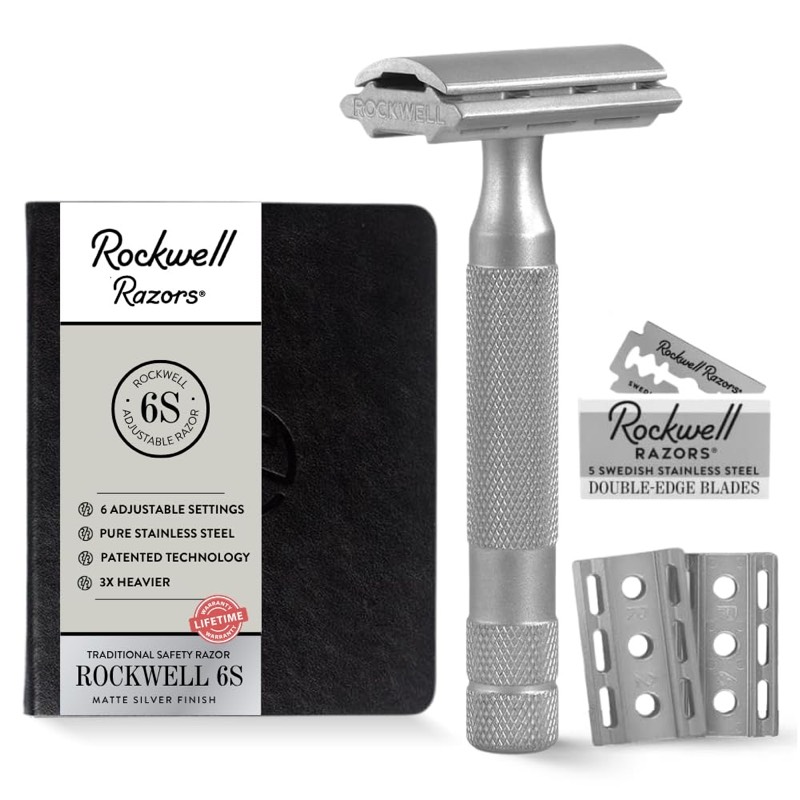
The 6S lets you change how aggressive the razor is. Rockwell makes it from 316L stainless steel and gives it six settings using three reversible base plates, sizes R1 to R6. Rockwell says the plates are made in the USA by metal injection molding and the razor weighs over 100 g. The Amazon listing includes five blades.
You can start on a mild setting and move up one step at a time as your technique improves. Its weight helps with the no-pressure habit.
Trade-offs: changing settings means taking the head apart and swapping a small plate, and you have to keep the spare plates. Rockwell’s product page doesn’t publish blade-gap measurements for each setting. It is a heavy razor, which not everyone likes.
Rockwell’s 6S details · base plate specifications.
Check price on AmazonLightest option · anodized aluminum
Henson AL13 Safety Razor, Mild, Aircraft Aluminum
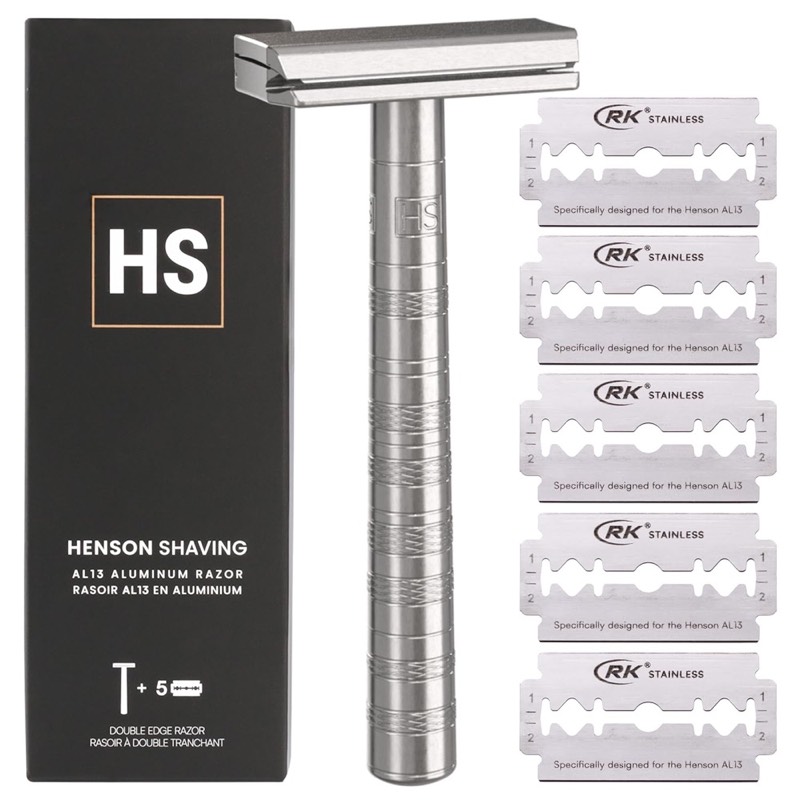
Henson makes its razors at an aerospace machining facility in Canada, and the AL13 is machined aluminum with a Type II anodized finish. Henson says the razor is all metal, made to AS9100 aerospace standards in Canada, and weighs 37 g. The head clamps the blade at a fixed 30° angle and supports it close to the edge so it doesn’t flex. Henson’s FAQ says the AL13 is offered in mild only and takes any standard double-edge blade; five RK blades come in the box.
It is the pick for someone who wants a light razor and a consistent, gentle shave. Henson says the head sets the angle for you and that you need very little pressure.
Trade-offs: at 37 g there is little weight to do the work, so you have to keep your own grip light. The AL13 comes only in mild; Henson’s more aggressive settings are on its titanium Ti22, so if you later want a closer shave you would need a different razor.
Henson’s AL13 details · Henson FAQ.
Check price on AmazonFor cartridge switchers and body shaving · pivoting head
Leaf Shave Leaf Two Kit, Chrome
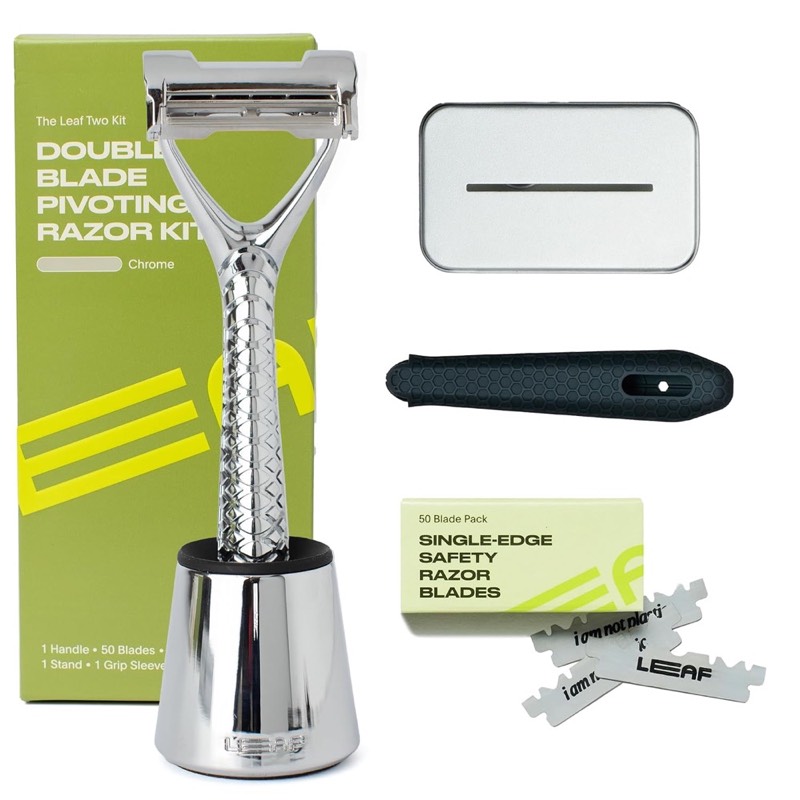
If a fixed head feels like too big a jump from cartridges, the Leaf Two is the halfway house. It has a spring-loaded pivoting head that holds one or two half blades, two by default, each with its own guard. Leaf says the razor is all metal with no plastic and is designed for face, head and body, including legs and underarms.
The kit on Amazon includes the razor, a stand, 50 single-edge blades, a blade recycling tin and a removable silicone grip sleeve. Silicone isn’t a conventional plastic, but it is a synthetic polymer; you can leave it off.
Trade-offs: more moving parts than a double-edge razor, and two blades per load. Leaf has just released a version 2.1 with the pivot moved to the base and retuned blade exposure, and says version 2.0 will sell through by the end of October. Check which version the listing ships.
Leaf’s Leaf Two details · version 2.1 notes.
Check price on AmazonFor finding your blade · paperboard boxes
Razor Blades Club Double Edge Blade Sampler, 40 Blades, 8 Brands
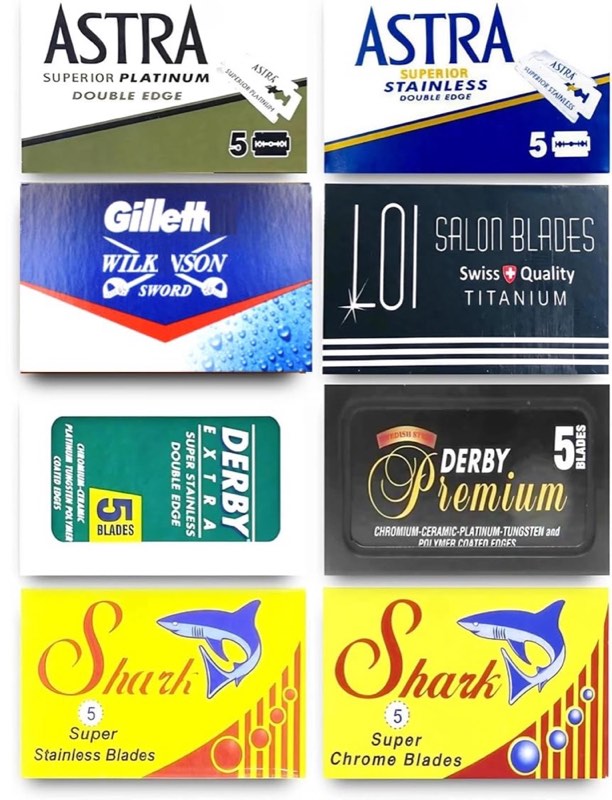
This sampler holds eight five-blade boxes: Astra Superior Platinum, Astra Superior Stainless, Gillette Wilkinson Sword, LOI Salon Titanium, Derby Extra, Derby Premium, Shark Super Stainless and Shark Super Chrome. It fits the Merkur, Rockwell and Henson razors above.
The listing photo shows paperboard tuck boxes, not plastic dispensers. The listing doesn’t describe the wrapping inside each box or any outer packaging, so we can’t confirm every layer is paper.
Trade-offs: blade preference is personal, and five blades per type is only a short trial. It doesn’t include some very sharp blades, such as Feather. When you find a favorite, buy that brand in a larger pack.
Check price on AmazonSoap, cream and brushes
- You don’t need new products. Any shaving cream, gel or soap you already own works with a safety razor.
- Soap pucks are often sold in metal tins or paper; check the listing, because some come in plastic tubs.
- Synthetic brushes are plastic. A Mühle synthetic brush catalogued by the Museum of Design in Plastics has polyamide (nylon) bristles and a resin handle. Boar and badger brushes use animal hair. You can also lather with your hands.
Finishing the bathroom? Our plastic-free toothpaste and toothbrush guide covers the other daily swap.
Frequently asked questions
Are safety razors plastic-free?
The razor itself usually is: the four razors here are metal. The blades are steel, but most modern blade edges carry a very thin PTFE coating, and packaging ranges from paper wrappers to small dispensers. Some kits also add a silicone grip.
Is a safety razor dangerous?
Not for most adults who learn the basics. Nicks usually come from pressure, a steep angle, a dull blade or going over the same spot again and again. Start with a mild razor, use short strokes with almost no pressure and rinse after each stroke. If irritation or razor bumps keep coming back, see a dermatologist.
What is the safest safety razor for a beginner?
We found no injury data that ranks models. Forgiving places to start are a mild, closed-comb razor such as the Merkur 34C, an adjustable razor on one of its lowest settings, or a pivoting razor such as the Leaf Two.
Do razor lubricating strips release microplastics?
We found no study that measured it. A Gillette patent describes conventional strips as a water-soluble polymer, polyethylene oxide, held in a water-insoluble matrix, typically polystyrene. The soluble part dissolves during shaving; the matrix stays in the cartridge and is thrown away with it.
Can I bring a safety razor on a plane?
In carry-on bags, only without the blade. TSA says to remove the blade before the checkpoint, and loose razor blades are not allowed in carry-on bags, so pack them wrapped in checked luggage. Disposable razors are allowed in carry-on bags. The TSA officer makes the final decision.
How do I dispose of safety razor blades?
Collect used blades in a closed metal blade bank or a sealed can, never loose in a bin. Rules for a full container vary: some cities take a lidded metal can of blades as scrap metal at a drop-off site, while others want blades taped or sealed and put in the trash.
How often should I change a safety razor blade?
The American Academy of Dermatology suggests replacing the blade after 5 to 7 shaves. Change it sooner if it starts to tug or irritate.
Is it true that 2 billion disposable razors are thrown away each year?
That figure comes from a 1990 EPA consumer booklet, which said the United States produces 2 billion throwaway razors and blades a year. It counts razors and blades together, gives no method, and is 36 years old. The EPA told the Associated Press in 2019 that it had no update.
Sources and editorial method
Researched October 27, 2026. We compared government guidance, manufacturer specifications and patents, a peer-reviewed safety review, and the exact Amazon variants linked above. This is a research-based buying guide, not a laboratory or hands-on comparison: we have not shaved with these products or measured particle release, blade sharpness or skin outcomes.
- US EPA (October 1990): The Environmental Consumer’s Handbook, EPA/530-SW-90-034B — origin of the “2 billion throwaway razors and blades” figure.
- Olson, Associated Press (Aug 7, 2019): How to keep your razors from contributing to landfill waste, via KSL.com — EPA’s statement that it has no update, and municipal recycling limits.
- Gillette Company: US 6,301,785 B1, Shaving aid strip for razor cartridge (filed 2000) — conventional strip composition and release.
- Gillette UK: ProGlide razor blades, 16 pack — ingredient list.
- Fruijtier-Pölloth (2005): Safety assessment on polyethylene glycols (PEGs) and their derivatives as used in cosmetic products, Toxicology, 214(1–2), 1–38.
- Gillette Company: US 6,110,532 A, Method of coating cutting edges — PTFE coating of razor blade edges.
- American Academy of Dermatology: How to shave and Razor bump remedies for men with darker skin tones.
- TSA “What Can I Bring?”: Safety razor, Razor-type blades, Disposable razor and final-decision note.
- City of Burbank recycling guide: Razor blades — one city’s disposal rules.
- Merkur: 34C, article 34001 — materials, comb and packaging.
- Rockwell Razors: Rockwell 6S and 1/3 base plate — steel grade, settings, weight and plate manufacture.
- Henson Shaving: AL13 in aircraft aluminum and FAQ — materials, weight, angle, aggression and blade compatibility.
- Leaf Shave: Leaf Two, Leaf Two version 2.1 and recycling tin.
- Classic Shaving: Feather Hi-Stainless 10-pack — dispenser packaging description.
- Museum of Design in Plastics: Mühle shaving brush — synthetic brush materials.
- Sampler contents and box packaging are taken from the linked Amazon listing photo; Leaf Two kit contents from its Amazon listing. We did not independently verify them.
Keep swapping
For the rest of the bathroom, see our plastic-free toothpaste and toothbrush picks. If you’re shopping for someone else, the plastic-free gift guide is organized by recipient. And for the bigger exposure question, read what the evidence says about microplastics in the body.