Air Fryer Microplastics: What Your Food Actually Sits On
The plastic shell isn’t the part that matters. Here is what the research shows about coated baskets, what the big brands disclose, and four options with glass, steel or a clearly labeled coating.
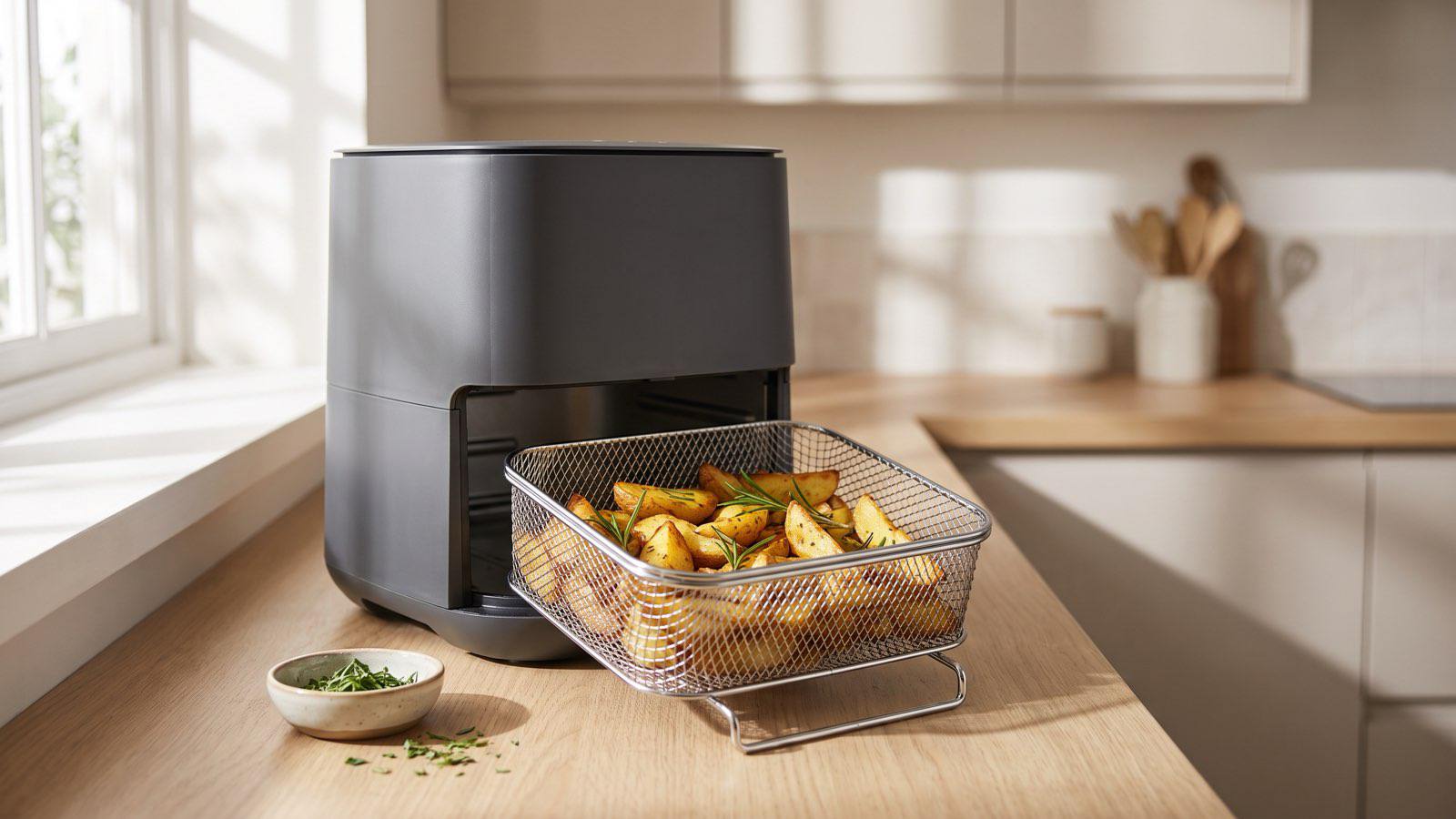
We may earn a commission when you buy through our links, at no additional cost to you. As an Amazon Associate we earn from qualifying purchases. These are research-based recommendations; we have not performed hands-on, coating-wear, or particle-shedding tests.
No published study has measured microplastics coming from an air fryer, so no one can tell you how many particles a given model sheds. The useful question is what your food sits on. The plastic housing doesn’t touch food; the basket, crisper plate and trays do, and many are coated with PTFE nonstick, a fluoropolymer that lab work on scratched pans suggests can shed particles once damaged. For fewer coated or plastic surfaces, look for a glass bowl or uncoated steel, and treat “ceramic” as a different coating, not no coating. See the studies and product sources.
Shopping Black Friday deals for a non-toxic air fryer? Use the checklist below to read past the labels. If your current basket isn’t scratched or flaking, keeping it is reasonable too.
Lower-plastic air fryers at a glance
| Option | What food touches | What to know |
|---|---|---|
| Fritaire glass air fryer, 5 qt | Glass bowl, 304 stainless accessories | A small internal plastic part; hand-wash bowl and lid. |
| Our Place Wonder Oven | Stainless interior, chrome-plated steel basket and rack | Included bake pan is ceramic-coated. |
| Our Place Wonder Oven Pro | Stainless interior, steel basket and rack | Larger; bake pan is ceramic-coated. |
| Cosori Iconic, 6.5 qt | Ceramic-coated stainless basket and crisper plate | No PTFE, but still a coating. |
These are not ranked by measured particle release; no such measurements exist for these models. They are ordered by how completely the maker documents uncoated food-contact surfaces.
What your food actually touches
An air fryer is a small convection oven. Its plastic housing sits outside the cooking chamber and doesn’t touch food; we found no study measuring particles from one, and a plastic part is not a measured exposure. Food touches the basket or bowl, crisper plate, racks and trays, and that is where coatings are found:
- PTFE nonstick. A fluoropolymer from the “Teflon” family. Philips says the baskets and meshes for the models its FAQ covers are steel or aluminized steel, mostly PTFE-coated. “PFOA-free” refers to one PFAS chemical; it doesn’t mean PTFE-free.
- Ceramic nonstick. Marketed as PFAS- and PTFE-free, but still a thin applied layer that can chip. None of the manufacturer pages we reviewed published its formulation.
- Bare or plated steel. Stainless steel, or chrome-plated steel, with no nonstick layer. Food sticks more, so expect a little oil and some soaking.
- Glass. No coating; heavier, breakable, and usually hand-wash only.
Small plastic parts can still sit inside a glass or steel chamber. Fritaire, for example, discloses a small internal component made of PPS, a high-temperature plastic. Look for a specific food-contact statement, like Our Place’s statement that no plastic touches food, rather than a general “non-toxic” badge.
What the air fryer microplastics evidence shows
Damaged PTFE coatings can shed particles, in pans
The key study is Luo et al. (2022) in Science of the Total Environment. Researchers at the University of Newcastle and Flinders University used Raman imaging and electron microscopy to identify PTFE micro- and nanoplastics on non-stick pots, and estimated that thousands to millions of particles might be released during a simulated cooking process.
The researchers’ Flinders University release gives the headline figures: about 9,100 particles from a single surface crack and about 2.3 million from a broken coating. A Food Packaging Forum summary describes six Teflon-coated pots (four new, two about two years old) stirred with stainless steel or wooden turners in a dry run without food or oil. Older pots released more and larger particles, even with wooden turners.
These are image-based estimates from pot surfaces, not particles counted in food; no air fryer basket was tested, and health effects weren’t measured. What carries over is the mechanism: a basket scraped with metal tongs, scrubbed with abrasive pads, or flaking is closest to the experiment. An intact coating used as directed wasn’t quantified.
What air fryer studies have measured
We searched PubMed on October 15, 2026 for air fryer studies on microplastics, PTFE, PFAS or coatings and found none measuring release from a basket into food. The existing research is about cooking fumes:
- Wang and Chan (2023) found higher PM10 and VOC emission factors from an air fryer than a pan for several foods, which they linked to higher temperature and turbulence.
- Tang et al. (2026) tested 12 dishes in a small chamber. Emissions came mainly from browning reactions and fat breakdown, and empty-appliance blank runs produced no nitrogen oxides. After more than 70 uses, residue in hard-to-reach areas raised VOCs by 23% and ultrafine particles by 236% with no food cooking.
- Ryu et al. (2025) measured ultrafine particles from air fryers, toasters and hair dryers; across the appliances they observed copper, silver, titanium and carbon-containing particles.
None identified plastic or coating particles. They are a reason to ventilate and clean the fryer, not evidence about microplastics either way.
What regulators say
The FDA lists non-stick coatings on pots and pans among authorized food-contact uses of PFAS. It says studies show negligible amounts of PFAS in those coatings can migrate to food, and that polymerized PFAS are not absorbed when ingested. That addresses chemical migration, not particles from damaged coatings. The FDA’s overview of microplastics in food describes uncertainties in measurement and health effects.
Ninja, Cosori, Philips and Gourmia: what the makers disclose
We found no brand-level particle study for any of these. What exists is manufacturer documentation, and it varies by model; we used only manufacturer pages and manuals.
| Brand | What the maker documents | What we couldn’t confirm |
|---|---|---|
| Ninja | The Crispi page says its glass containers are made without PFAS and PTFE. | The Crispi and Air Fryer Pro (AF141) pages don’t name the crisper plate or basket coating. |
| Cosori | The Iconic and TurboBlaze pages describe PFAS-free ceramic-coated baskets and crisper plates. | The coating formulation; other models may differ. |
| Philips | Its materials FAQ lists steel or aluminized steel parts, mostly PTFE-coated, plus ceramic-coated meshes on 7000 Series models. | The US page covers the HD9650/90; check the version for your model. |
| Gourmia | We found no Gourmia page or manual naming its basket coating. | Ask Gourmia about your exact model. |
What to check before buying
“Stainless,” “glass” and “non-toxic” often describe the outside. Ask a narrower question: what is every part that touches food made of, and is it coated?
- Match the exact model. Coatings change between generations and sizes, so check the model number against the maker’s page or manual.
- List every food-contact part. Basket or bowl, crisper plate, racks, trays, rotisserie parts and included pans.
- Look for the coating by name. “PTFE,” “ceramic coating,” “uncoated stainless” and “glass” are useful. “Nonstick” alone means some coating.
- Read free-of claims precisely. PFOA-free is not PTFE-free, PFAS-free ceramic is still a coating, and BPA-free is not plastic-free.
- Check inside the chamber and the accessories. Note any disclosed internal plastic parts. A steel oven can ship with a coated pan: Breville’s Smart Oven Air manual lists a non-stick pizza pan and non-stick interior walls.
- Accept the trade-offs. Uncoated steel sticks more, glass is heavier and breakable, and coated baskets need gentle tools and replacement once scratched.
Four lower-plastic air fryers worth considering
We chose these for documented food-contact materials, not cooking performance. Product photos show the linked models. We left out models such as Cuisinart’s TOA-112, whose page documents a stainless steel interior but not its basket or pan material.
Our first choice · glass bowl, steel accessories
Fritaire Self-Cleaning Glass Air Fryer, 5 qt, White
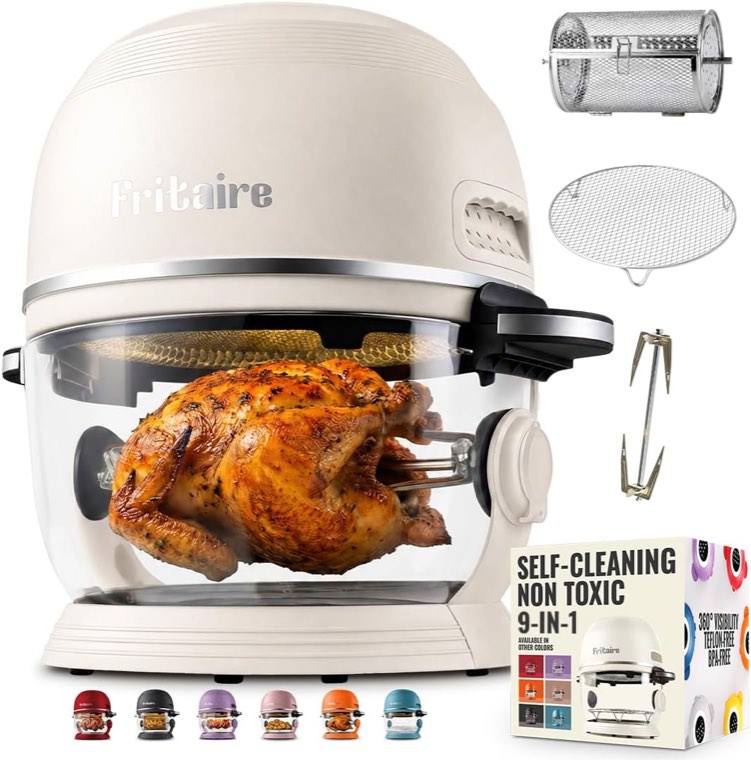
The Fritaire swaps the drawer basket for a glass bowl. Fritaire lists tempered glass for the bowl, 304 stainless steel for the rotisserie, tumbling basket and air stand, and “none” for food-contact coatings. It is our first choice because Fritaire documents the bowl, accessories and its one internal plastic part.
Trade-offs: It is not plastic-free. Fritaire discloses a small internal PPS component, which it rates to 500°F, and the Amazon listing says plastic is used in exterior parts such as the handles. The lid material isn’t named. The bowl and lid are hand-wash only, glass can break, and a round bowl holds less flat food than a large drawer. The link is the white 9-in-1 model with rotisserie.
Fritaire’s materials and specifications.
Check price on AmazonFor a compact oven · no plastic on food-contact surfaces
Our Place Wonder Oven, 6-in-1, Steam
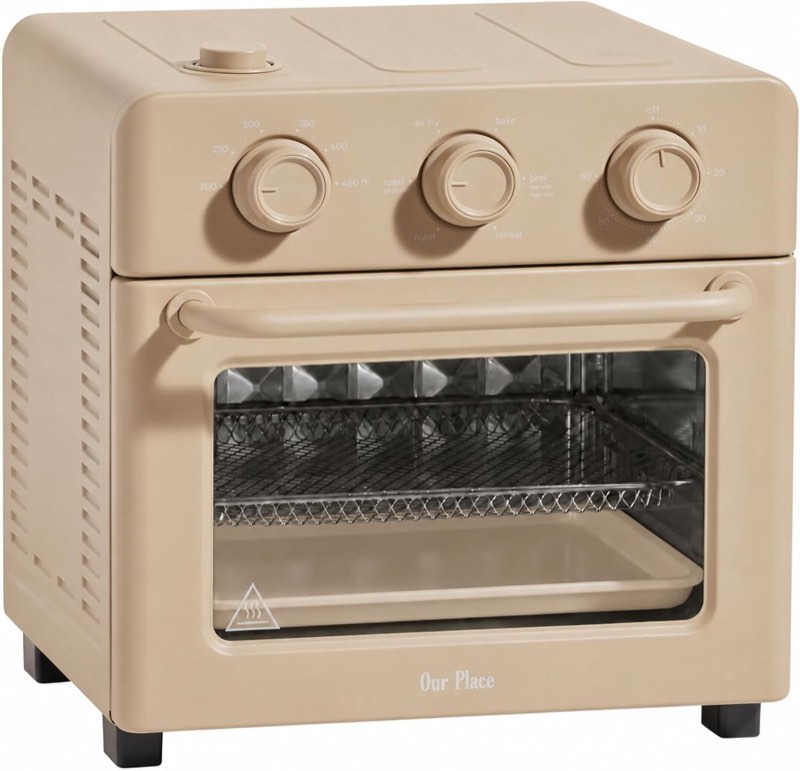
For an air fryer toaster oven, Our Place documents a stainless steel interior, a chromed-steel air fryer basket and wire rack, and a stainless crumb tray. It states that no plastic is on any surface touching food and that the oven is made without PFAS, including PTFE. Two rack levels suit a small household.
Trade-offs: The included bake pan is aluminum with a ceramic nonstick coating; to avoid coatings entirely, use a steel or glass dish that fits and is oven-safe. Chromed steel is a plated finish, and Our Place doesn’t call it stainless. Materials for parts that don’t touch food aren’t listed. The link is the Steam color.
Our Place’s Wonder Oven materials.
Check price on AmazonFor bigger batches · steel basket, coated pan
Our Place Wonder Oven Pro, 8-in-1, Cream
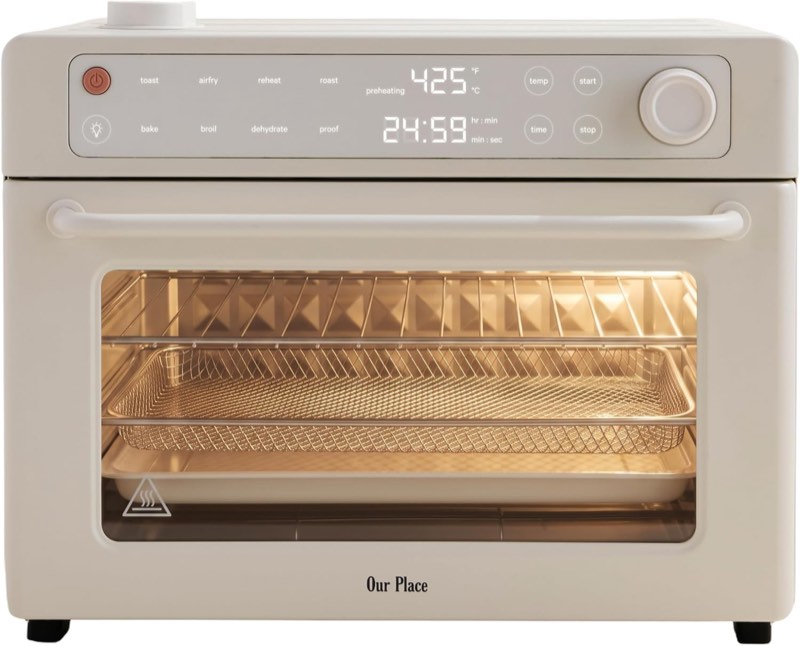
The Pro is the family-size option; the linked listing describes a 30-quart interior with three rack levels. Our Place states a stainless steel interior, lists the air fryer basket, wire rack and crumb tray as steel, and repeats its no-plastic-on-food-contact-surfaces statement.
Trade-offs: The bake pan is aluminum with a ceramic nonstick coating. Our Place lists the basket and rack as “steel” without saying stainless or uncoated, so ask if that matters to you. It takes far more counter space than a basket fryer. The link is the Cream color.
Our Place’s Wonder Oven Pro specifications.
Check price on AmazonFor a drawer-style fryer · ceramic coating, not bare steel
Cosori Iconic Stainless Steel Air Fryer, 6.5 qt
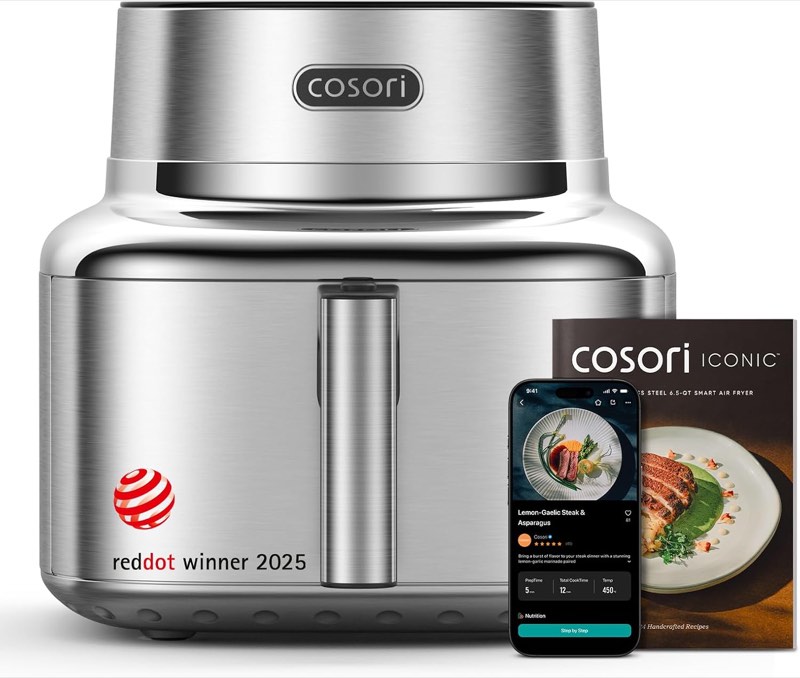
If you want the familiar drawer, the Iconic (model CAF-SE601S-CUS) is the most metal-forward basket model we found documented. Cosori says the basket is made with 304 stainless steel, the basket and crisper plate have a PFAS-free ceramic nonstick coating, and the unit is 96% metal by visible area, a figure that excludes the cord, glass panel, non-visible areas and internal components.
Trade-offs: This is the “less plastic, still a coating” option. The ceramic layer avoids PTFE, but Cosori doesn’t publish its formulation, and we found no study of particle release from ceramic air fryer coatings. Use non-metal tools, skip abrasive pads, and replace the basket if the coating chips.
Cosori’s Iconic materials and FAQ.
Check price on AmazonAir fryer liners: parchment, silicone or foil?
Liners sit directly under food, so check your manual first. The Cuisinart and Breville air fryer oven manuals we read say not to put paper in the oven or cover the crumb tray or any part of it with foil.
- Parchment. Paper, not plastic. A 2023 method-development study reported low-level migration of PFAS and organophosphate esters from baking-paper samples into a food simulant, calling the results preliminary. Where paper is allowed, weigh it down so it can’t lift into the heater.
- Silicone. The documented issue is chemical migration, not particle shedding. A 2026 study of ten silicone air fryer molds sold in Panama found all ten exceeded the 0.5% volatile-release guidance used by Germany’s BfR, and in some tests dibutyl phthalate and cyclic siloxanes exceeded migration limits. A 2025 Health Canada study measured siloxanes moving from silicone bakeware into a fatty food simulant and room air during baking, declining with repeated use.
- Foil. Not plastic. Germany’s BfR advises against wrapping acidic or salty foods in aluminium foil.
- No liner. Glass and uncoated steel can be soaked and scrubbed, which is much of the reason to choose them.
Use and care for any air fryer
- Use wood or silicone tongs on coated baskets (see our plastic-free utensils guide), skip metal scouring pads, and replace a basket that is scratched or flaking.
- Clean grease and crumbs regularly, including areas your manual says you can reach; residue raised idle emissions in Tang et al.
- Run a new appliance empty if the manual says to, with ventilation. Breville’s manual attributes first-use vapors to protective substances on the heating elements.
Frequently asked questions
Do air fryers release microplastics?
No published study has measured microplastics released from an air fryer. Research on scratched non-stick pans suggests damaged PTFE coatings can shed particles, so a scratched or flaking coated basket is the more relevant concern than the plastic housing.
Does the plastic in an air fryer touch food?
In most basket air fryers, the plastic housing and handle sit outside the cooking chamber. Food touches the basket, crisper plate, racks and trays. Some models also have small plastic parts inside, so check the manufacturer’s food-contact statement.
Is a ceramic air fryer basket plastic-free?
A ceramic nonstick basket avoids PTFE, but it is still an applied coating, and the manufacturers we reviewed don’t publish its formulation. If you want no coating at all, look for glass or uncoated steel food-contact parts.
What is the most non-toxic air fryer material?
Glass and uncoated stainless steel avoid nonstick coatings on the surfaces food touches. No study ranks air fryer materials by measured health outcomes, so treat them as lower-coating choices, not a guarantee of zero particles.
Are silicone air fryer liners safe?
Studies of silicone air fryer molds and silicone bakeware found siloxanes and other substances migrating into food simulants, in some tests above regulatory limits or guidance. If you use one, follow the maker’s temperature limit; glass and steel baskets don’t need a liner.
Do Ninja, Cosori or Philips air fryers have microplastics?
We found no brand-specific particle studies. Philips documents PTFE coatings on many baskets for the models its FAQ covers, Cosori documents ceramic coatings on models such as the Iconic, and Ninja describes its Crispi glass containers as made without PFAS and PTFE. Check your exact model.
Sources and editorial method
Researched October 15, 2026. We searched PubMed for air fryer studies, read the studies and manufacturer documents below, and checked the exact Amazon variants linked above. This is a research-based buying guide, not a laboratory comparison. We have not tested these appliances, measured coating wear or particle release, or evaluated cooking performance. We could not access the full text of Luo et al.; its counts here follow the abstract and the university release.
- Luo et al. (2022): Raman imaging for the identification of Teflon microplastics and nanoplastics released from non-stick cookware, Science of the Total Environment, 851, 158293. PubMed.
- Flinders University (2022): Not-so-tough Teflon — particle estimates. Food Packaging Forum summary — pots, utensils and dry-run setup.
- Tang et al. (2026): VOCs, NOx and ultrafine particles emitted by domestic air fryers, ACS ES&T Air, 3(2), 473–487.
- Wang and Chan (2023): Particulate matter and VOC emissions from a domestic air fryer, Environmental Science & Technology, 57(45), 17384–17392.
- Ryu et al. (2025): Ultrafine particles from small home appliances, Journal of Hazardous Materials, 498, 139796.
- FDA: Authorized uses of PFAS in food contact applications and FDA: Microplastics and nanoplastics in foods.
- Jaén et al. (2026): Chemical characterization and migration profile of silicone molds for air fryers, Polymers, 18(17), 2162.
- Zhu et al. (2025): Silicone bakeware as a source of exposure to cyclic siloxanes, Journal of Hazardous Materials, 497, 139591.
- Sonego et al. (2023): Chemicals from baking paper and aluminium foil, Food Chemistry, 409, 135260.
- BfR (2018): Aluminium and food — foil advice.
- Fritaire product page; Our Place Wonder Oven; Our Place Wonder Oven Pro; Cosori Iconic — food-contact materials and coatings.
- Philips airfryer materials FAQ; Cosori TurboBlaze; Ninja Crispi; Ninja Air Fryer Pro — brand coating disclosures.
- Cuisinart TOA-112 product page and manual; Breville Smart Oven Air (BOV900) instruction book — interiors, accessories, foil and paper warnings.
- The Fritaire exterior-plastic statement, the Wonder Oven’s rack levels and household size, and the Wonder Oven Pro’s 30-quart capacity and rack levels come from the linked Amazon listings. We did not independently test those claims.
Keep swapping
For pans and pots, compare coatings in our non-toxic cookware guide. For leftovers, see our glass food-storage guide, and for covering food without cling film, our plastic wrap alternatives.