Do Microplastics Make Dangerous Chemicals in Water? What the Nature Study Found
Headlines say plastic particles turn water into a source of tissue-damaging chemicals. The study behind them is real and interesting. Here is what it tested, what it didn’t, and whether you should change anything.
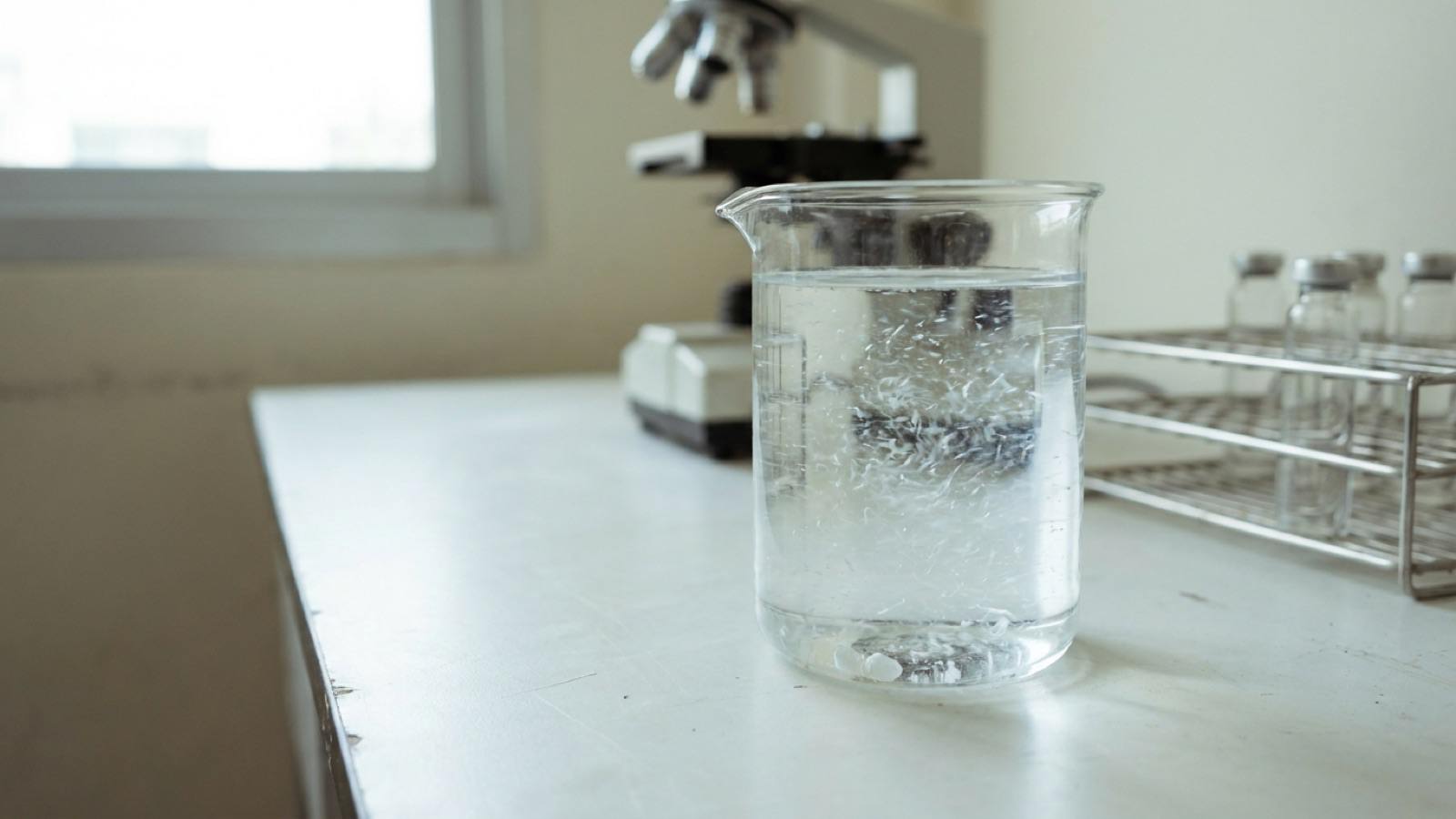
In the lab, yes. A Columbia-led team reported in Nature on October 14, 2026 that six common plastics, as microscopic particles in water, spontaneously produced hydroxyl radicals, a highly reactive form of oxygen. The tests used large amounts of new plastic powder, a single protein and mouse blood cells in a dish. They do not show harm in people, and they don’t change the practical advice: keep plastic away from heat and filter your water. See the sources we reviewed.
This is a research-based study breakdown. We read the open-access paper, its methods and extended data, the published peer-review file, the university announcement and independent expert comment. We have not run any experiments. The study got a second wave of attention after The Washington Post covered it on October 25.
The study at a glance
| Claim | What the paper shows | Type of evidence |
|---|---|---|
| Microplastics make radicals in water | All six plastics tested produced hydroxyl radicals in water without light or added oxidizers. Three detection methods agreed. | Lab chemistry |
| Water-repellent plastics are more active | Polyethylene and polypropylene were most active; PET and acrylic least. Activity tracked how strongly each plastic repels water. | Lab measurements plus computer simulation |
| Why it happens | Simulations suggest hydroxide ions at the plastic surface give up an electron more easily. The electric field behind this was inferred, not measured directly. | Simulation, indirect measurement |
| Damage to proteins and cells | A protein clumped on particle surfaces; a radical scavenger reduced it. Mouse red blood cells broke apart, more so with the more active plastics. | Cells and one protein in a dish |
| Harm in people | Not tested. | None |
What the team did
The paper, “Intrinsic physicochemical activity at microplastic–water interfaces,” comes from Wei Min’s chemistry lab at Columbia University, with Teresa Head-Gordon’s theory group at UC Berkeley. First author Naixin Qian is the same researcher who led the group’s 2024 bottled-water study. Plastics are usually treated as chemically inert. The team asked whether that still holds once plastic is ground into particles with far more surface touching water.
- A dye test. They stirred polystyrene powder in water containing methyl orange, a dye that breaks down when attacked by reactive oxygen. With 10 milligrams of powder per millilitre (10 grams per litre), stirred for 10 days, about 90% of the dye was gone. The same powder in alcohols and other solvents left the dye intact, which pointed to water as the key ingredient.
- Catching the radicals. Electron spin resonance, which detects unpaired electrons, picked up signals attributed to hydroxyl radicals in water that had held the powder for 20 minutes. A fluorescent probe that lights up when hit by hydroxyl radicals glowed mainly at the particle surfaces, suggesting the reaction happens where plastic meets water.
- How much. The authors give a lower-bound estimate on the order of 0.1 to 1 nanomolar of hydroxyl radicals per minute at the polystyrene surface. Coating the particles with a detergent-like surfactant largely shut the reaction down. The extended data also report activity in cell-culture medium and serum, not just in salt buffer.
- The theory. Simulations of polyethylene, PVC and acrylic in water found that hydroxide ions near the most water-repellent surface were more often under-surrounded by water molecules, and that this, together with negative charge at the surface, makes it easier for them to lose an electron and become hydroxyl radicals. The team links this to its 2025 Nature paper on oil droplets in water.
Hydroxyl radicals are among the most reactive molecules in chemistry and last only a tiny fraction of a second. Your own cells also produce reactive oxygen species all the time, some as normal signals, and toxicology studies have long linked microplastic exposure in cells and animals to oxidative stress. What is new here is a proposed source: the particle surface itself, not just the body’s response to it.
The biology experiments
Charged proteins and DNA collected on polypropylene particles far more than on acrylic. In one test, lysozyme, an egg-white enzyme used as a model protein, formed clumps on polystyrene surfaces over time. Adding caffeine, which mops up radicals, significantly reduced the clumping, which points to the radicals as a cause.
In the second test, red blood cells from mice were incubated with particles. Some cells touching polystyrene broke into fragments. How much hemoglobin leaked from the cells varied by plastic, in step with each plastic’s radical activity (correlation 0.75). That is a correlation across six plastics in a dish, not a measurement of damage in a living animal.
Which plastics were most active
All six commodity plastics produced radicals: polyethylene (PE), polypropylene (PP), polystyrene (PS), PVC, PET and acrylic (PMMA). The polyolefins, PE and PP, were the most active. PET and PMMA, whose structures include oxygen groups that attract water, were the least active, with PS and PVC in between. In simulations, the share of “dangling” water bonds at each plastic’s surface tracked the measured activity closely (correlation 0.94).
That ordering is the part most readers will want to apply to their kitchens, and it needs care. PE and PP are among the most common food-contact plastics, used for tubs, bottle caps, bags and many baby bottles. But the study tested particles, not a container’s intact surface, which exposes far less plastic to water. And “least active” does not make PET bottles a better choice: other research has counted large numbers of particles in water from PET bottles. The ranking tells you about surface chemistry, not about which product releases fewer particles.
What the study doesn’t show
- Real-world doses. The dye test used 10 grams of plastic powder per litre of water; the radical-imaging tests used roughly 1 milligram per millilitre. Those are loads of powder you can see. Studies of drinking water count particles per litre, typically far smaller by mass, and the paper does not estimate radical production at those levels. For how much plastic people likely swallow, see our credit-card fact-check.
- Fresh plastic, not weathered plastic. The main experiments used new, laboratory-grade powders with clean surfaces. In the extended data, polystyrene powders from other suppliers with more oxidized surfaces, a chemical change that also happens as plastic ages in the environment, were less water-repellent and less active, though still reactive.
- Microplastics, not nanoplastics. The particles were micrometre-sized powders. June-Woo Park of the Korea Institute of Toxicology, commenting via the Science Media Centre, noted that nanoscale particles were not examined, although they are thought to be more hazardous. He also judged the evidence sufficient for the mechanism the paper describes.
- Cells in a dish, not bodies. One model protein, mouse red blood cells and no living animals. Whether particles in the body generate enough radicals, close enough to tissue, to matter is untested.
- A mechanism partly inferred. The proposed driver, a strong electric field at the plastic surface, comes from simulations and zeta-potential measurements of surface charge rather than a direct field measurement.
- Interfacial water chemistry is contested territory. A related claim, that water microdroplets spontaneously make hydrogen peroxide, was reported in 2019 and then disputed by another group that found no hydrogen peroxide in microdroplets formed by ultrasound or condensation. Results at the boundary of water and another material are sensitive to conditions and contamination, which is why independent replication matters here.
Two disclosures from the paper: Columbia has filed a provisional patent application based on the work, and the research was funded by the National Institutes of Health, the US Air Force Office of Scientific Research and the US Department of Energy.
Inside the peer review
Nature published the reviewers’ reports and the authors’ replies alongside the paper. Several reviewers said their concerns were addressed after revision. One reviewer remained unconvinced after the revision, arguing that:
- the work mainly applies the team’s 2025 oil-droplet findings to a new material, rather than establishing a new mechanism;
- the electric field “is inferred rather than directly demonstrated”;
- other radical sources, such as additives, leftover chemicals from manufacturing or oxidized surface groups, needed to be ruled out more thoroughly; and
- the paper should spell out how lab conditions differ from real environments, to avoid overgeneralizing.
An earlier round of review had also asked for radical-scavenger controls to show that radicals, not just particle contact, damaged proteins and cells. The editor overruled the novelty objection and said the authors were not expected to test environmentally weathered microplastics experimentally. None of this means the finding is wrong. It does mark where the open questions are.
How the coverage compares with the paper
The paper’s own language is careful: it calls the radicals “a possibly overlooked mechanism” for harm. Columbia’s announcement goes further. It quotes Wei Min saying the radicals “very likely” contribute to damage seen in animals and potentially humans, and it refers to micro- and nanoplastics, bottled water and the bloodstream, none of which were tested directly. Those are reasonable hypotheses for the next studies, not findings.
Does this change what you should do?
Not much. The study adds a possible reason why swallowed particles could matter; it doesn’t identify a new source of exposure or a new way to avoid one. The FDA’s position remains that current evidence does not demonstrate that the levels found in foods pose a risk to human health. The steps that cut exposure are the same as before:
- Don’t heat food or drinks in plastic. In a 2023 lab study, microwaving some plastic containers released up to 4.22 million microplastic and 2.11 billion nanoplastic particles per square centimetre of plastic within three minutes. Reheat in glass containers and boil water in a plastic-free kettle.
- Filter tap water rather than defaulting to bottled. Our water filter guide covers filters with published microplastic data.
- Swap the plastic that touches hot drinks. Check which tea bags have plastic, and carry a stainless steel bottle.
- Skip the detox products. No study has shown that any supplement removes microplastics or counters this effect in people; see what the evidence says about removal.
Frequently asked questions
Do microplastics create dangerous chemicals in water?
In lab tests, microplastic particles in water produced hydroxyl radicals, short-lived molecules that can damage proteins and cells. The study used large amounts of new plastic powder. It did not measure radicals in drinking water or show harm in people.
Are microplastics free radicals?
No. Microplastics are small pieces of plastic, not radicals. The new study suggests that their surfaces can generate radicals, mainly hydroxyl radicals, from the water around them.
Which plastics produced the most radicals?
Polyethylene and polypropylene, the most water-repellent of the six plastics tested. PET and acrylic (PMMA) were the least active, with polystyrene and PVC in between.
Does this mean bottled water is dangerous?
The study did not test bottled water; it tested plastic powders in lab solutions. Earlier research from the same Columbia group counted many small plastic particles in bottled water, which is one reason to prefer filtered tap water, but neither study shows that drinking bottled water causes harm.
Should I take antioxidants to counter microplastics?
We found no study testing whether antioxidant supplements offset this effect in people. Reducing how much plastic you swallow is the step with evidence behind it.
Has the study been replicated?
Not as of October 27, 2026. It is one research team’s peer-reviewed result. Independent replication and tests on weathered particles, nanoplastics and living animals are the next things to watch for.
Choosing water treatment requires separate performance evidence. Our RO and nanoplastics explainer shows how to check a complete system's claims without converting a laboratory finding into a household guarantee.
Sources and editorial method
Reviewed October 27, 2026. This is a research-based study breakdown, not a laboratory study or medical guidance. We read the open-access paper, including its methods and extended data, the published peer-review file and the sources below. We have not repeated any experiment. Numbers are as reported by the authors; where the paper gives a lower-bound estimate, we say so.
- Qian et al. (2026): Intrinsic physicochemical activity at microplastic–water interfaces, Nature 658:650–657. Open access; published October 14, 2026.
- Peer Review File for Qian et al. (2026), Nature. Reviewer reports and author responses.
- Columbia University: Microplastics are chemically active, and could cause biological harm (October 14, 2026).
- Science Media Centre Spain: expert reaction from June-Woo Park, Korea Institute of Toxicology (October 14, 2026).
- The Washington Post: coverage of the study (October 25, 2026).
- Shi et al. (2025): Water structure and electric fields at the interface of oil droplets, Nature 640:87–93. The same groups’ earlier work.
- Qian et al. (2024): Rapid single-particle chemical imaging of nanoplastics by SRS microscopy, PNAS 121(3). Bottled-water particle counts.
- Sies and Jones (2020): Reactive oxygen species (ROS) as pleiotropic physiological signalling agents, Nature Reviews Molecular Cell Biology 21:363–383.
- Hu and Palić (2020): Micro- and nano-plastics activation of oxidative and inflammatory adverse outcome pathways, Redox Biology 37:101620. Review.
- Lee et al. (2019): Spontaneous generation of hydrogen peroxide from aqueous microdroplets, PNAS 116:19294–19298.
- Musskopf et al. (2021): The air–water interface of water microdroplets formed by ultrasonication or condensation does not produce H2O2, Journal of Physical Chemistry Letters 12:11422–11429.
- Hussain et al. (2023): Release of microplastics and nanoplastics from plastic containers and reusable food pouches, Environmental Science & Technology 57(26):9782–9792.
- FDA: Microplastics and nanoplastics in foods.
Keep reading
For the bigger picture, see what the studies show about microplastics in the body, then start with the swaps that matter most: water filters, glass storage containers and non-toxic cookware.