Which Tea Bags Have Plastic? 16 Brands Checked
Pyramid mesh, heat-seal fibers and “plant-based” PLA are the usual suspects. Here is what each tea maker says about its own bags, what the studies actually measured, and where the gaps are.
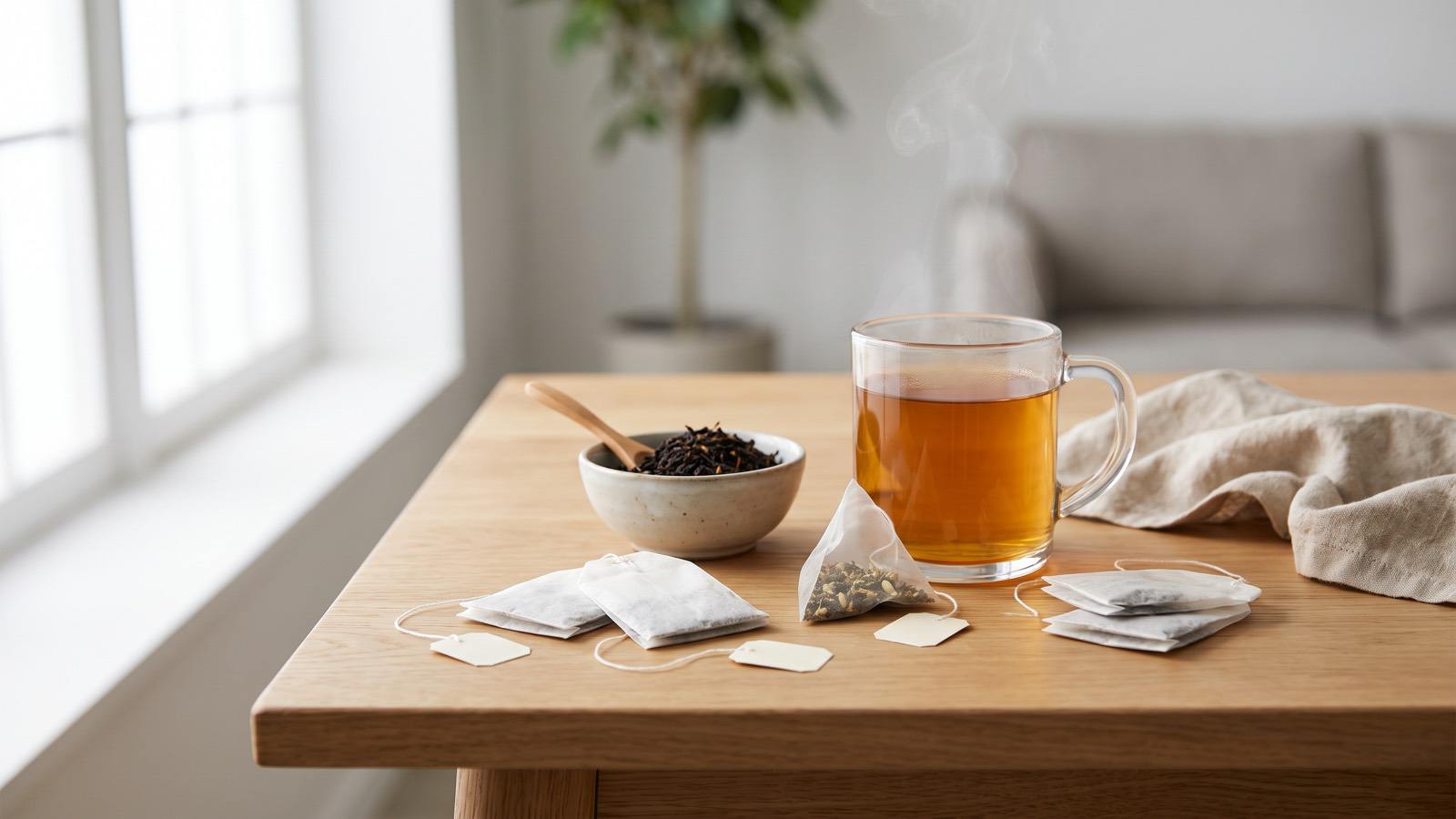
We may earn a commission when you buy through our links, at no additional cost to you. As an Amazon Associate we earn from qualifying purchases. This is a research-based guide; we have not tested any tea bag for particle release or analyzed its materials.
Plastic in tea bags usually comes from one of three places: woven nylon or PET mesh in “silky” pyramid sachets, polypropylene fibers that let paper bags be heat-sealed, or PLA, a plant-derived plastic often sold as “plant-based” or “compostable.” We checked what 16 tea brands say about their own bags on October 15, 2026. Bigelow, Stash, Traditional Medicinals, Yogi and Numi say their paper bags contain no plastic, and PG Tips says its UK bags contain no synthetic plastics. Several others describe plant fibers or “plant-based” materials without saying whether any plastic is present, and for four brands (Celestial Seasonings, Good Earth, The Republic of Tea and Trader Joe’s) we found nothing on plastic at all.
These are manufacturer statements, not lab results, and no study we cover named these brands. Jump to the brand table.
Want to skip the bag question entirely? Our plastic-free tea guide covers steel strainers, glass teapots and loose-leaf starter options.
Which tea bags have plastic? The brand-by-brand table
We classified each brand only from its own FAQ, sustainability page or product page, linked in the last column. Where the maker doesn’t say, we wrote Not stated rather than guess. Statements apply to the market shown (US unless noted), product lines within one brand can use different bags, and companies can change materials without updating their websites.
| Brand / product line | Bag type | What the maker says about bag material | Source and date checked |
|---|---|---|---|
| Bigelow (all lines) | Mostly non-heat-sealed paper bags; some heat-sealed bags; pyramids in Steep Café and Charleston Tea Garden lines | Says no plastic. All bags described as biodegradable, compostable and plastic-free. Standard paper is wood pulp and abaca, folded without adhesive. Heat-sealed bags and pyramids use a sealant made from corn and sugarcane starches; the polymer is not named. | Bigelow tea bag materials (page updated Jul 30, 2026); checked Oct 15, 2026 |
| Celestial Seasonings | Bags without strings, tags or staples | Not stated. Product pages describe the stringless format but not the bag material; the FAQ has no material entry. | Product page and FAQ; checked Oct 15, 2026 |
| Good Earth | Not confirmed | Not stated. We found no first-party statement, and the brand’s website did not load when we checked. | No maker statement found; checked Oct 15, 2026 |
| Harney & Sons sachets | Pyramid-style sachets | Plant-derived; polymer not named. Most sachets are an industrially compostable material derived from sugarcane. Hot Cinnamon is the stated exception; that post does not name its material. In 2019 Harney described its sachets as food-grade nylon. | Harney blog (Jan 23, 2026) and 2019 statement; checked Oct 15, 2026 |
| Harney & Sons tea bags | Flat paper bags | Plastic not addressed. Describes the paper as oxygen-bleached and compostable. | Harney blog (Jan 23, 2026); checked Oct 15, 2026 |
| Lipton pyramid line | Pyramid bags | “Plant-based”; polymer not named. | Lipton product page; checked Oct 15, 2026 |
| Lipton classic black tea | Classic flat bags | Not stated on the product page or US FAQ. | Product page and FAQ; checked Oct 15, 2026 |
| Numi | String-and-tag paper bags | Says no plastic. Bags are unbleached manila hemp fiber, which Numi says is not plastic; cotton string. The wrapper, not the bag, is lined with PLA. | Numi FAQ and blog (Feb 16, 2024); checked Oct 15, 2026 |
| PG Tips (UK range) | Paper bags | Says no synthetic plastics. Bags are paper and cornstarch, industrially compostable; the polymer is not named. The page also claims no microplastics in the cup but cites no test. | PG Tips brand page; checked Oct 15, 2026 |
| Pukka | String-and-tag, stitched | Plant fibers; plastic not addressed for the bag. Paper is abaca, wood pulp and plant cellulose; bags are stitched with organic cotton rather than stapled, and certified home compostable. Envelopes carry a thin plastic coating. | Pukka packaging page (UK); checked Oct 15, 2026 |
| The Republic of Tea | Round bags, no strings, tags or staples | Not stated. Unbleached paper and no glue; nothing on plastic or how the bag is sealed. | Our Tea Bags page; checked Oct 15, 2026 |
| Stash | String-and-tag paper bags | Says no plastic. Filter paper is 100% wood cellulose, machine-folded and pressed without glue. | Stash FAQ; checked Oct 15, 2026 |
| Tazo | Tea bags (range-wide answer) | Plant fibers; no direct yes or no. Asked whether its bags contain plastic, Tazo says the paper is home compostable and made from abaca, wood pulp and plant-based fibers. | Tazo FAQ; checked Oct 15, 2026 |
| Tetley (UK range) | Retail bags; catering packs | “Plant-based”; polymer not named. Catering-pack bags are described as not yet compostable. We found no statement for the US range. | Tetley packaging page (UK); checked Oct 15, 2026 |
| Traditional Medicinals | Paper tea bags | Says no plastic. Paper bags are not heat-sealed and are made from abacá and FSC-certified wood pulp. Many wrappers still have a thin plastic lining. | Help center and wrapper FAQ; checked Oct 15, 2026 |
| Trader Joe’s | Varies by product | Not stated. We found no bag-material statement from the retailer. | No maker statement found; checked Oct 15, 2026 |
| Twinings string-and-tag | Flat string-and-tag | Plant fibers; plastic not addressed directly. Wood and abaca fibers, fold-sealed without staples, cotton string, compostable. | Twinings packaging page and FAQ; checked Oct 15, 2026 |
| Twinings other formats | Pyramids and other bags | Not stated on the US pages we checked. | Same US pages; checked Oct 15, 2026 |
| Yogi | Paper bags with tags, some stapled | Says paper is free from plastics. Abaca (or bamboo) fiber and wood pulp, non-heat-sealable; staples on some teas. Envelopes have a protective inner lining. | Our process and FAQ; checked Oct 15, 2026 |
Three patterns stand out. First, no current statement we found says the brand uses polypropylene, nylon or PET; the closest is Harney & Sons’ 2019 description of its sachets as nylon, which it says it has since replaced for most teas. Second, “plant-based” does a lot of work: Lipton, Tetley, Harney and Bigelow’s heat-seal papers describe plant-derived materials without naming the polymer. Third, silence is common. A missing statement is not evidence of plastic, and a “no plastic” claim is not a particle measurement.
The three ways plastic gets into a tea bag
1. Woven nylon or PET pyramid sachets
Shiny, see-through pyramids sold as “silken” or “mesh” sachets give whole leaves room to unfurl, which is why premium lines adopted them. Some have been made from nylon or polyethylene terephthalate (PET), and those are the bags the widely quoted 2019 McGill study tested. If a sachet looks like fine fabric and the maker doesn’t name its material, treat it as unknown rather than as paper.
2. Polypropylene in heat-sealed paper bags
A flat bag can be closed by folding, stitching, stapling or heat. Heat sealing needs a material in the paper that melts, and polypropylene (PP) is one of the plastics researchers have identified in tea bag materials. Because it is a small share of the paper, these bags look like ordinary paper. That is why “not heat-sealed,” “folded and pressed” or “stitched” in a maker’s description is useful, and why a plain paper look tells you little.
3. PLA: plant-based, but still a polymer
Polylactic acid (PLA) is made from fermented plant sugars, usually from corn or sugarcane. It has replaced petroleum-based plastics in many “plant-based” and “biodegradable” bags, either as the mesh or as the heat-seal component. It is still a plastic polymer. “Compostable” often refers to industrial composting: in a 2024 field study, a PLA tea bag material was unchanged after seven months buried in soil, while cellulose–PLA blends lost mass mainly as their cellulose broke down.
When a maker describes a sealant or sachet as derived from corn or sugarcane without naming it, PLA is one common material of that kind, but we have not assumed it for any brand. We also did not find a study that measured particle release from PLA tea bags during brewing, so we can’t say whether PLA sheds more or less than nylon or polypropylene.
What the tea bag microplastics studies measured
Hernandez et al. 2019: the 11.6 billion figure
The study behind most headlines, Hernandez et al. in Environmental Science & Technology, tested four commercial plastic tea bags made of nylon or PET. The researchers emptied and rinsed the bags, then steeped them at 95 °C for five minutes (in 10 mL of water, per Germany’s Federal Institute for Risk Assessment, BfR). They reported about 11.6 billion microplastic and 3.1 billion nanoplastic particles per bag, expressed as one cup. Particles were counted by electron microscopy of a dried residue, and plastic identity was checked on that dried film as a whole, not particle by particle. Brands were not named.
The published critique
In a 2020 comment in the same journal, Busse and colleagues, including BfR scientists, argued that drying the extract lets dissolved substances crystallize and be counted as particles. Using micro-Raman spectroscopy, which identifies individual particles, they found 5,800 to 20,400 microplastic particles larger than 1 µm per tea bag, and microplastics made up a low single-digit percentage of all particles. Particles were already on the bag surfaces before brewing.
In an August 2025 communication, the BfR concluded that the original count of particles larger than 1 µm was probably two to three orders of magnitude too high, and that most particles counted were likely oligomers, short-chain by-products of the plastics, rather than microplastics. It said the authors’ 2020 response did not resolve this, and that it expects no health effects at the reported levels, while data remain insufficient for a full assessment. That doesn’t mean nylon or PET bags release nothing: the critics still found thousands of plastic particles per bag, though they traced them to the bag surface rather than the material breaking down.
Banaei et al. 2024: polypropylene, cellulose and nylon-6
Researchers at the Universitat Autònoma de Barcelona simulated tea preparation with three commercial tea bags, made of polypropylene, cellulose and nylon-6 (Banaei et al., Chemosphere). Using nanoparticle tracking analysis, they reported about 1.2 billion particles per milliliter from the polypropylene bag, 135 million per milliliter from cellulose and 8.18 million per milliliter from nylon-6, with average sizes of roughly 137 to 244 nanometers. Human intestinal cells took up the particles, in patterns that differed by material and cell type.
Caveats: counts are per milliliter of lab leachate, not per cup; tracking analysis doesn’t identify each particle’s chemistry; cellulose is not a synthetic plastic, so its count isn’t a plastic count; and brands weren’t identified.
Newer work, 2025–2026
- Yaroslavov et al. (2025, Polymers) tested eight bag types made of nylon, polypropylene or cellulose. Concentrations rose with water temperature and brewing time, peaking around 14 billion particles per liter for synthetic bags and 170 billion for cellulose, mostly 200 nm to 1 µm. The authors reported no toxicity to a human intestinal cell line at those levels.
- Jayasekara et al. (2026, Environmental Science: Processes & Impacts) used optical coherence tomography to count larger particles from nylon tea bags: 16,000 to 24,000 per milliliter across the 12–30 µm and over-30 µm size classes after five minutes at 100 °C. Cold brewing released fewer large particles but a similar number of small ones. Validation was by Nile Red staining and microscopy, not particle-by-particle chemical identification.
- A 2026 systematic review of 19 studies found that release depended on bag material, temperature, brewing time and agitation. Paper and woven nylon bags tended to release less, yet even bags marketed as eco-friendly released measurable particles. The reviewers noted that methods aren’t standardized and exposure estimates remain preliminary.
What this means for the table
The studies did not test the products in our table, and their counts span many orders of magnitude depending on method. No Stash or Bigelow bag has been shown to release zero particles, and no Lipton pyramid has been shown to release billions. The defensible conclusion is narrower: synthetic bag materials can release particles into hot water, the amount depends heavily on how it is measured, and skipping the bag removes that source. Nor do studies agree on which material sheds least: Banaei’s nylon-6 bag released the fewest particles of the three, and a 2022 study rated woven nylon-6 filter bags lowest risk among three types, while the 2019 headline came from nylon and PET. We therefore don’t rank materials.
How to check a tea bag your brand doesn’t explain
- Find the statement for the exact line. Pyramids, flat bags, bulk packs and foodservice packs can differ, as Tetley’s catering packs and Harney’s Hot Cinnamon sachets show.
- Look for a named material. “Abaca and wood pulp, not heat-sealed” tells you something. “Plant-based” alone does not.
- Read “compostable” carefully. An industrially compostable bag can still contain PLA.
- Separate the bag from the wrapper. Pukka and Traditional Medicinals describe a thin plastic coating or lining on envelopes, Numi lines its wrappers with PLA, and Yogi’s envelopes have a protective inner lining. Wrappers don’t go in your cup, but they are part of the packaging.
- Ask the company. A question such as “Is there any polymer in the bag paper, sealant or mesh for this product?” should get a direct answer.
- Or skip the bag. Loose leaf in a steel basket avoids the question; our plastic-free tea guide compares strainers and glass teapots.
Hot water is part of the picture too. If your kettle has plastic in the water path, see our plastic-free kettle guide.
Tea bags whose makers document no plastic, plus a bag-free option
Not ranked by particle testing: two teas whose makers name the bag materials and say they contain no plastic, and one strainer for loose leaf. Product photos show the linked items; the header image is an illustration.
Documented non-heat-sealed paper bags
Traditional Medicinals Organic Chamomile, 96 Tea Bags (6 boxes of 16)
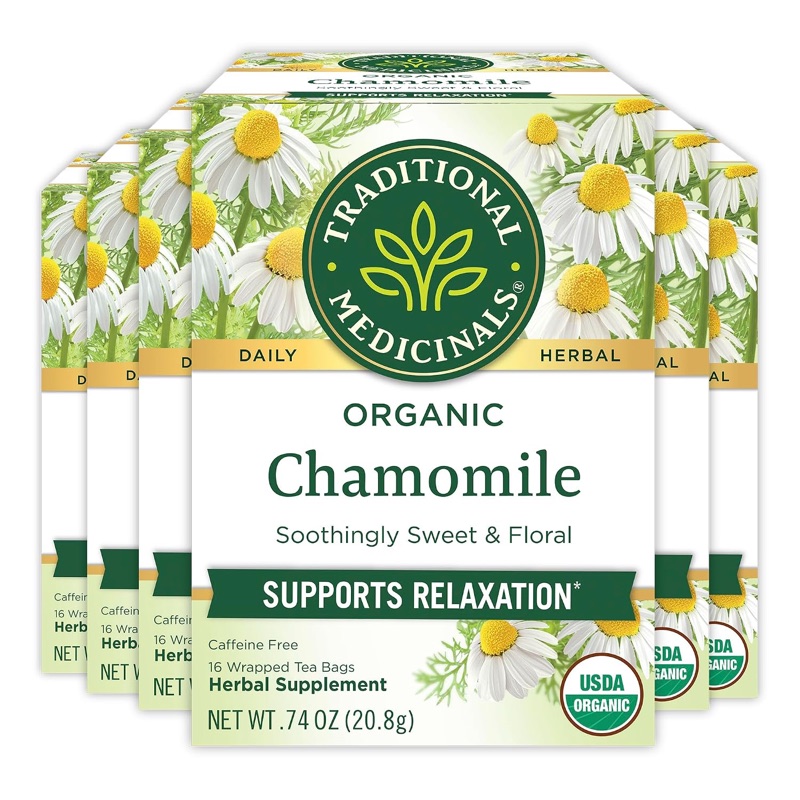
Traditional Medicinals says its paper tea bags are not heat-sealed and contain no plastics, and that they are made from abacá fiber and FSC-certified wood pulp. That named-material statement is what we look for.
Trade-offs: The company says most of its teas still come in wrappers with a thin plastic lining; chamomile was not on its list of teas with the newer compostable wrapper when that page was last edited (April 2024). The wrapper isn’t steeped, but it is plastic packaging. A maker’s statement is not a particle measurement.
Check price on AmazonFolded wood-cellulose bags, no glue
Stash Peppermint Herbal Tea, 100 Bags
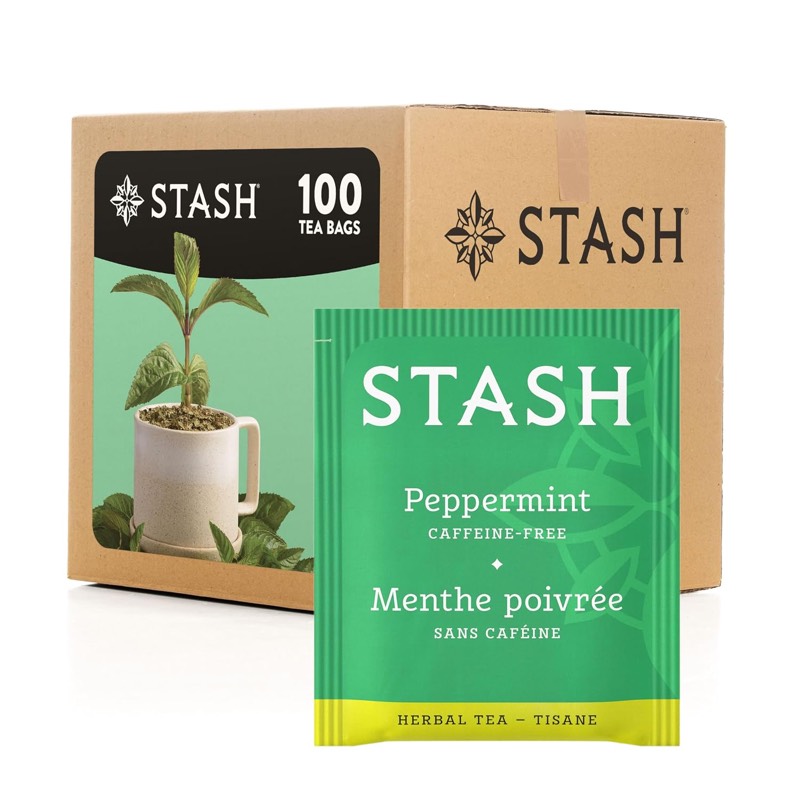
Stash’s FAQ answers the polypropylene question directly: its filter paper is 100% cellulose fibers from wood, machine-folded and pressed without glue, and the bags contain no plastic. The 100-bag pack suits an office or a daily peppermint habit.
Trade-offs: Each bag comes in a foil envelope that Stash says cannot be recycled. The no-plastic statement comes from the maker; we have not seen independent testing of these bags.
Check price on AmazonNo bag at all · for loose leaf
OXO Brew Tea Strainer Basket
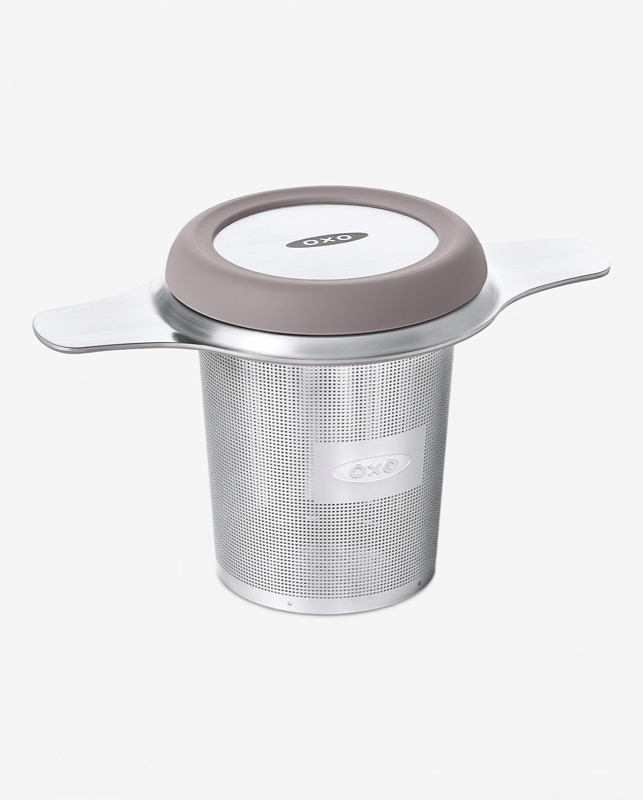
The most direct way to avoid tea bag materials is not to use a bag. OXO lists a stainless steel basket with an etched hole pattern, heat-safe silicone touchpoints and a lid that doubles as a drip tray (OXO sells it as the Tea Infuser Basket, model 11213300). It sits in most mugs.
Trade-offs: OXO does not publish a part-by-part materials list for the lid, and silicone is itself a synthetic polymer, so we call it bag-free rather than plastic-free. For glass teapots, other infusers and loose-leaf starter sets, see our plastic-free tea guide.
Check price on AmazonFrequently asked questions
Which tea bags have plastic in them?
Three kinds commonly do: woven nylon or PET pyramid sachets, paper bags heat-sealed with polypropylene fibers, and bags or sachets made with PLA, a plant-derived plastic. Boxes rarely say which one you have, so check the maker’s own materials statement for that exact product line.
Which tea bag brands say they are plastic-free?
When we checked on October 15, 2026, Bigelow, Stash, Traditional Medicinals, Yogi (US) and Numi said their tea bags contain no plastic, and PG Tips said its UK bags contain no synthetic plastics. These are manufacturer statements, not independent test results.
Is a plant-based or compostable tea bag plastic-free?
Not necessarily. PLA is made from plant sugars but is still a polymer, and “compostable” often means industrial composting. If a brand says plant-based without naming the material, ask what it is.
Which tea bags have the least microplastics?
No study we found ranks brands. Studies agree that bag material, water temperature and steeping time matter, but they use different methods and do not agree on the order of materials. Loose leaf in a steel strainer removes the bag entirely.
Do Twinings tea bags have plastic?
Twinings’ US site says its string-and-tag bags are made from wood and abaca fibers, fold-sealed without staples, and compostable. The US pages we checked do not describe the material of other formats, such as pyramid bags.
Do Lipton tea bags have plastic?
Lipton’s US site says its pyramid tea bags are plant-based but does not name the material. We found no material statement for its classic black tea bags.
Did the 11.6 billion particle study test brands like Lipton or Celestial?
The 2019 study did not name the brands it tested. It used four commercial tea bags made of nylon or PET, and Germany’s risk assessment institute later concluded that its count of particles larger than 1 µm was probably far too high.
Sources and editorial method
Researched October 15, 2026. We read each brand’s own FAQ, packaging or product page on that date and classified it only by what the page says; where we found nothing, we wrote Not stated. We then compared the peer-reviewed studies and regulator assessments below. This is a research-based guide: we have not tested any tea bag, measured particle release, or verified manufacturers’ material claims in a laboratory.
- Hernandez et al. (2019): Plastic teabags release billions of microparticles and nanoparticles into tea, Environmental Science & Technology, 53(21), 12300–12310.
- Busse et al. (2020): Comment on Hernandez et al., Environmental Science & Technology, 54(21), 14134–14135; and the authors’ response, 14136–14137.
- BfR Communication 029/2025: BfR assesses study on tea bags and microplastic particles (August 5, 2025).
- Banaei et al. (2024): Teabag-derived micro/nanoplastics as a surrogate for real-life exposure scenarios, Chemosphere, 368, 143736.
- Yaroslavov et al. (2025): Evolution of microplastics released from tea bags into water, Polymers, 17(19), 2700.
- Jayasekara et al. (2026): OCT reveals microplastic release from nylon tea bags, Environmental Science: Processes & Impacts, 28(2), 392–404.
- Sanei et al. (2026): Tea bags as hidden source of micro- and nanoplastics, a systematic review, Current Research in Food Science, 12, 101425.
- Mei et al. (2022): Microplastics from tea filter bags based on Raman imaging, Foods, 11(18), 2871.
- Courtene-Jones et al. (2024): Deterioration of PLA plastic teabags under environmental conditions, Science of the Total Environment, 934, 172806.
- Brand statements, all checked October 15, 2026: Bigelow; Celestial Seasonings; Harney & Sons; Lipton; Numi; PG Tips; Pukka; The Republic of Tea; Stash; Tazo; Tetley UK; Traditional Medicinals; Twinings US; Yogi US. We found no first-party statement for Good Earth or Trader Joe’s.
- OXO Tea Infuser Basket, model 11213300, matched to the linked Amazon listing’s model number.
Keep swapping
For the full loose-leaf setup, start with our plastic-free tea guide. Coffee drinkers can compare brewing methods in our plastic-free coffee guide, and if you want to work on the water itself, see water filters that address microplastics. For what the research does and doesn’t say about clearing particles from the body, read our evidence review. And if billions of particles per cup sounds alarming, see why particle counts and grams tell different stories.